
YUM Brands Strengthens Franchise Leadership with AI-Driven Growth in Q1 2026
YUM’s Q1 2026 results underscore digital sales acceleration and strategic brand portfolio moves amid robust franchise operations.
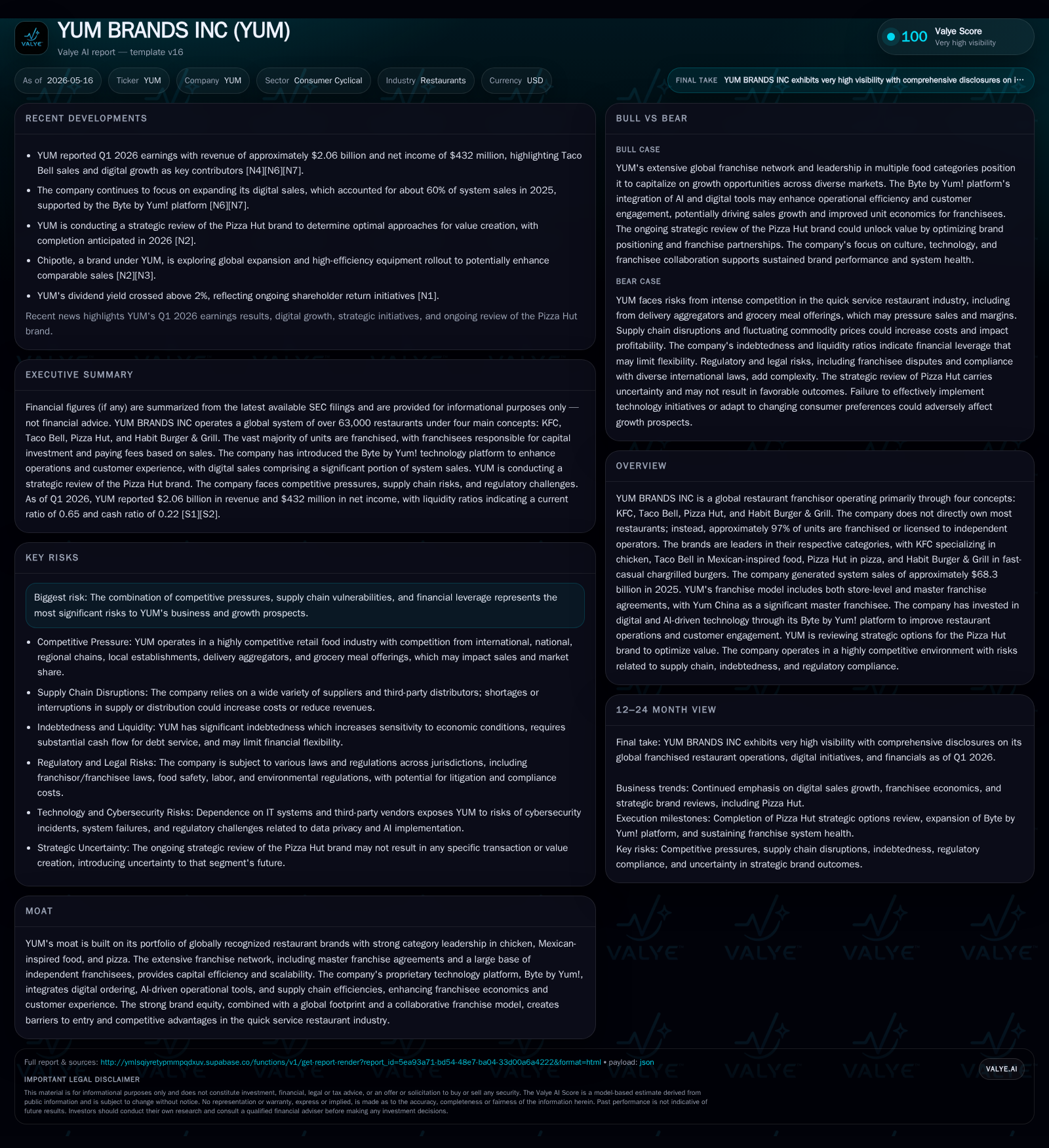
In the first quarter of 2026, YUM Brands demonstrated notable digital sales momentum, with approximately 60% of system-level sales facilitated through digital channels. Taco Bell led comparable sales growth while the company advanced its strategic review of Pizza Hut to unlock long-term value. YUM’s capital-light franchising model, anchored by category-leading brands and augmented by its proprietary AI-driven Byte by Yum! platform, continues to reinforce its competitive moat. Key growth avenues include international expansion via master franchises, fast casual penetration with Habit Burger, and digital ecosystem monetization. However, supply chain risks, legal exposures, and ongoing leverage considerations remain watchpoints.
Q1 2026 Operating Highlights Reflect Digital Momentum
YUM Brands' latest quarterly filing for Q1 2026 ([S2]) underscores the accelerating importance of technology-enabled consumer engagement. Digital sales comprise nearly 60% of overall system sales, signaling that franchisees are increasingly dependent on online ordering platforms and mobile app interactions facilitated by YUM's proprietary Byte by Yum! technology stack ([S1], [S3]). Taco Bell notably contributed strength to the quarter's comparable sales performance, per earnings commentary ([N1], [N3]), reflecting successful execution on menu innovation and targeted marketing spend within this core U.S.-centric brand.
In parallel, YUM has intensified its strategic review process concerning Pizza Hut ([S1]), with aims to unlock latent value within a highly fragmented global pizza market. The outcome is expected in 2026 but remains uncertain; nonetheless, it signals management's proactive approach to portfolio optimization amidst shifting consumer preferences.
Overview of YUM’s Franchise-Centric Business Model
YUM operates primarily as a franchisor with over 63,000 restaurants globally as of year-end 2025 ([S1]). Approximately 97% of these units operate under franchise or license agreements rather than company ownership, underscoring a capital-light model that leverages franchisee investment for unit expansion and reinvestment ([S1], [S23]). This structure provides scalable revenue streams via ongoing royalties—typically between 4-6% of restaurant-level sales—and initial franchise fees.
Units are divided chiefly into two forms: store-level franchises directly contracted with YUM and master franchise arrangements which orchestrate sub-franchise networks. About 40% of units are under master franchise agreements—including around 17,000 in mainland China operated by Yum China—reflecting a geographic franchising strategy tailored to large emerging markets with local expertise ([S1], [S29]).
Revenue derives predominantly from percentage royalties on franchisee sales alongside contribution-type fees for advertising cooperatives where funds support local marketing efforts coordinated with YUM's centralized brand management ([S8]). Franchisees independently manage capital expenditures such as property acquisition or leasing, equipment purchases, and inventory replenishment.
Competitive Positioning within Quick Service & Fast Casual Restaurants
YUM's brands maintain category leadership positions globally;
- KFC dominates the chicken segment,
- Taco Bell leads in Mexican-inspired quick service,
- Pizza Hut is a major global pizza chain,
- Habit Burger & Grill targets fast casual chargrilled burger consumers ([S1], [S8]).
This leadership confers pricing power advantages by virtue of brand equity built over decades coupled with high customer recognition. The breadth of YUM’s footprint across more than 150 countries creates significant entry barriers to new competitors due to economies of scale in marketing procurement, supply sourcing, and technology investments ([S8]).
Within fast casual dining, Habit Burger & Grill serves as a growth vector with relatively lower franchise penetration currently (22%) compared with the broader system (97%), providing opportunity for conversion towards the capital-efficient franchise model over time ([S1]).
Technology and Digital Innovation as Differentiators
A centerpiece of YUM’s growth strategy is the Byte by Yum! platform introduced in late 2025 ([S12], [S23]). This integrated suite includes mobile app ordering, point-of-sale systems, kitchen and delivery optimizations supplemented by artificial intelligence tools designed to streamline restaurant operations and enhance consumer experience.
The platform drives improved unit economics for franchisees by reducing friction points in order execution and inventory/labor management while enabling superior customer personalization through AI-enabled marketing. Such digital sophistication also bolsters customer loyalty engagement metrics that reinforce sustained same-store sales growth potential. Approximately $40 billion in system-wide digital sales were recorded for full-year 2025—around 60% penetration—with further expansion expected as adoption continues across concepts and geographies ([S1]).
By consolidating these capabilities under one proprietary ecosystem accessible at scale exclusively to its franchise network, YUM fortifies its competitive moat against standalone tech providers or peers lacking comparable platform scale ([N3]).
Growth Drivers: Expanding Penetration and Brand Optimization
Growth at YUM hinges on several focused drivers:
- International Master Franchise Expansion: Leveraging regional partners like Yum China enables rapid scaling without direct capital commitment while capturing emerging market penetration opportunities ([S1]).
- Fast Casual Acceleration: Habit Burger represents an adjacent segment poised for franchise mix growth based on evolving consumer preferences towards higher quality burger offerings combined with convenience ([S1]).
- Digital Monetization: Escalating share of digitally facilitated transactions enhances margin capture potential both by reducing reliance on third-party delivery aggregators and boosting average ticket size through personalized promotions ([S12]).
- Pizza Hut Strategic Review: Unlocking structural advantages in this fragmented global segment could involve repositioning or transaction(s) aimed at better aligning brand footprint with long-term profitability imperatives ([S1]).
- Same-store Sales & Menu Innovation: Sustained promotional creativity combined with pricing discipline supports comp sales increases critical for royalty base stability.
KPIs such as unit growth rates within high-potential markets and share gains in digital ordering penetration serve as measurable indicators of underlying demand strength for investors tracking execution efficacy ([N12]).
Risks and Constraints: Supply Chain, Litigation, and Leverage
Several risk factors persist:
- Supply Chain Vulnerabilities: Particularly acute in poultry-related procurement impacting KFC margins, these can trigger cost inflation or availability disruptions affecting franchisee economics ([S11], [S19]).
- Litigation Exposure: Ongoing claims from franchisees, suppliers, employees or regulatory bodies impose potential financial penalties or distraction risks despite no materially adverse effects currently anticipated ([S5], [S14]).
- Regulatory Compliance Burdens: Increased legal mandates regarding labor classification rules, food safety standards, data privacy laws impose compliance complexity that may elevate operating costs or restrict operational flexibility ([S18], [S24], [S27]).
- Financial Leverage Considerations: As of March-end 2026, cash balances totaled $689 million against current liabilities exceeding $3.1 billion resulting in a current ratio near 0.65 indicative of liquidity tightness requiring managerial oversight ([F1]). Total debt stood around $11.8 billion at end-2025 contributing a high net leverage position slightly exceeding $11.1 billion when offsetting cash holdings ([F1]). Interest rate sensitivity coupled with refinancing needs represents an ongoing financial constraint.
- Competitive Intensity: The restaurant sector faces escalating rivalry from both traditional chains and grocery/meal kit alternatives which may pressure pricing power over time if consumer preferences shift abruptly away from quick service formats ([S8], [S28]).
These risks underscore the need for prudent operational vigilance balanced against innovation-led growth efforts.
Upcoming Catalysts and Strategic Watchpoints
Key developments to monitor include:
- Completion timeline and results from the Pizza Hut strategic review anticipated later in calendar year 2026 which could materially affect portfolio composition (#[S1], #[N12]).
- Quarterly comparable sales trajectories particularly across Taco Bell and Habit Burger which serve as bellwethers for broad brand vitality (#[N3]).
- Technology adoption rates across the franchise network for Byte by Yum! enhancements influencing margin expansion pathways.
- International unit count progression under master franchises especially expansion dynamics within China.
- Margin trends reflecting input cost pass-through success balanced against wage inflation pressures.
These milestones will provide tangible barometers on strategy execution momentum.
Latest Financial Snapshot & Capital Structure Overview
Latest financial snapshot
| Metric | Value | Period |
|---|---|---|
| Cash & equivalents | $689mm | |
| 2026-03-31 | ||
| Total debt | $11.8bn | |
| 2025-12-31 | ||
| Net debt | $11.1bn | |
| 2025-12-31 | ||
| Current assets | $2.0bn | |
| 2026-03-31 | ||
| Current liabilities | $3.1bn | |
| 2026-03-31 | ||
| Current ratio | 0.65x | |
| 2026-03-31 |
Source: SEC companyfacts cache [F1].
| Metric | Value |
|---|---|
| Cash & Equivalents | $689 million (3/31/26) |
| Total Debt | $11.8 billion (12/31/25) |
| Net Debt | ~$11.1 billion (est.) |
| Current Assets | $2.03 billion (3/31/26) |
| Current Liabilities | $3.12 billion (3/31/26) |
| Current Ratio | 0.65 |
This snapshot reflects a leveraged balance sheet typical in franchising enterprises prioritizing firm scale expansion combined with strong cash flow generation capacity supporting debt servicing requirements ([F1], [S2], [S13]).
Disclaimer: This analysis is intended solely for informational purposes based on publicly available SEC filings and news sources dated through May 16, 2026. It does not constitute investment advice or recommendations regarding YUM Brands Inc.
Disclaimer: This is research-only, informational analysis and not investment advice. It may include AI-generated interpretation and general industry context. Always verify important details using primary sources.

Comments