
Fulton Financial Leverages Regional Expansion and Relationship Banking Amid Merger Integration
The company's recent quarterly filings detail significant debt repayment and progress on a major merger, reinforcing its community banking strategy.
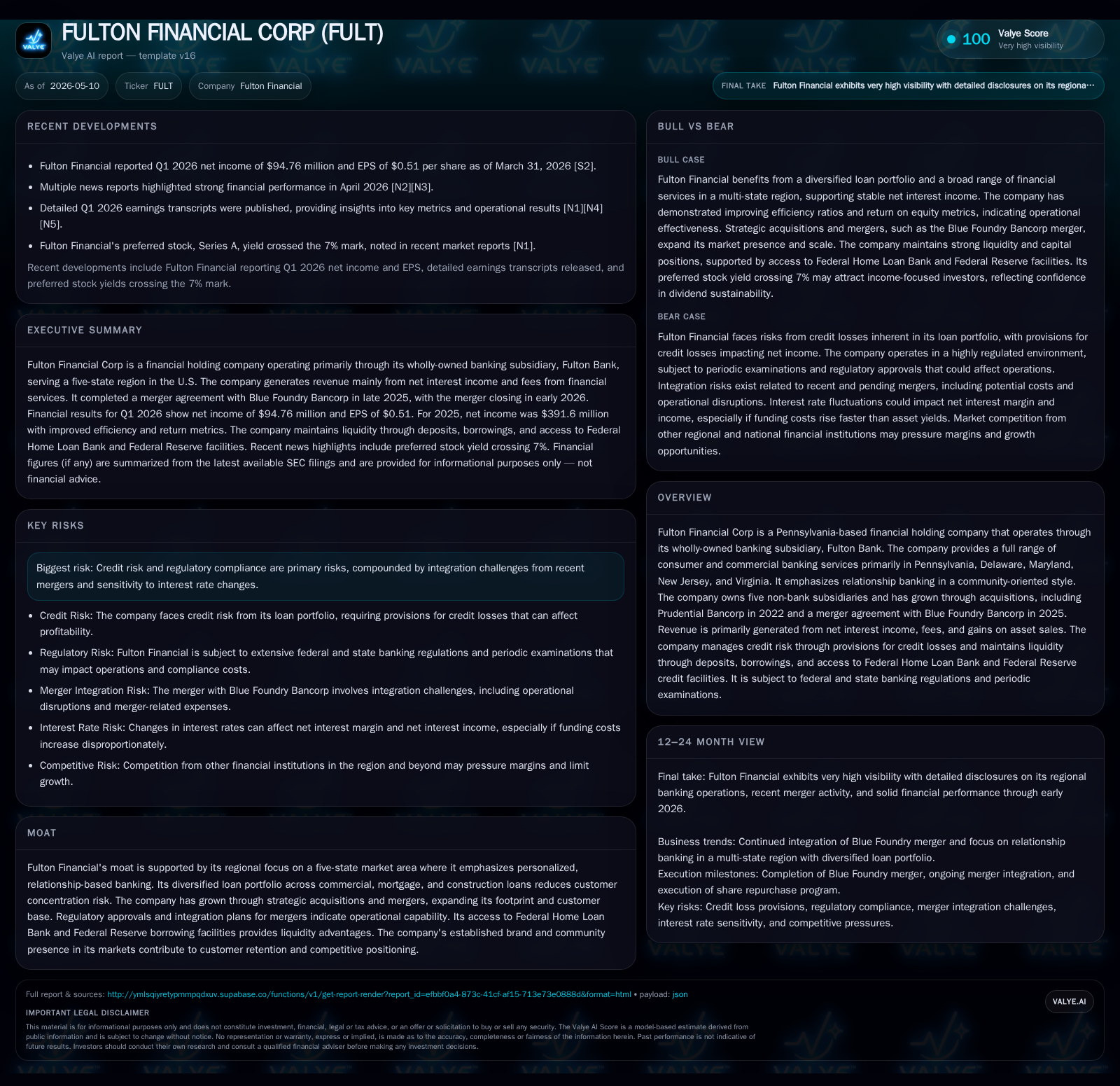
Fulton Financial's latest 10-Q and 8-K filings reveal active capital redeployment, including a $195 million redemption of subordinated notes to enhance liquidity amid the integration of the Blue Foundry Bancorp merger. Operating through Fulton Bank, the company sustains its regional focus across five Mid-Atlantic states leveraging relationship banking and a diversified commercial loan portfolio. Growth is driven by strategic acquisitions and cross-selling opportunities within its expanded footprint. Risks largely stem from credit exposure, regulatory compliance requirements, and execution challenges tied to recent mergers.
Announced via an April 22, 2026 8-K filing ([S3]), this debt repayment will be funded from net proceeds of a recent offering aimed at deleveraging the capital structure. The move effectively frees up financial flexibility crucial during integration phases following large mergers. The notes also carry an optional redemption feature starting May 15, 2031, providing management longer-term refinancing optionality.
Complementing this capital action is the nearing completion of the Blue Foundry Bancorp merger that was formally agreed upon in November 2025 ([S1]). Regulatory approvals have been secured with shareholders' greenlight attained early January 2026. The firm anticipates closing the legal merger on or about April 1, 2026, followed by operational integration of Blue Foundry Bank into Fulton Bank in the third quarter ([S1],[S2]). These sequential steps suggest careful planning aimed at minimizing customer disruption while capturing anticipated synergies.
Fulton’s Community-Centric Business Model: Relationship Banking in a Five-State Footprint
Operating primarily through its wholly-owned banking subsidiary Fulton Bank, Fulton Financial pursues a full-service commercial and consumer banking approach centered on community-oriented relationship banking ([S1]). Its market presence spans Pennsylvania, Delaware, Maryland, New Jersey, and Virginia—geographies anchored by diverse economies including manufacturing, healthcare services, agriculture, and other sectors ([S1]).
Revenue streams predominantly derive from net interest income supported by a multifaceted loan portfolio encompassing commercial loans, commercial mortgage lending, construction loans plus residential mortgages sold to secondary markets ([S1],[S20]). By diversifying across these loan types without dependency on any single customer or small cluster ([S1]), Fulton mitigates concentration risk effectively—a critical factor given cyclical nature inherent in certain lending segments such as construction.
Cross-selling opportunities benefit from established localized relationships enabling fee income generation aside from pure interest spreads. This multi-channel revenue mix helps soften margin pressure from interest rate fluctuations while emphasizing customer retention built around trusted advisory roles.
Competitive Positioning within Regional Banking Markets
Within an industry landscape crowded with national banks and smaller local institutions alike, Fulton differentiates itself through mid-sized scale combined with focused regional expertise enhanced by strategic acquisitions. The incorporation of Prudential Bancorp in July 2022 ([S1]) and Republic First Bank assets in April 2024 ([S27]) has incrementally expanded its footprint notably around Philadelphia and New Jersey markets.
The upcoming Blue Foundry merger further cements this trajectory by adding complementary customers and products that align with Fulton’s core competencies. Moreover, its maintained compliance agility amid evolving federal/state regulatory frameworks means fewer operational disruptions relative to less regulated players ([S11],[S8]).
Community banking's inherently high switching costs due to ingrained deposit relationships strengthen Fulton's competitive moat alongside its credible brand presence dating back years within these markets ().
Growth Catalysts: Acquisitions, Product Mix, and Cross-Selling Opportunities
From a growth standpoint, acquisition-driven expansion stands out as a clear pillar. The Republic First transaction added approximately $4.8 billion in assets ([S27]) augmenting deposit scale and advancing market penetration. Additionally, potential synergy realization exists through cross-selling innovations encompassing digital wealth tools under the broader bank umbrella.
Beyond inorganic growth drivers are organic avenues such as expanding commercial loan volumes fueled by economic activity within its regions combined with mortgage product origination supporting fee income streams ([S1]). Management discussions hint at deliberate initiatives to deepen wallet share through enhanced client experience platforms - these factors should underpin sustained top-line momentum post-merger integration.
Key Risks: Credit Exposure, Regulatory Hurdles, and Merger Execution
Notwithstanding growth prospects, material risks persist notably credit quality sensitivity inherent in commercial loan portfolios. While adequate provisions exist for potential impairments along with historical loss reserve buffers ([S25],[S8]), macroeconomic shifts impacting borrower performance require vigilant monitoring.
Further complexity arises from rigorous regulatory capital mandates detailed under current Capital Rules which enforce minimum CET1 ratios (4.5%) with conservation buffers pushing thresholds higher ([S11]).
Lastly, seamless execution of recent mergers represents an operational hurdle. Given direct costs already recorded for Blue Foundry integration ($1.1 million through end-2025) ([S1]), unanticipated expenses or cultural misalignments might delay synergy capture affecting near-term profitability.
Near-Term Outlook: Integration Milestones and Demand Indicators
Looking ahead into late 2026 and beyond, crucial milestones include finalizing Blue Foundry's bank entity consolidation targeted for Q3 ([S2],[S1]). Concurrently tracking deposit inflows post-merger will reveal customer retention success while credit demand trajectories will indicate economic resilience or softness within regional industries.
Ongoing share repurchases authorized under the $150 million program approved December 2025 imply confidence in stock valuation aligned with earnings stability ([S2]). Market commentary from Q1 earnings reports signals substantial beat versus consensus expectations reflecting controlled expense management balanced against modest top-line gains ([N1],[N2],[N3]).
Stakeholders should monitor loan portfolio quality metrics closely over coming quarters since unlocking full benefits from acquisitions depends critically on maintaining disciplined underwriting standards despite growth ambitions.
Supporting Financial Context: Capital Structure and Liquidity Overview
The recent $195 million note retirement further de-risked subordinated debt maturities enhancing long-term capitalization flexibility supportive of investment in technology modernization or future opportunistic acquisitions ([S3],[F1]).
Disclaimer:
This analysis is for informational purposes only based on public SEC filings and news sources as of May 10, 2026. It does not constitute investment advice or recommendations regarding any securities discussed herein.
Disclaimer: This is research-only, informational analysis and not investment advice. It may include AI-generated interpretation and general industry context. Always verify important details using primary sources.

Comments