
Biglari Holdings Advances Investment and Restaurant Operations with Solid Liquidity Position
The latest quarterly update reveals Biglari Holdings’ strong liquidity foundation amid investment fund volatility and growing restaurant subsidiary sales.
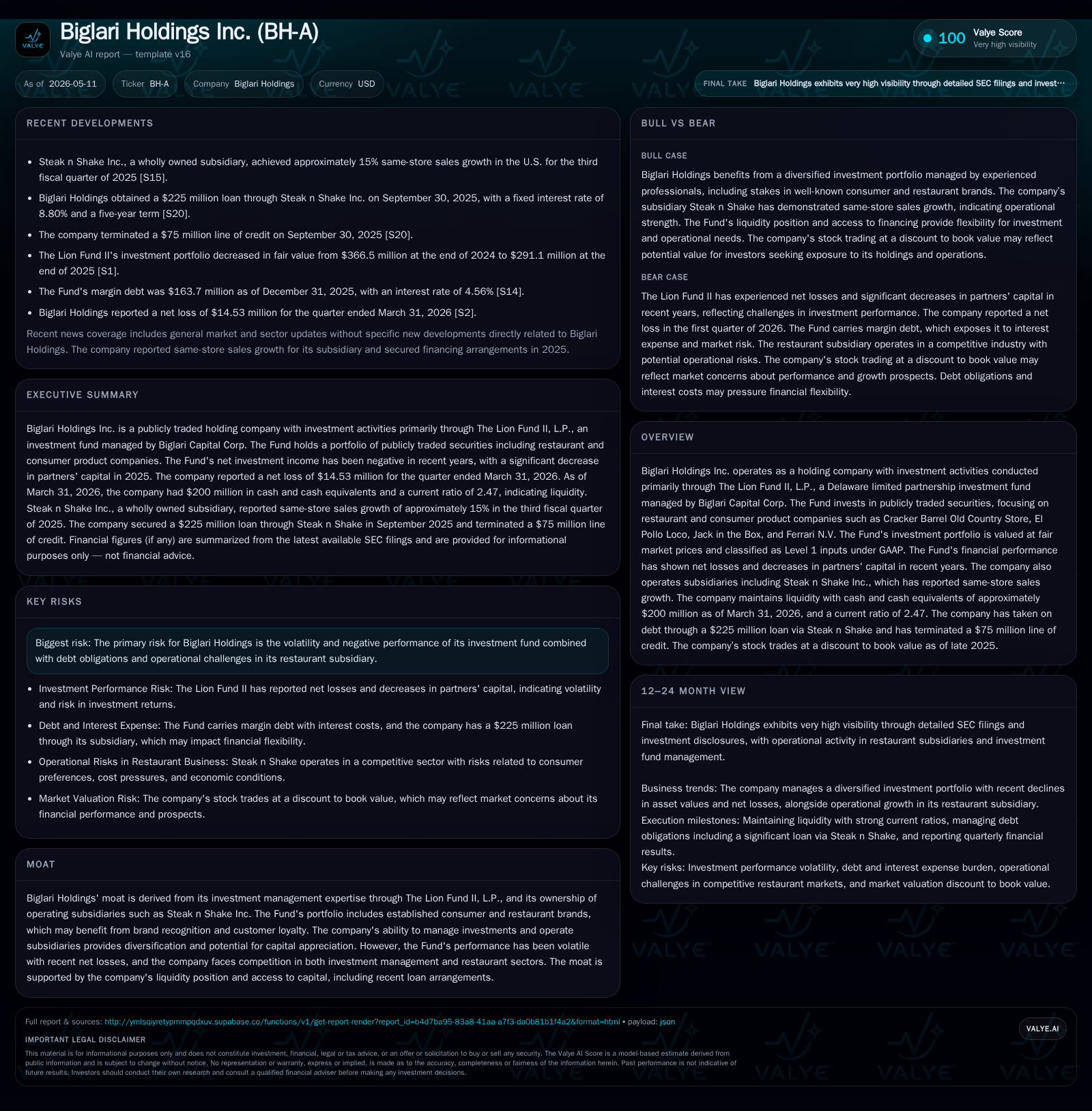
Biglari Holdings reported maintaining a robust liquidity buffer with approximately $200 million in cash and a current ratio of 2.47 as of Q1 2026, underpinning its dual business model. Despite net losses in The Lion Fund II investment portfolio, operational progress continues through subsidiaries such as Steak n Shake, which has achieved meaningful same-store sales growth. The firm's business model balances exposure to public equities in consumer and restaurant sectors with direct restaurant operations, offering diversification but also concentration risk on select holdings. Going forward, capital flexibility and subsidiary execution remain key growth levers, while investment volatility and debt service obligations warrant close monitoring.
Q1 2026 Operating Update and Its Immediate Implications
Biglari Holdings’ latest Form 10-Q filed on May 8, 2026, shows the company held approximately $200 million in cash and cash equivalents alongside current assets totaling $356.2 million against $144.3 million in current liabilities, delivering a current ratio of 2.47—an indicator of strong near-term liquidity [S2][F1]. This liquidity cushion is critical for managing swings in The Lion Fund II’s portfolio valuation and supporting operational needs within subsidiary businesses.
The report confirms that The Lion Fund II continued to incur net losses during the period as investment valuations declined, reflecting the challenging market environment for its targeted sectors—publicly traded restaurant and consumer product companies such as Cracker Barrel Old Country Store, Jack in the Box, El Pollo Loco, and Ferrari N.V. These investments are valued using Level 1 fair value inputs (observable quoted prices), aligning with GAAP requirements but inherently exposed to market price volatility [S1]. Concurrently, Biglari Holdings announced material operational progress via Steak n Shake Inc., its wholly owned operating subsidiary, which sustained same-store sales growth over 15% across company-operated and franchisee stores in the U.S. over recent quarters—a notable performance signal amid restaurant sector uncertainty [S19].
This updated financial landscape establishes that while investment fund performance remains volatile with periods of capital erosion impacting the equity holders’ accounts within the partnership structure, Biglari Holdings sustains operational momentum supported by financial flexibility.
Business Model Overview: Dual Engines of Investments and Restaurant Operations
Biglari Holdings functions principally as a holding company managing investment activities through The Lion Fund II, L.P., a Delaware limited partnership managed by Biglari Capital Corp., alongside direct ownership of hospitality-operating subsidiaries such as Steak n Shake Inc. Revenue primarily arises from two sources: appreciation or depreciation within The Lion Fund II securities portfolio (through unrealized/realized gains or losses) and operating income generated by subsidiaries.
The Lion Fund II targets publicly traded equities concentrated within restaurant chains and consumer product companies recognized for brand strength but subject to economic cyclicality and consumer preference shifts. Its investment methodology focuses on long-term capital appreciation; however, fair value fluctuations recorded as Level 1 inputs lead to significant revenue volatility depending on external equity markets [S1]. This volatility was evidenced by net losses allocated during recent periods.
Simultaneously, subsidiaries contribute more stable revenue streams derived from ongoing operations—sales volumes driven by consumer demand at physical locations or franchises. For instance, Steak n Shake’s reported same-store sales growth reflects effective operational execution benefiting from brand loyalty and market positioning [S19]. This direct operation provides revenue diversification beyond market-driven investment gains but remains sensitive to industry competition and margin pressures inherent in fast-casual dining.
This blended model creates a balance of cyclical investment returns offset partially by stable operational cash flow streams while requiring astute capital allocation decisions.
Competitive Positioning within Investment Management and Consumer Brands
In investment management terms, The Lion Fund II’s concentrated focus on publicly traded restaurants and consumer brands situates it amid specialized sector funds that face amplified risk-reward profiles due to industry-specific headwinds like changing dining patterns or economic slowdowns. Key portfolio holdings such as Cracker Barrel or Jack in the Box operate in competitive landscapes where brand loyalty is a definite moat but vulnerable to shifting consumer trends toward healthier options or digital convenience.
Within the restaurant domain, Steak n Shake competes among mid-tier casual dining providers where differentiation relies heavily on brand heritage and consistent service quality. Its reported double-digit same-store sales increases suggest effective customer retention strategies potentially differentiating it from competitors also battling labor cost inflation, supply chain constraints, and heightened customer expectations [N1][S19].
However, both sides confront challenges: concentrated positions introduce sector cyclicality risks for the investment fund; meanwhile the restaurant segment faces margin pressure amid commodity cost fluctuations. Switching costs among consumers are moderate but brand affinity combined with localized franchise networks supports retention.
Strategic Growth Drivers: Portfolio Focus, Subsidiary Dynamics, and Liquidity Strength
Growth catalysts hinge primarily on three interrelated axes:
Selective Investment Appreciation: Targeted holdings like Cracker Barrel or Jack in the Box possess potential for capital gains driven by sector recovery or operational turnarounds underpinned by post-pandemic normalization of consumer spending patterns [S1]. Yet this driver depends critically on market timing given recent net loss trends.
Operational Expansion and Margin Improvement at Subsidiaries: Notably at Steak n Shake where robust same-store sales growth (above 15%) implies successful marketing programs or menu innovation attracting foot traffic; this momentum can translate into improved margins if fixed costs are properly leveraged [S19]. Franchise expansion opportunities could further boost revenue mix.
Strong Liquidity Enabling Flexibility: The company's cash reserves (~$200M) combined with a favorable current ratio allow for strategic debt repayments—or opportunistic acquisitions—enhancing optionality amid an uncertain macroeconomic environment [F1].
These drivers collectively support potential incremental shareholder value through both capital appreciation from funds plus operating subsidiary scaling.
Risks to Monitor: Fund Volatility, Debt Considerations, and Operational Challenges
Significant risks persist around several vectors:
Investment Fund Volatility: The negative return trajectory within The Lion Fund II constrains capital account growth and creates earnings unpredictability; concentrated exposures exacerbate this effect during market downturns especially in cyclical restaurant sectors [S2][S13].
Debt Service Obligations: While liquidity remains solid presently (~$200M cash), structural obligations stemming from subsidiary-level loans—including substantial loans obtained by Steak n Shake (e.g., $225M at ~8.8% fixed rate expiring over five years)—demand ongoing vigilance given interest cost burdens [S23].
Operational Execution Risks: Sustaining double-digit same-store sales growth amid inflationary input costs presents margin compression risks; fierce retail competition may also impact volume or pricing power within restaurants.
Market Sensitivity: Broader economic shifts affecting discretionary spending can disproportionately weigh on both investment holdings’ valuations and retail restaurant performance simultaneously.
Regular reassessment of portfolio composition alongside cost controls within subsidiaries is essential to mitigate these threats.
Forward-Looking Indicators: Investor Milestones and Execution Triggers
Critical near-term markers include:
- Quarterly tracking of profitability trends at Steak n Shake beyond sales lift to confirm margin stability.
- Portfolio rebalancing announcements by The Lion Fund II management that could signal strategic shifts addressing risk concentration or capturing upside opportunities [S2][S3].
- Monitoring updates on scheduled debt amortizations/refinancings influencing leverage metrics.
- Subsequent earnings releases revealing changes in fund valuation or operating efficiencies validating current momentum.
These execution points define whether Biglari Holdings can successfully navigate prevailing challenges while leveraging liquidity advantages.
Latest Financial Snapshot and Capital Structure
Latest financial snapshot
| Metric | Value | Period |
|---|---|---|
| Cash & equivalents | $200mm | |
| 2026-03-31 | ||
| Current assets | $356mm | |
| 2026-03-31 | ||
| Current liabilities | $144mm | |
| 2026-03-31 | ||
| Current ratio | 2.47x | |
| 2026-03-31 |
Source: SEC companyfacts cache [F1].
| Metric | Value |
|---|---|
| Cash & Equivalents | $200.1 million |
| Current Assets | $356.2 million |
| Current Liabilities | $144.3 million |
| Current Ratio | 2.47 |
| Total Debt | ~$69.7 million |
As outlined above, the company maintains a healthy liquidity buffer supported by modest debt levels relative to cash available at quarter-end March 31, 2026 [F1]. This balance sheet disposition enables financial flexibility critical for sustaining operations through volatile equity markets affecting The Lion Fund II investments as well as funding growth initiatives within its restaurant platforms.
This analysis synthesizes public SEC filings up to Q1 2026 inclusive of Biglari Holdings Inc.’s detailed disclosures without forecasting future performance or providing investment advice.
Disclaimer: This is research-only, informational analysis and not investment advice. It may include AI-generated interpretation and general industry context. Always verify important details using primary sources.

Comments