
Greystone Housing Impact Investors Advances with New Credit Facility and Stable Portfolio
Q1 2026 updates highlight new $80M credit agreement, routine cash distributions, and continued risk management in affordable housing investments.
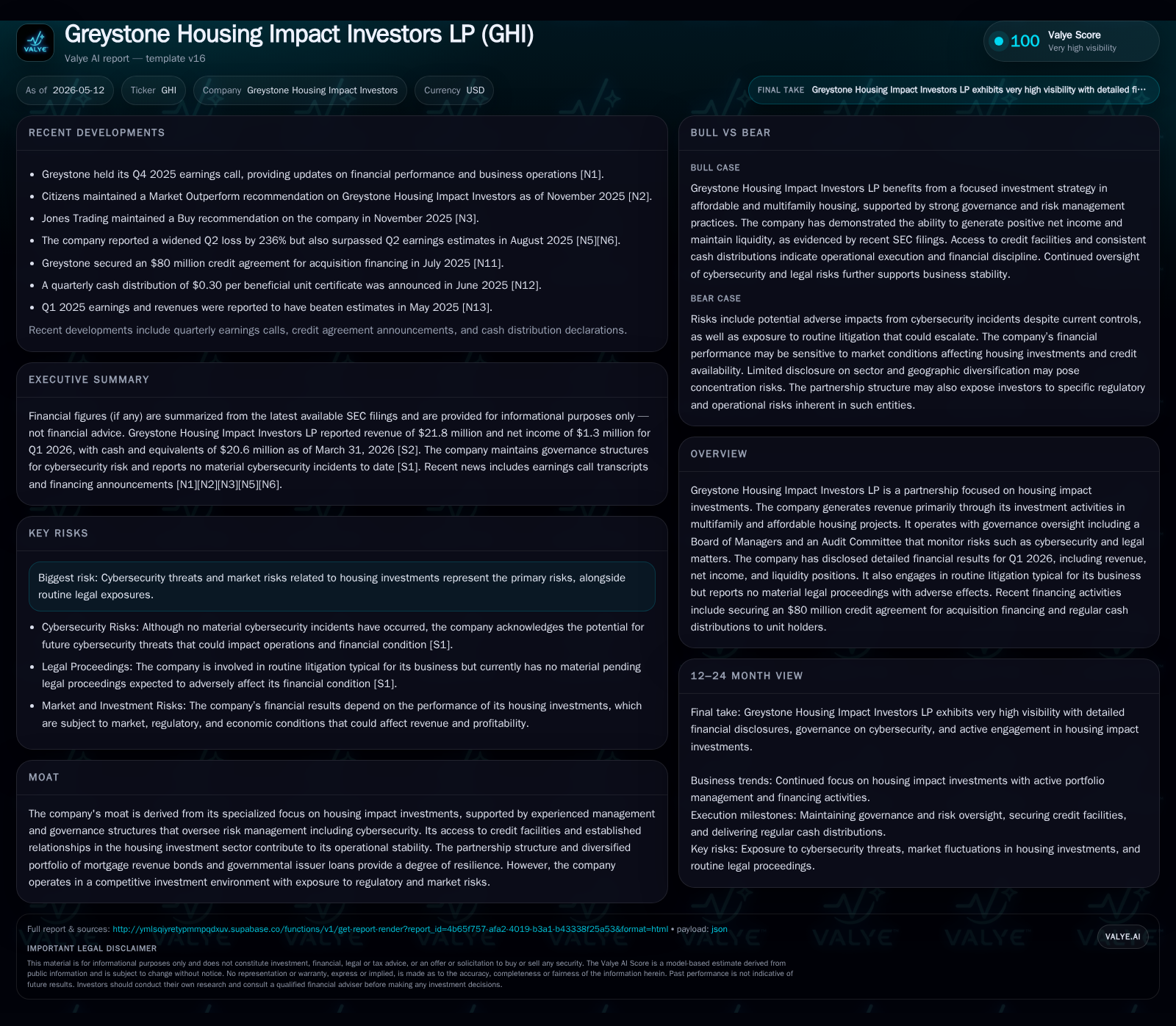
In its latest quarterly filing, Greystone Housing Impact Investors LP secured an $80 million credit facility that enhances its acquisition capacity while maintaining stable portfolio performance and routine distributions to unit holders. Governance structures continue to focus heavily on cybersecurity risk and legal compliance, underpinning operational resilience. The partnership’s strategic emphasis on multifamily and affordable housing investments, particularly mortgage revenue bonds and governmental issuer loans, positions it within a competitive yet regulatory-intensive sector. Growth prospects are tied to acquisition activity enabled by new financing and the expanding demand for impact investments, balanced against cybersecurity risks and regulatory sensitivities.
Latest Operating Update: Q1 2026 Highlights
Greystone Housing Impact Investors LP’s Q1 2026 10-Q filing dated May 11 reveals critical operational developments that reinforce the partnership’s capacity to grow within the affordable housing impact investment space. The company executed an $80 million credit agreement enhancing its flexibility for acquisitions and refinancing activities [S2]. This increment in financing capacity is strategically significant given the capital-intensive nature of acquiring new multifamily projects supported by tax-exempt or taxable mortgage revenue bonds.
Concurrently, Greystone announced routine cash distributions to its limited partners consistent with its recurring income model [S2]. The partnership reported no materially adverse legal proceedings at quarter-end; litigation remains typical for the industry but without significant operational or financial disruption [S1]. Cash & equivalents balance of approximately $20.6 million as of March 31, 2026, provides coverage for ongoing operations and near-term investment deployment [F1].
Business Model: Leveraging Impact Investments in Affordable Housing
Greystone Housing Impact Investors operates as a partnership focusing on impact-driven investments in affordable multifamily housing. Its primary revenue generation derives from interest income and fees linked to mortgage revenue bonds alongside governmental issuer loans. These fixed-income style assets are underpinned by tax-advantaged structures designed to foster affordable housing development and preservation.
The partnership's structure allows it to pool investor capital and leverage credit facilities like the recent $80 million loan to acquire or refinance portfolios that meet stringent affordability criteria and impact goals [S1][F1]. The business model emphasizes recurring interest income supplemented by fee revenues from managing complex financings tied to governmental issuances.
This focus on affordable housing injects strategic relevance amid rising societal attention on housing affordability challenges. It also acts as a moat by embedding Greystone within specialized regulatory frameworks that establish higher barriers to entry compared to generic real estate finance players.
Governance and Risk Oversight: Cybersecurity and Legal Compliance
Governance oversight is robust, featuring a Board of Managers with an Audit Committee dedicated to enterprise risk management including a strong emphasis on cybersecurity threats. The company highlights layered risk evaluation processes involving the CFO, information technology specialists within Greystone managers’ affiliate IT teams, and external cybersecurity experts including penetration testers and auditors [S1].
Incident response protocols designate both CEO and CFO roles for timely escalation and mitigation actions in case of cyber events. The Audit Committee receives detailed reports on cyber risk assessments annually alongside internal audit findings regarding control effectiveness. No known cybersecurity incidents have materially impacted operations or financial conditions as of latest filings [S1].
Legal risks remain within typical bounds for mortgage-backed securities investment firms with no material lawsuits pending that could significantly affect results [S1]. This stable legal posture supports investor confidence amid complex regulatory environments governing municipal bond markets.
Competitive Environment and Industry Dynamics
Greystone competes within a niche segment focused on tax-exempt multifamily housing finance—an area characterized by public-private partnership dynamics involving state/local government issuers of mortgage revenue bonds. Competition is framed not only by other specialized investors but also by capital providers including banks, insurers, and specialized REITs.
Pricing power is limited due to regulatory constraints impacting yields allowed on tax-exempt bonds; however, Greystone’s established relationships with governmental entities, demonstrated execution history, and access to structured credit facilities provide competitive advantages [S1].
The sector faces macroeconomic influences such as interest rate fluctuations affecting borrowing costs for new bond issuances as well as policy shifts related to Low Income Housing Tax Credits (LIHTC) impacting project economics. Nonetheless, the persistent undersupply of affordable housing units implies structural demand support for the investment themes embodied in GHI’s portfolio.
Key Growth Drivers and Expansion Opportunities
The newly secured $80 million credit facility signals immediate growth capacity by enhancing the partnership's ability to pursue accretive acquisitions or refinance favorable deals in its target markets [S2]. Efficient deployment of this capital will be central to realizing pipeline expansion potential.
Additionally, broader market trends show increasing institutional appetite for social impact investing strategies coupled with legislative focus on affordable housing solutions—factors likely to steer more capital toward entities like Greystone with proven expertise in navigating complex governmental financing structures.
Incremental operational efficiencies gained from scale may improve portfolio management margins while maintaining underwriting discipline will be key amid competitive asset bidding environments.
Risks and Growth Constraints
Cybersecurity presents an ongoing risk despite comprehensive controls—emerging threats require constant vigilance lest operational disruptions or data breaches occur [S1]. The firm’s reliance on third-party managed IT services adds complexity which necessitates rigorous oversight.
Regulatory changes affecting bond issuance frameworks or LIHTC policy could alter economic returns unexpectedly or reduce availability/accessibility of public financing vehicles.
Market sensitivity exists around interest rates influencing both issuance volumes and pricing spreads within municipal bond segments where Greystone operates.
Routine course litigation risks persist but currently pose no material threats; nonetheless, any escalation would warrant close monitoring given potential legal expenses or reputational impacts.
What to Monitor Next: Upcoming Catalysts and Metrics
Stakeholders should track deployment progress of the new $80 million credit facility capital—key will be visible acquisitions or refinancing closings reported over upcoming quarters [S2][S3].
Management commentary regarding funding prioritization between acquisition versus redevelopment projects will indicate strategic focus areas.
Regular reporting on property occupancy levels will offer insight into operational quality supporting cash flow stability.
Distribution trends remain an important marker for underlying income health; sustained consistency supports valuation assumptions for income-focused investors.
Regulatory announcements related to mortgage revenue bond issuance limits or tax credit provisions should be watched closely given their direct influence on deal supply/demand dynamics.
Financial Position Snapshot
At quarter-end March 31, 2026, Greystone held approximately $20.6 million in cash & equivalents providing solid near-term liquidity ([F1]). Operating income reported historically reflects positive contribution though net income swings have been negative in recent full-year figures indicative of valuation adjustments or non-cash items common in financial partnerships ([F1]). These metrics underscore importance of examining operating cash flows alongside accounting earnings when assessing financial health.
-- This analysis synthesizes publicly available SEC filings as primary sources reflecting Greystone Housing Impact Investors LP current operating status without making investment recommendations or forecasts. Readers should consider this report informational rather than prescriptive.
Disclaimer: This is research-only, informational analysis and not investment advice. It may include AI-generated interpretation and general industry context. Always verify important details using primary sources.

Comments