
Arteris Advances Network-on-Chip Integration Amid Challenging Liquidity
Arteris' latest quarter reveals revenue resilience in its Network-on-Chip IP business despite tightened liquidity and ongoing losses.
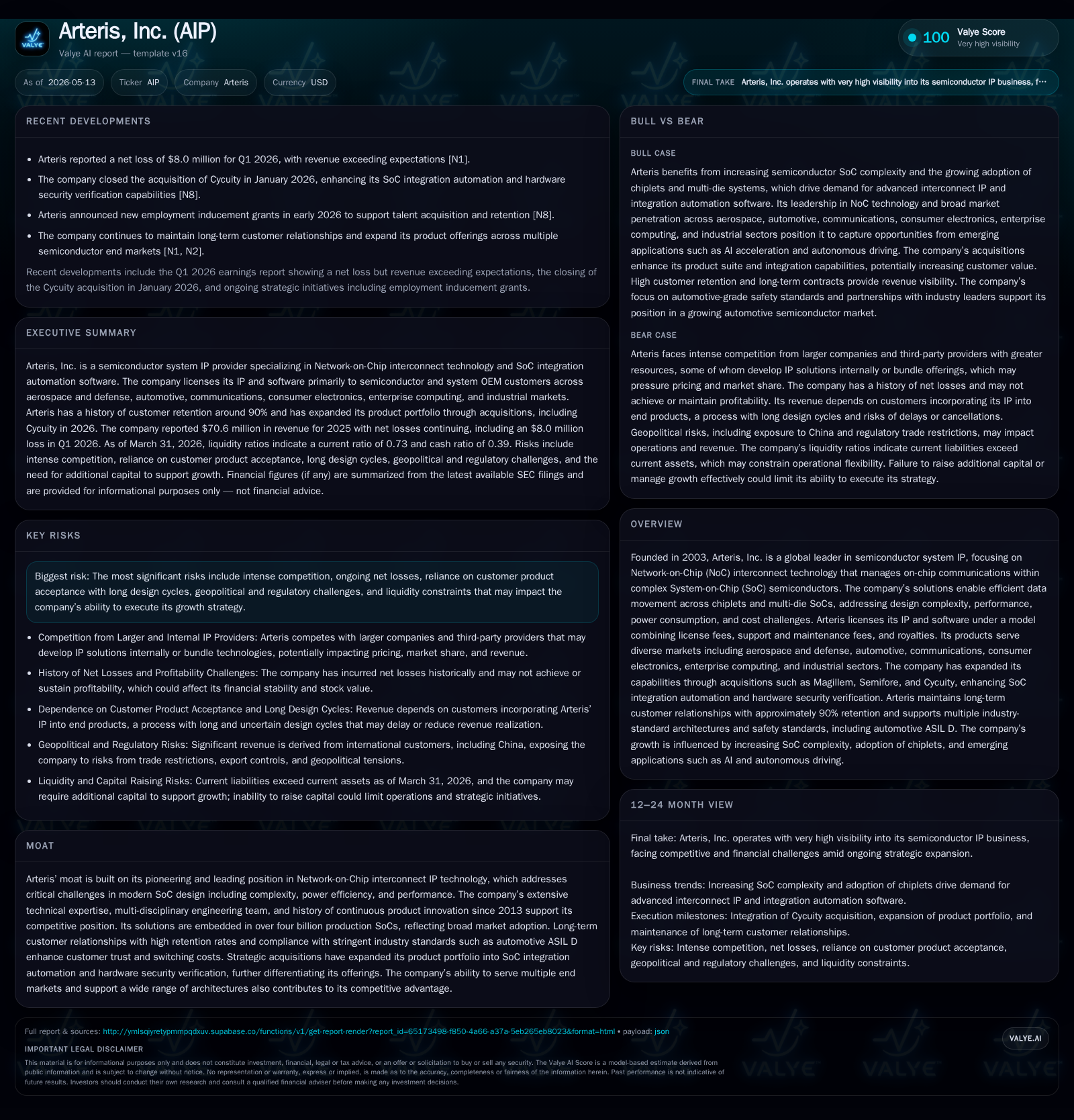
In Q1 2026, Arteris reported revenue exceeding estimates but continued net losses, highlighting operational momentum amid capital constraints. The company’s licensing and royalty-driven model centers on advanced Network-on-Chip interconnect IP and expanded SoC integration automation capabilities through strategic acquisitions such as Cycuity. Competitive pressures from large-scale semiconductor IP providers and prolonged design cycles underpin risks, while rising SoC complexity and chiplet adoption support growth. Liquidity remains a near-term concern with a current ratio below 1, making upcoming execution milestones and acquisition integration crucial to sustaining expansion.
Q1 2026 Operational Performance and Recent Developments
Arteris' most recent quarterly filing (10-Q dated May 12, 2026) revealed a mixed operational profile characterized by revenue growth overshadowed by continuing net losses [S2][N1]. The company exceeded top-line expectations with increasing license fees and royalties tied to its Network-on-Chip (NoC) interconnect technology despite competitive headwinds. However, operating expenses and research investments kept profitability elusive.
Liquidity remains constrained as of March 31, 2026, with cash & equivalents at $11.67 million juxtaposed against current liabilities totaling $84.52 million resulting in a current ratio of only 0.73 — well below the comfortable benchmark of 1.0 [F1].
The company's May 12th event filing also announced CFO Nick Hawkins will retire by the end of August 2026 due to family health reasons — potentially signaling transitional risk in financial leadership during this critical period of product ecosystem expansion [S3].
Business Model and Product Portfolio: Network-on-Chip IP and SoC Automation
Arteris operates primarily through an IP licensing model generating revenues via upfront license fees, followed by recurring support & maintenance contracts plus royalties linked to silicon production volumes embedding its NoC interconnect solutions [S1][S2]. This three-pronged licensing approach aligns incentives with customer adoption breadth and production scale.
The company’s flagship offering addresses increasingly complex on-chip communication challenges inherent to modern System-on-Chip (SoC) designs that employ multi-die architectures and chiplets rather than monolithic silicon dies. By efficiently managing data flow between processor cores, memory subsystems, logic blocks, and I/O controllers within these multi-domain chips via proprietary NoC architectures, Arteris significantly reduces power consumption while improving throughput and design scalability.
Strategic acquisitions have materially widened Arteris’ portfolio beyond pure interconnect IP:
- Magillem (2020) enhanced SoC integration automation software enabling configuration of complex IP deployment flows,
- Semifore (2022) strengthened capabilities around SoC assembly,
- Cycuity (2026), a hardware security verification domain expert, extends the platform to address semiconductor cybersecurity vulnerabilities critical during rising geopolitical risks [S1][S3].
These additions position Arteris as one of the few vendors offering not just connectivity IP but integrated design automation coupled with security verification — a uniquely comprehensive stack that supports customer design teams across multiple phases of the chip development lifecycle.
Industry Context and Competitive Positioning
Within the semiconductor intellectual property sector, Arteris competes against multinational heavyweights like Arm Holdings and Cadence Design Systems that possess far larger financial resources enabling expansive engineering investments often geared toward developing integrated IP suites or internal proprietary solutions for specific OEMs [S1][S16]. These firms benefit from scale advantages facilitating bundling offers at discounted price points potentially eroding Arteris' standalone licensing appeal.
The industry is also shaped by fragmentation with some semiconductor companies opting for internal IP development where budgetary capacity allows; others prefer licensed third-party IP to reduce time-to-market risks amidst steeply rising design complexity. This choice dynamics underpin long sales cycles extending over multiple years from initial engagement through tape-out given extensive verification phases typical in mission-critical sectors such as automotive — where compliance with stringent safety standards like ISO 26262 ASIL-D is mandatory for autonomous driving applications [S1][S7].
Arteris leverages these switching costs generated by multi-year integrations along with adherence to quality certifications demanded by aerospace/defense and industrial customers as moat components deterring competitor substitution post-design wins.
Key Growth Drivers and Market Opportunities
Demand for Arteris’ offerings is structurally propelled by several converging factors:
- Increasing fragmentation of SoCs into chiplets necessitates sophisticated NoC interconnects that can efficiently manage communication protocols such as UCIe to ensure robust functionality across heterogeneous die stacks.
- Autonomous vehicle electronics expansion drives higher SoC complexity demanding guaranteed reliability interconnects compliant with automotive safety integrity levels.
- The rise of disaggregated semiconductor architectures in communications infrastructure fosters need for flexible interconnect frameworks embedded into multi-domain platforms.
- Strategic acquisitions enabling full-spectrum SoC Integration Automation combined with hardware-level security verification meet emergent regulatory and customer demands around cybersecurity resilience amidst escalating hardware threat landscapes [S1][S2][N1].
Market penetration advances downstream as Arteris broadens engagements into system companies and OEMs beyond traditional semiconductor fabless designers — directly supporting larger ecosystem adoption.
Risks and Constraints Impacting Execution and Profitability
Despite encouraging signs in top-line trends, Arteris confronts formidable execution risks:
- Persistent operating losses demonstrate challenges achieving profitability owing largely to sustained R&D spend essential for maintaining technological edge versus far larger competitors with deeper pockets [S2].
- Ongoing geopolitical trade tensions notably involving China—which accounted for nearly one-quarter of revenue—pose macro uncertainty caps on growth potential while complicating sales execution due to export controls or tariffs affecting supply chains [S9][S15].
- Executive turnover risk exists given impending CFO retirement during transition phase possibly impacting operational continuity.
- Patent infringement litigation exposure remains a material operational hazard diverting management focus while imposing potential financial penalties or injunctions detrimental to product sales volume if adverse rulings occur [S10][S23].[N6]
Additionally, extended lead times embedded in lengthy design-in cycles limit responsiveness to rapid market shifts while enhancing customer retention risks if newer technologies supplant incumbent platforms faster than anticipated.
Investor Watchpoints: Guidance and Milestones Ahead
Critical indicators to observe in subsequent quarters include:
- Sustained revenue growth surpassing analyst consensus evidencing healthy design win conversions translating into royalty income ramp-ups.
- Marginal improvements manifesting integration cost synergies from recent acquisitions—especially progressive monetization of Cycuity’s cybersecurity verification tools augmenting total contract value per client.
- Retention rates among key aerospace/automotive OEM customers retaining high switching costs suggestive of durable recurring revenue streams.
- Management commentary addressing liquidity strategy including workforce optimization initiatives or potential capital raises clarifying runway adequacy.
- Progress in global regulatory approvals particularly surrounding hardware security standards compliance influencing addressable market expansions.[S2][S3]
Achieving these targets will reflect positively on the company’s ability to balance innovation investment against financial discipline amid evolving competitive dynamics.
Latest Financial Snapshot
Latest financial snapshot
| Metric | Value | Period |
|---|---|---|
| Cash & equivalents | $11.67mm | |
| 2026-03-31 | ||
| Current assets | $61.54mm | |
| 2026-03-31 | ||
| Current liabilities | $84.52mm | |
| 2026-03-31 | ||
| Current ratio | 0.73x | |
| 2026-03-31 |
Source: SEC companyfacts cache [F1].
| Metric | Measure |
|---|---|
| Cash & Equivalents | $11.67M (03/31/26) |
| Current Assets | $61.54M (03/31/26) |
| Current Liabilities | $84.52M (03/31/26) |
| Current Ratio | 0.73 |
This snapshot underscores tight liquidity conditions placing pressure on working capital financing even as operational cash flow remains challenged by continued losses from investment-heavy scaling efforts [F1].
This analysis is based entirely on publicly available filings and news reports without giving investment advice or recommendations.
Disclaimer: This is research-only, informational analysis and not investment advice. It may include AI-generated interpretation and general industry context. Always verify important details using primary sources.

Comments