
Mentor Capital Advances Classic Energy Royalties but Faces Auditor Transitions and Financing Challenges
The latest quarter highlights Mentor Capital's strategic energy acquisitions alongside operational and capital market access risks.
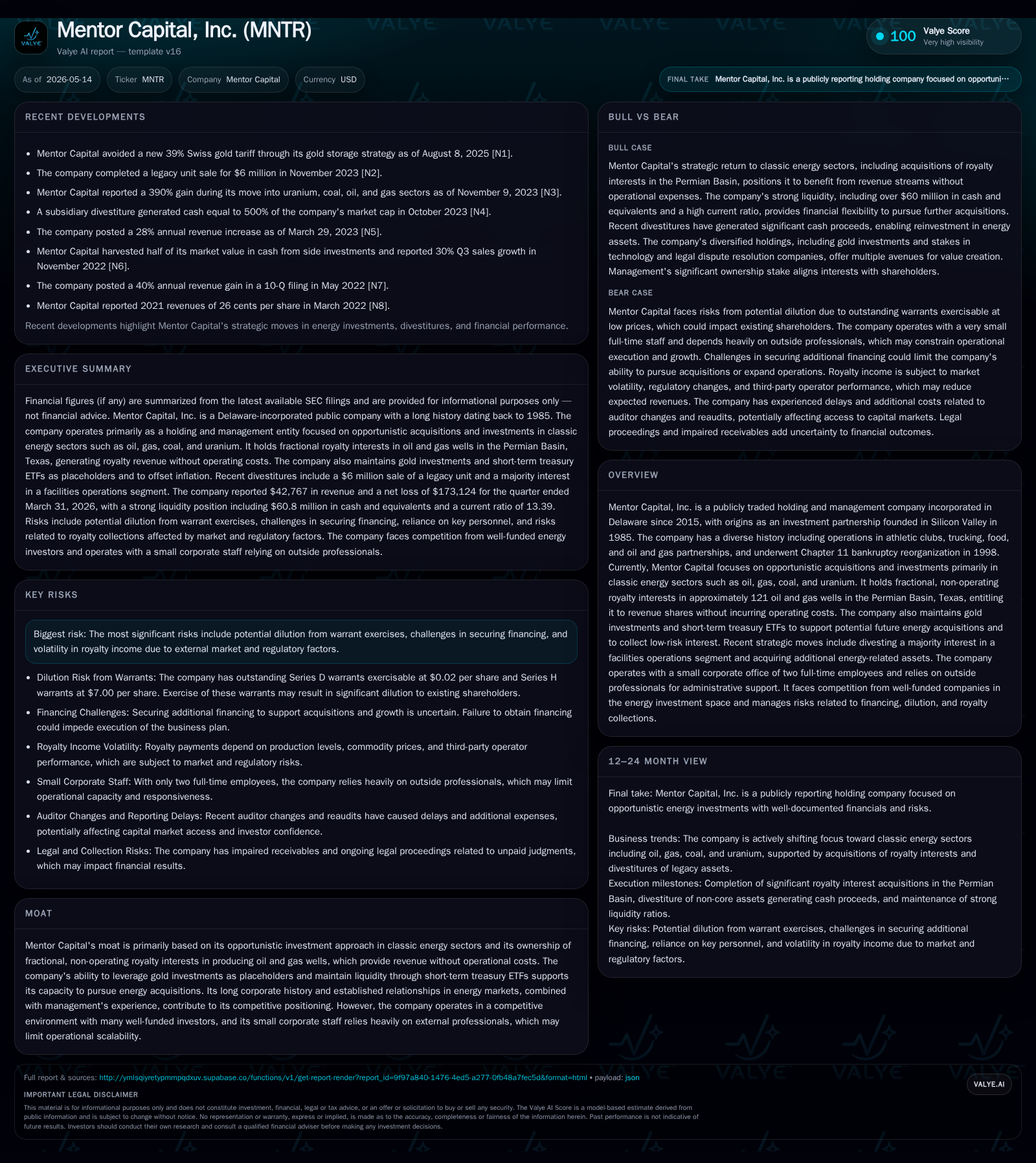
Mentor Capital, Inc.'s most recent quarter underscores a clear pivot to classic energy assets, marked by the acquisition of fractional royalty interests in the Permian Basin. While this move aligns with its historical roots and offers revenue with minimal operational expenses, the company's ongoing auditor changes pose short-term filing and financing risks. Its business model as a holding company focused on opportunistic energy investments provides a low-cost exposure angle but relies heavily on external funding and market conditions. Sustained growth will depend on securing financing, warrant exercise dynamics, and capitalizing on energy sector demand drivers amid competitive pressures.
Recent Operating Update
Mentor Capital's latest quarterly filing dated May 14, 2026 [S2] reiterates its focus on classic energy asset accumulation. The company recently completed the acquisition of three fractional, non-operating royalty interests covering approximately 121 producing oil and gas wells in the Permian Basin's Spraberry Field in West Texas during public auctions in March 2025. These interests entitle Mentor Capital to revenue shares derived from hydrocarbon production without incurring any operating or production costs [S1], [S4]. This acquisition was funded partly through a $6 million divestment earlier in October 2023 of its controlling interest in Waste Consolidators Inc. producing cash inflows alongside continued use of gold and Treasury ETFs as transitional investment vehicles.
However, the company continues to face challenges tied to multiple auditor changes which have impeded timely financial statement filings [S2], [S3]. Switching auditors from BF Borgers (prohibited from practicing before the SEC) to Spicer Jeffries (later acquired by Cherry Bekaert), then dismissing Cherry Bekaert for a new auditing firm has caused material delays and additional audit costs. This disruption complicates Mentor's access to capital markets and could delay financing or acquisition initiatives.
Business Model
Mentor Capital operates primarily as a publicly traded holding and management company deploying capital opportunistically across classic energy markets—oil, natural gas, coal, uranium—and related sectors. Its core revenue generation comes from fractional royalty interests in oil and gas wells where it receives proportional royalties based on production revenues without incurring operating expenses [S1]. This model yields cash flow tied directly to commodity extraction volumes and prices while maintaining a lower cost structure than operating producers.
Additionally, Mentor holds gold investments serving as placeholders or store-of-value vehicles while seeking new energy deals. It also maintains positions in short-term Treasury ETFs that generate low-risk interest income supporting liquidity needs. The company's small corporate staff (two employees) leverages external professional services for management functions including audits, accounting, legal counsel, payroll, and tax compliance [S9].
Revenue mechanics depend on two main drivers: production volumes (which fluctuate per well performance) and commodity pricing dynamics within oil & gas markets. The variable nature of production introduces cyclicality risk into revenue streams though absence of operational CAPEX or OPEX dampens margin volatility.
Industry Structure and Competitive Position
Mentor Capital sits within an industry niche at the intersection of mineral rights investment and small-scale royalty interests—a segment characterized by fragmented ownership structures across thousands of wells primarily concentrated in prolific basins like the Permian. Competition is intense with numerous institutional investors, private equity firms, mineral funds, family offices, and individual stakeholders competing for attractive royalty acquisitions.
The company’s competitive moat lies in its opportunistic approach—utilizing management experience dating back to its Silicon Valley roots—and steady presence in traditional energy zones supported by long-standing industry relationships [S1], [S9]. However, its limited operational scale compared to larger mineral owners limits negotiating leverage or access to proprietary deal flow; likewise its reliance on external professionals restricts internal scalability.
Growth Drivers
Opportunistic Acquisitions in Classic Energy Sectors
Mentor Capital targets accretive acquisitions primarily focused on purchasing non-operating royalty interests amid favorable auction environments or secondary markets [S24]. Its March 2025 acquisition underscores this strategy’s potential to deploy capital into producing assets with ongoing cash flows yet minimal operating complexity.
Warrant Exercises Fueling Cash Inflows
A considerable portion of Mentor’s equity structure includes warrants originally issued during bankruptcy reorganization phases. Many have been reset at extremely low strike prices ($0.02 per share plus redemption fees), incentivizing conversion if share price exceeds this threshold over sustained periods [S14]. Warrant exercises can provide important financing without debt issuance or dilution from new shareholders beyond warrant holders.
Maintaining Liquidity Through Conservative Instruments
Holding gold investments and Treasury ETFs allows partial hedging against inflationary risk while preparing dry powder for timely acquisition opportunities without undue pressure on cash reserves or credit lines [S24].
Risks / Watchpoints / Growth Constraints
- Auditor Changes and Financial Reporting Delays: Multiple auditor transitions have increased audit costs and delayed filings jeopardizing capital market access essential for financing growth plans [S2], [S3].
- Dilution Risk: Exercise of court-reset warrants can lead to significant dilution depending on share price trajectories affecting existing equity holders [S14].
- Variable Royalty Income: Revenue depends heavily on volatile commodity prices and production volumes inherent in legacy oil & gas wells [S16].
- Limited Workforce and Reliance on External Support: With only two full-time employees supported by outside professionals, operational scale is constrained potentially limiting rapid expansion or internal control robustness [S9].
- Thin Trading Market: Trading exclusively via OTCQB limits stock liquidity and broad investor engagement compared to listed peers reducing capital raising flexibility [S19].
- Capital Raising Challenges: Despite efforts to raise funds through equity or debt offerings, obtaining substantial financing remains uncertain amid economic constraints [S2], [S6].
What to Watch Next
- Completion of financial statement audits by the newly engaged independent registered public accountant will be pivotal for restoring filing timeliness and enhancing capital market credibility.
- Progress with warrant redemptions following board-approved pricing reset mechanisms which could materially affect cash balances.
- Additional acquisitions or investments announced demonstrating continued strategic commitment to classic energy asset accumulation.
- Any refinancing or capital raises indicating management’s success navigating external funding challenges.
- Commodity price movements influencing royalty income trajectory given their direct impact on production revenue shares.
- Updates on collection efforts related to litigation settlements or annuity-like receivables that could improve other income streams.
Financial Profile Summary (Latest Quarter)
Latest financial snapshot
| Metric | Value | Period |
|---|---|---|
| Cash & equivalents | $60,834 | |
| Current assets | $1,429,438 | |
| Current liabilities | $106,794 | |
| Current ratio | 13.39x |
Source: SEC companyfacts cache [F1].
As per the latest snapshot data [F1], Mentor Capital holds a solid current ratio of approximately 13.4x driven largely by sizeable current assets relative to liabilities suggesting healthy near-term liquidity buffers despite modest cash levels.
Disclaimer: This is research-only, informational analysis and not investment advice. It may include AI-generated interpretation and general industry context. Always verify important details using primary sources.

Comments