
Bodhi Tree Biotechnology Details Early-Stage Focus on Vegetarian Menu Innovation
Bodhi Tree Biotechnology’s latest quarter highlights its ongoing development as a niche consulting firm targeting vegetarian and flexitarian consumers amidst a fragmented competitive landscape.
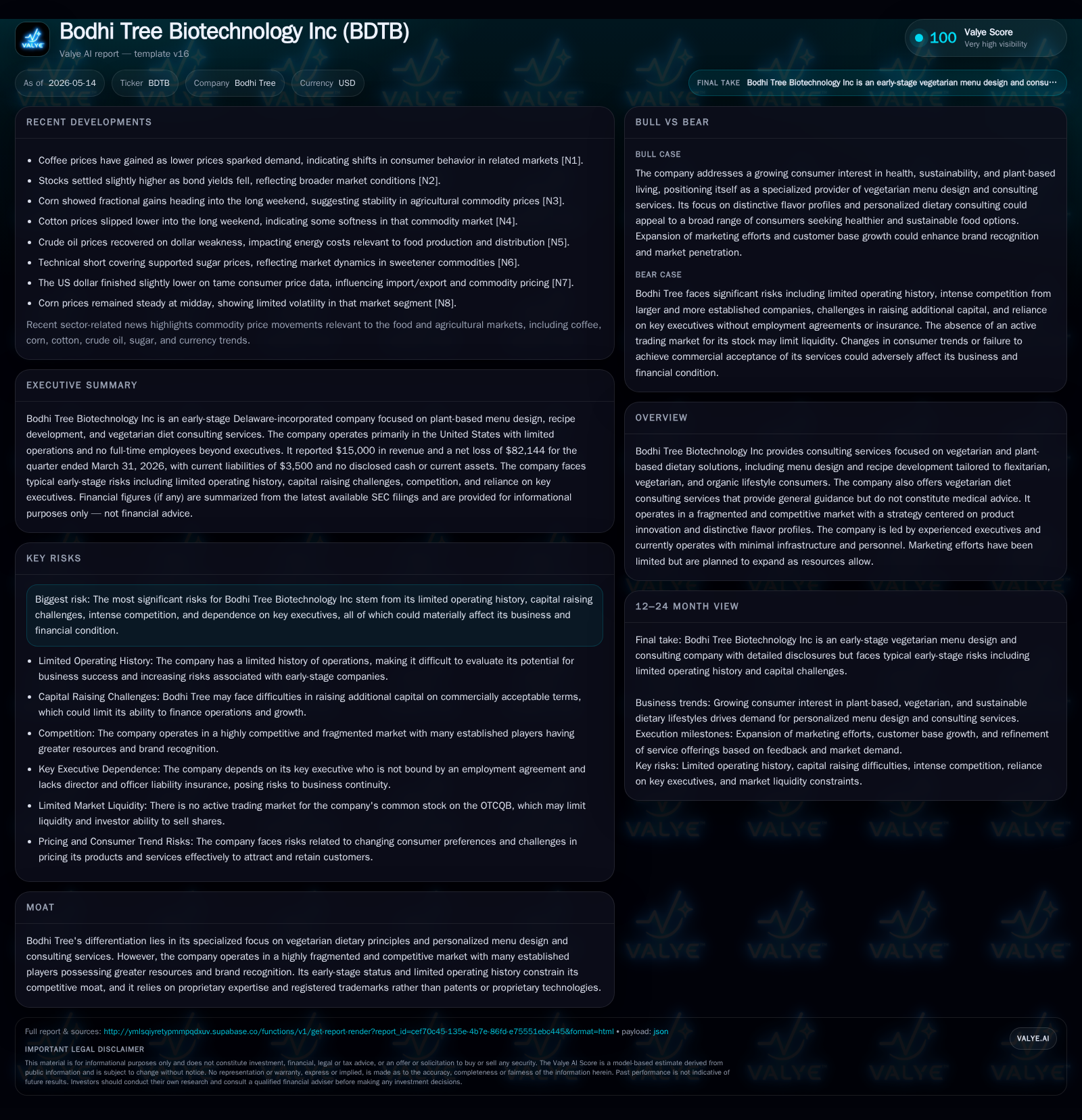
In its May 2026 quarterly update, Bodhi Tree Biotechnology reaffirmed its early-stage status with limited operating activity focused on vegetarian menu design and recipe consulting services. The company leverages specialized expertise to address growing consumer interest in plant-based diets but remains constrained by small scale, limited marketing, and capital needs. Operating in a highly fragmented market with established competitors, Bodhi Tree’s strategic emphasis on product innovation and distinctive flavor profiles aims to differentiate it. Key near-term indicators include marketing expansion, client acquisition, and further refinement of offerings aligned to evolving dietary trends.
Latest Quarterly Operating Update Shapes Near-Term Prospects
Bodhi Tree Biotechnology’s latest SEC filing dated May 14, 2026 (Form 10-Q) continues to paint the picture of an early-stage consulting enterprise focused on vegetarian menu innovation. The company did not report significant operational changes or new revenue streams during the quarter; its financial results reflect minimal revenue generation—approximately $17,000 through September 2025—and ongoing operating losses nearing $148,000 [F1]. There were no updates to risk factor disclosures within this period. The absence of material shifts underscores Bodhi Tree’s nascent status in a competitive market requiring scale and investment before meaningful commercial traction can be achieved [S2].
Focused Business Model Serving Vegetarian and Flexitarian Consumer Bases
Bodhi Tree operates as a project-based consulting firm delivering vegetarian menu design, recipe development, and diet consulting services tailored primarily to consum ers interested in flexitarian, vegetarian, and organic lifestyles. Unlike medical nutritional providers, its diet consulting is confined to general guidance without clinical advice [S1][S11][S19].
Revenue hinges on contracts for menu planning and recipe formulation projects that emphasize innovative flavor profiles adapted to evolving consumer tastes. The company’s strategy centers not on mass commercialization but rather on creating distinctive products that resonate with health-conscious consumers seeking sustainable plant-based options. This approach supports customer retention through personalized service but poses scalability challenges given individualized consulting resource demands [S11][S19].
Competitive Dynamics and Industry Position in a Fragmented Market
The vegetarian recipe development space is saturated with numerous small-scale consultants, wellness service providers, digital content platforms offering recipes or lifestyle advice, as well as larger established firms possessing extensive marketing budgets and brand equity [S5][S8]. Bodhi Tree faces steep competitive hurdles amplified by its limited operational history and minimal infrastructure—no dedicated commercial office space beyond its administrative headquarters—and reliance solely on executive officers for operations [S1][S24].
The company holds two registered trademarks granted in 2025 contributing some brand differentiation; however, it does not possess patents or proprietary technologies that could cement a defensible moat. Its competitive edge rests on specialized knowledge of vegetarian dietary principles combined with customized recipe innovation rather than scale economies or technology barriers [S5][S21]. In such an intensely fragmented industry favoring well-funded incumbents with broader distribution channels, Bodhi Tree must leverage product uniqueness alongside strategic marketing expansion to enhance visibility.
Growth Drivers Powered by Product Innovation and Lifestyle Trends
Long-term growth prospects stem from sustained consumer shifts toward plant-based eating patterns driven by health awareness, environmental concerns, and ethical considerations. The company's tailored vegetarian menus tap into this trend by combining nutrition-conscious recipes with appealing flavor constructs designed for flexitarian consumers who partially reduce meat intake [S1][S19].
Scalability potential exists if Bodhi Tree successfully expands its client base beyond referral networks via enhanced online marketing initiatives detailed as future plans. As consumer adoption evolves alongside dietary lifestyle trends emphasizing sustainability and organic sourcing, the demand for curated vegetarian culinary solutions is poised to increase. Continued innovation in recipe design aligned with these preferences could translate into incremental project engagements driving revenues upward over time [S1][S11].
Risks and Constraints Amid Limited Scale and Capital Needs
Despite positive secular tailwinds, Bodhi Tree contends with substantial constraints. The company’s limited operating history complicates risk assessment while exposing it to standard new business hazards including execution missteps [S1]. Capital raising remains critical since early revenues are insubstantial relative to ongoing operating expenses necessitating fresh financing rounds that may dilute existing ownership stakes or introduce onerous terms [S1][S18][S23].
Management also faces concentration risk given dependence on key executives without formal employment agreements or director/officer liability insurance—a vulnerability particularly acute given the firm’s small size [S28]. Competitive pressures from better-resourced incumbents alongside rapidly changing consumer tastes present additional uncertainty regarding market acceptance. Operational dependency on evolving customer preferences heightens risks linked to pricing strategy efficacy and product relevance over time [S15][S18]. Maintaining intellectual property protections effectively also represents an ongoing challenge given lack of patents and potential exposure to infringement disputes.
Monitoring Milestones: What Investors Should Watch Next
Key indicators of execution progress will revolve around several tactical objectives:
- Expansion of digital marketing efforts beyond current referral-driven modest outreach toward broader consumer engagement platforms.
- Progression in project bookings reflecting growing acceptance of menus/recipes among target flexitarian/vegetarian audiences.
- Further development or registration of intellectual property including trademarks or proprietary culinary methodologies.
- Management disclosures in upcoming SEC filings elucidating customer acquisition rates or any pivots in service offerings.
- Operational metrics capturing cost efficiencies or new partnerships enhancing distribution reach. These milestones will collectively signal whether Bodhi Tree can convert its niche expertise into scalable commercial momentum amid fragmented competition.
Brief Financial Context Supporting Operational Narrative
From a financial standpoint as of the latest period ending September 30, 2025, revenues remain nominal at approximately $17,000 juxtaposed against operating losses totaling around $147,618 reflective of startup phase investments in service development [F1]. Net losses closely align with operating deficits indicating minimal non-operating income influence at this juncture. Current liabilities are modest—about $3,500—as of March 31, 2026 suggesting a lean cost base but also indicative of constrained financial resources restricting growth capacity absent fresh capital infusion [F1].[S2]
This financial snapshot corroborates the company’s narrative as an emerging player prioritizing service design over scale monetization currently. Funding adequacy remains an overarching theme necessary to sustain ongoing product innovation efforts alongside planned sales channel expansions.
Disclaimer: This analysis is based solely on publicly available SEC filings and documented company facts as of May 14, 2026. It does not constitute investment advice nor reflect an endorsement of any security. Users should conduct additional research or consult professional advisors before forming judgments.
Disclaimer: This is research-only, informational analysis and not investment advice. It may include AI-generated interpretation and general industry context. Always verify important details using primary sources.

Comments