
Sativus Tech Advances Automated Saffron Cultivation with Vertical Farming Innovation
Recent quarterly disclosures highlight Sativus Tech’s strides in scaling proprietary indoor saffron farming despite pronounced financial challenges.
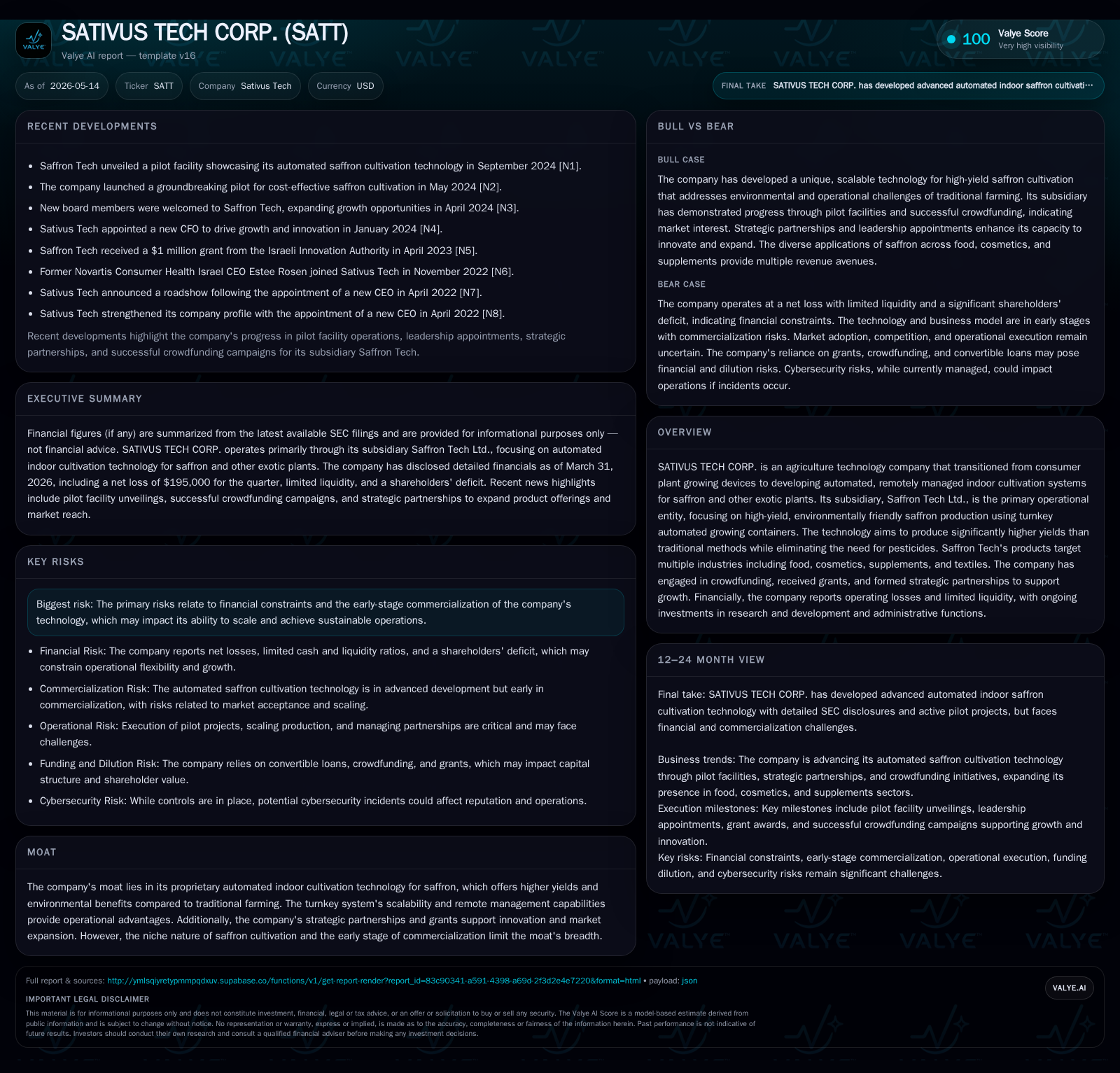
In its May 2026 10-Q filing, Sativus Tech Corp. reported an ownership stake of 54% in its subsidiary Saffron Tech Ltd., advancing automated vertical farming to produce saffron at scale for niche markets across food, cosmetics, and pharmaceuticals. The company’s technology aims to generate yields up to ten times higher than traditional cultivation while eliminating pesticide use through a controlled environment. However, sustained operating losses, zero cash on hand as of March 2026, and negative operating cash flow underscore significant liquidity risks. Going forward, growth depends on commercial scaling of turnkey automated growing containers, further strategic partnerships, and securing additional financing.
Latest Quarterly Update: Progress and Operational Highlights
Sativus Tech Corp.’s Q1 2026 reporting (10-Q filed May 14) marked a pivotal stage in the company’s evolution from consumer-focused plant cultivation devices to industrial-scale agricultural technology targeting exotic crops like saffron [S2]. The company now holds a controlling 54% interest in Saffron Tech Ltd., its operational subsidiary leading development and commercialization of fully automated vertical farming systems designed specifically for saffron. This increase followed recent equity raises within Saffron Tech, underscoring Sativus' strategic emphasis on this niche but premium agricultural market.
Operationally, the subsidiary claims advancement towards large-scale production using vertical farming technology that achieves significantly higher yields—up to tenfold compared with traditional outdoor farming—while maintaining environmental sustainability by eliminating pesticide use. The facility operates under remote management protocols enabled by automation software [S2]. Despite these technical strides, financial disclosures note zero cash balance as of March 31, 2026 alongside negative operating cash flow totaling $73K. The company explicitly flagged substantial doubt about its ability to continue as a going concern without securing additional financing [S2]. Additionally, the filing highlighted that while no material cybersecurity incidents have occurred, risks remain significant given the reliance on digital control systems [S2].
Business Model and Product Differentiation
Sativus generates revenue primarily through the deployment and licensing of turnkey automated growing containers engineered for high-quality saffron production year-round. This system integrates an environmentally sealed environment with precise resource management—water, energy, fertilizer—to maximize yield efficiency relative to land use [S1]. The company positions this solution as scalable with remote operational control capabilities that reduce labor needs and enhance consistent quality outcomes.
Product quality is enhanced by eliminating pesticides/herbicides common in traditional farming due to the sealed indoor environment. This eco-friendly profile aligns with increasing demand from specialized markets including gourmet food sectors (e.g., Michelin-starred chefs), natural cosmetics that value purity and sustainability, dietary supplements leveraging saffron’s purported health benefits (antioxidant, antidepressant), and dyes for textiles [S1]. This differentiation supports command of premium pricing where supply meets exacting quality standards.
Revenue mechanics revolve around contracts to supply these vertical growing systems plus potential royalties tied to product sales developed with grants received by the subsidiary. These multi-channel industries provide diversification but the narrow exotic crop focus keeps the business model reliant on successful scalability of proprietary cultivation technology.
Competitive Environment and Industry Positioning
Indoor agriculture technologies broadly compete on automation level, crop variety suitability, yield per square foot metrics, energy consumption profiles, and scalability of deployment. Sativus’ moat concentrates on its exclusive automated cultivation system tailored for saffron—a high-value but challenging crop characterized by limited annual seasonal harvest traditionally and requiring specialized agronomy [S1].
Barriers are partly IP-driven but amplified by partnerships (notably with research institutes) supporting continuous innovation. Yet broader adoption hurdles exist: many competitors focus on more mainstream vertically farmed crops (leafy greens or herbs), making saffron a niche proposition with a longer education/adoption curve among growers and buyers.
Pricing power appears contextually durable given few alternative suppliers match similar quality/yields sustainably; however, market size constraints cap expansion potential absent product line diversification or new crop introductions. Regulatory oversight focuses mainly on agricultural safety standards though indoor controlled environments simplify compliance relative to field farming.
Growth Catalysts and Market Opportunities
Growth relies heavily on multiple vectors:
- Expansion of turnkey container deployments enabling volume scale-up necessary for meaningful commercial sales figures.
- Penetration into specialty markets where saffron command premium prices justified by traceability and purity.
- Leveraging R&D grants successfully tied to ongoing yield improvement innovations reduces cost structure over time.
- Strategic partnerships accelerating market entry or providing channel access within food service or cosmetic ingredient supply chains [S1][S2].
Concrete KPIs supporting growth outlook would be capacity additions at indoor facilities or booked contracts for container systems. Also critical are milestones related to royalty revenue triggers underpinning grant repayment schedules—a reflection of commercialization progress [S2][S9].
Risks and Execution Challenges
Liquidity is arguably the foremost risk highlighted in recent filings: zero cash reserves reported at quarter-end March 2026 alongside $73K quarterly operating cash burn intensify pressure for near-term capital raising [F1][S2]. Accompanied by accumulated deficits exceeding $24 million cumulatively erodes financial flexibility.
Commercial execution remains nascent—technology still advancing from proof-of-concept toward scaled operations—and adoption uncertainty exists given niche crop focus. Cybersecurity risk featuring prominently due to dependency on networked remote control introduces operational vulnerabilities that could disrupt production or impair customer relationships if incidents arise [S2].
Finally, restrictive debt covenants tied to convertible loans create conditions whereby share price volatility could affect financing options or loan redemptions underway per recent disclosures [S2]. This constellation underscores heightened execution risk amid capital constraints.
Near-Term Milestones and What to Monitor
Stakeholders should track several explicit operational markers indicated by filings:
- Progress reports or announcements detailing automation system installations beyond pilot phases.
- Royalty payments commencing as products derived from R&D grants begin sales; these serve as proxy validation points for commercial viability [S9][S20].
- Performance vs. share price thresholds linked to redemption rights on outstanding convertible debt — fluctuations here impact refinancing approaches [S2].
- Quarterly updates quantifying scaling velocity of production capacity and customer acquisition strides.
- Any cybersecurity incident reports or enhancements signaling management’s response readiness [S2].
Collectively these indicators will clarify trajectory from technology development into sustainable revenue generation.
Financial Snapshot: Liquidity, Debt, and Sustainability
Latest financial snapshot
| Metric | Value | Period |
|---|---|---|
| Cash & equivalents | 0 USD | |
| 2026-03-31 | ||
| Current assets | $18000 | |
| 2026-03-31 | ||
| Current ratio | 0x | |
| 2026-03-31 |
Source: SEC companyfacts cache [F1].
The latest quarter reveals a stark liquidity deficit with zero cash available even as modest debt remains outstanding from prior periods [F1][S2]. Negative operating cash flow continues amid heavy investment in R&D and administrative functions. The SEC filing explicitly cites substantial doubt about the company's ability to continue without new financing secured imminently [S2]. Given limited current assets relative to liabilities recorded previously, the capital structure demands careful monitoring with respect to refinancing risks or equity raises.
In sum, while Sativus Tech advances unique indoor agriculture technologies with promising yield augmentation prospects in specialized saffron markets, financial headwinds pose material constraints requiring resolution before upside is attainable at scale.
This analysis is based solely on mandated SEC filings dated through May 14, 2026 ([S1],[S2]) augmented by validated third-party research excerpts. It does not constitute investment advice nor predict future results but serves as an informed evaluation of Sativus Tech Corp.’s operational status within its specialized agricultural technology domain.
Disclaimer: This is research-only, informational analysis and not investment advice. It may include AI-generated interpretation and general industry context. Always verify important details using primary sources.

Comments