
Permian Basin Royalty Trust Secures Governance Reform to Enhance Unitholder Control
Recent court-approved amendments simplify voting rules, improving unitholder influence over trust governance.
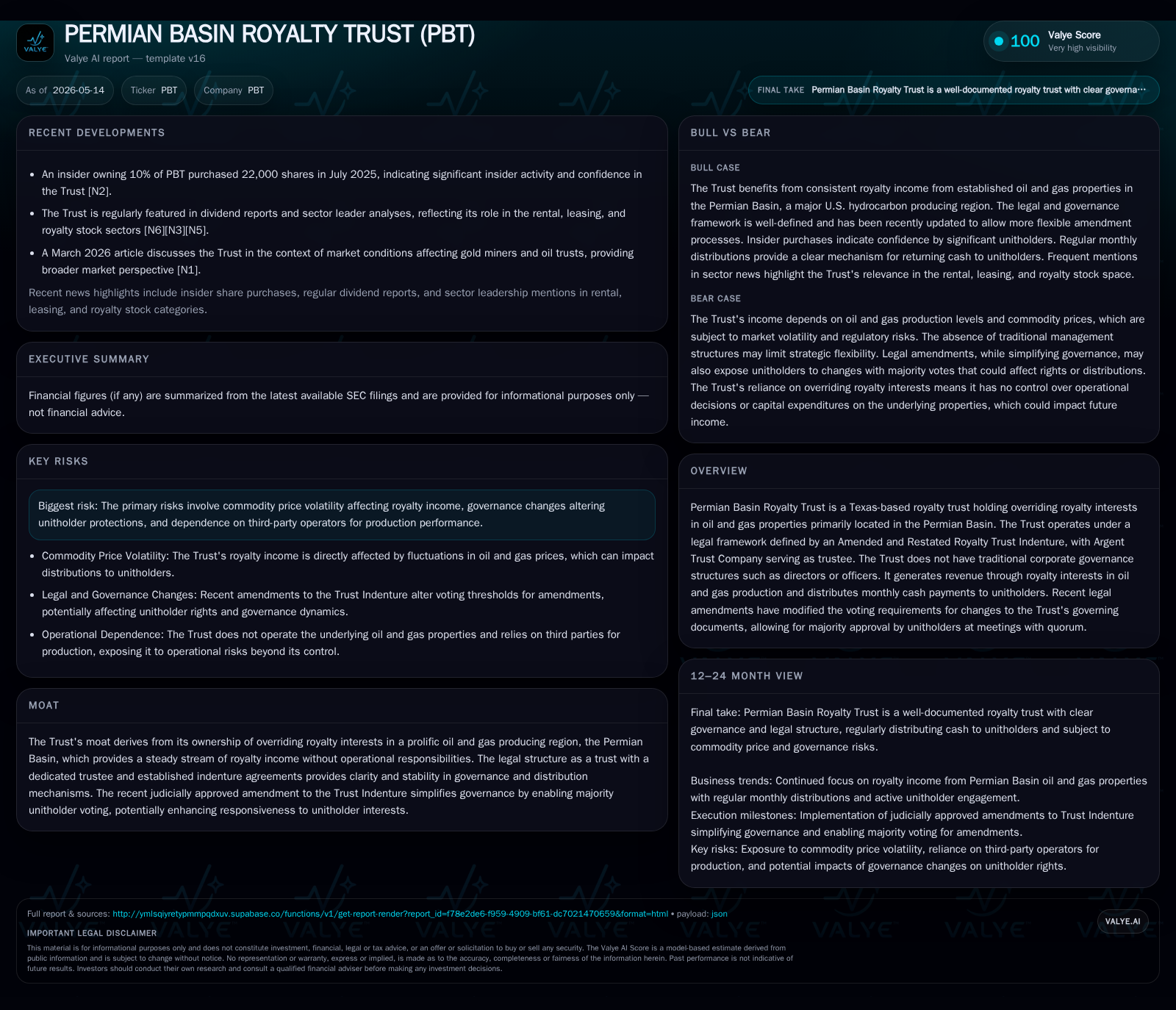
Permian Basin Royalty Trust recently secured a judicially approved amendment to its governing indenture that reduces amendment approval thresholds from a supermajority to a simple majority vote of unitholders at meetings with quorum. This change marks a significant shift in governance, potentially enabling more responsive management of trust provisions and aligning decision-making closer to unitholder interests. The trust continues to generate income solely from overriding royalty interests in the prolific Permian Basin, dependent on third-party operators’ production and commodity prices. While the legal reform is notable, risks remain tied to commodity volatility and operator execution.
Recent Operating Update: Governance Amendments and Their Significance
In May 2026, Permian Basin Royalty Trust (PBT) enacted a pivotal governance reform following a court hearing before the 96th District Court of Tarrant County, Texas. The court approved modifications initiated by SoftVest, L.P., a significant unitholder seeking enhanced control over trust amendments. The key change was amending Section 8.03 of the Trust Indenture to remove the previously mandated supermajority approval threshold—specifically eliminating the 75% vote requirement for certain amendments—and substituting it with a straightforward majority approval by unitholders present constituting a quorum at meeting [S3][S29].
Moreover, Section 10.01 of the Indenture, which previously listed specific prohibited amendments, was deleted and replaced with an updated Article X permitting any amendment through such majority vote procedures [S29]. This legal restructuring effectively lowers the barriers for altering governing documents, reducing procedural friction and potentially enabling faster alignment with unitholder interests.
This development is significant because PBT’s governance architecture had historically been rigid due to its trust structure—typically less flexible than corporate entities. Now, with judicial sanctioning of majority-rule amendments at properly convened meetings, unitholders gain increased influence over essential facets of the trust’s operation including distribution policies or other structural provisions. Argent Trust Company continues as trustee overseeing adherence to these protocols without operating roles or officers involved [S2][S3].
Business Model: Royalty Interest Revenue Without Operational Burdens
PBT operates as a royalty trust holding overriding royalty interests (ORRI) primarily in oil and gas producing properties within Texas’s Permian Basin, one of North America's most prolific hydrocarbon basins [S1][S2]. It does not engage directly in exploration, drilling, or production activities; instead, it receives passive income streams based on proportional shares of production revenue from third-party operators managing wells.
This model means PBT’s revenue stems from two variables: commodity prices (oil and natural gas) realized at point-of-sale and production volumes yielded by wells subject to its overriding royalties [S1]. No operational costs or capital expenditure burdens fall upon the trust since working interests remain with operators. Monthly cash distributions flow directly to unitholders mirroring this income net of minimal administrative expenses managed by the trustee.
Such structure affords PBT predictable cash flows sensitive predominantly to commodity market cycles and operator effectiveness but insulated from drilling risk or cost overruns. As a result, margins are structurally high due to absence of operating costs but revenue volatility aligns closely with upstream industry fundamentals [S1][S2].
Competitive Position: Trust Structure and Its Moat in the Permian Basin
The trust’s competitive advantage centers on ownership of substantial ORRIs embedded in the Permian Basin—a region characterized by extensive proven reserves, established infrastructure, and historically low lifting costs per barrel relative to other US basins [S1]. This geographical placement confers both resource quality and cost advantages indirectly benefiting trust revenue.
Additionally, PBT’s legal form as an established royalty trust creates a moat rooted in clarity and stability of income rights governed under long-standing indenture terms overseen by an independent trustee. Its exemption from corporate complexities such as board management or executive compensation further concentrates value on pass-through royalty yields without overhead dilution [S1].
This clarity attracts investors seeking direct commodity exposure via stable monthly distributions backed by transparent agreements. Moreover, recent governance enhancements further reinforce this moat by balancing flexibility with protective oversight mechanisms ensuring orderly evolution aligned with unitholder interests.
Legal and Governance Framework: Stability Through Trustee Oversight and Indenture Controls
Unlike conventional public entities, PBT does not maintain directors or officers; Argent Trust Company acts solely as trustee tasked with administering revenue collections and distributions per indenture provisions documented since inception in 1980 [S1][S2]. Operating disclosures affirm that no Rule 10b5-1 trading plans exist among non-existent officers/directors reflecting this non-corporate setup [S2].
Governance is largely dictated by the Amended and Restated Royalty Trust Indenture—a contract prescribing rights concerning revenue streams, voting procedures for amendments, and trustee responsibilities. The recent judicially authorized Amendment No. 2 simplifies amendment procedures reducing supermajority thresholds—as initiated by SoftVest—increasing democratic responsiveness while maintaining judicial oversight safeguards typical of such trusts [S3][S29].
Trusteeship ensures continuity without day-to-day operational interference but enforces distributive discipline maintaining cash payment regularity integral to investor expectations. Legal proceedings section in annual filings notes ongoing litigation history primarily surrounding governance issues underscoring this dimension remains actively relevant [S1].
Growth Drivers: Commodity Price Sensitivity and Production Dynamics
PBT’s revenue growth fundamentally ties to commodity pricing cycles—especially crude oil prices given Permian production mix—and sustained well productivity upstream controlled by working interest owners [S1]. While acreage positions are fixed due to royalty conveyances established decades ago, production volumes can fluctuate depending on operators’ capital expenditure levels focused on drilling activity intensity.
Thus demand drivers for PBT equity units correlate strongly with bullish oil price environments encouraging upstream activity expanding output; conversely downcycles compress these streams proportionally. Stable regional pipeline infrastructure supporting efficient take-away capacity mitigates logistical risks enabling realization of spot market differentials close to benchmark indices.
Importantly, PBT benefits if Permian operators enhance recovery techniques or expand enhanced oil recovery projects raising ultimate recovery per well—though such factors are outside direct control given PBT’s ORRI status. Consequently growth is structurally capped by mineral acreage limits yet levered economically into fluctuating commodity markets aiding cyclical gains [S1].
Risks and Watchpoints: Commodity Volatility, Third-Party Operator Dependence, and Governance Changes
Intrinsic risks derive primarily from highly volatile commodity markets driving royalties up or down often rapidly affecting monthly income streams experienced by unitholders [S1][S2]. Additionally, since PBT holds only overriding royalty shares without operational rights or control over well management decisions, reliance on third-party operators’ effectiveness constitutes another key vulnerability.
Operational disruptions—whether technical failures, regulatory challenges impacting drilling permits, or strategic operator cutbacks—could reduce production volumes thus compressing revenues despite favorable prices. Moreover legal uncertainties around governance continue as evidenced by SoftVest’s litigation efforts culminating in recent amendment approval; future disputes could materialize potentially altering protections or rights accorded under existing indenture language [S1][S3][S29].
While modifications enhancing majority voting lower procedural hurdles favoring active unitholder input—this also introduces speculative risk about potential changes impacting long-term unitholder value if aligned factions pursue contentious reforms.
What to Watch Next: Cash Distributions, Further Legal Developments, and Production Trends
Market participants should closely monitor upcoming monthly cash distribution announcements which serve as direct barometers for realized commodity prices adjusted for production levels attributable to PBT's overriding royalties [S2]. Consistent or improving distributions would signal sound operator execution amid prevailing energy market conditions.
Further legal developments merit attention regarding any additional amendments proposed leveraging new majority voting rights granted under Amendment No. 2. Observers should note whether governance responsiveness accelerated post-April-May rulings facilitates adaptive evolution versus riskier disruptive proposals.
Lastly drilling rig counts linked indirectly via operator capital budgets within Permian sub-basins offer proxy insights into volume trajectories underpinning future cash flow stability or growth potential despite no direct acreage expansion capacity for PBT itself.
Disclaimer: This analysis is provided solely for informational purposes without investment advice or recommendations. It reflects summarized facts grounded in recent SEC filings dated through May 14, 2026.
Disclaimer: This is research-only, informational analysis and not investment advice. It may include AI-generated interpretation and general industry context. Always verify important details using primary sources.

Comments