
XTI Aerospace Grows Commercial Drone Services While Pausing TriFan 600 Manned Aircraft Development
Q1 2026 results reflect revenue from drone distribution and training as XTI shifts focus to unmanned defense R&D and builds domestic manufacturing capabilities amid regulatory pressures.
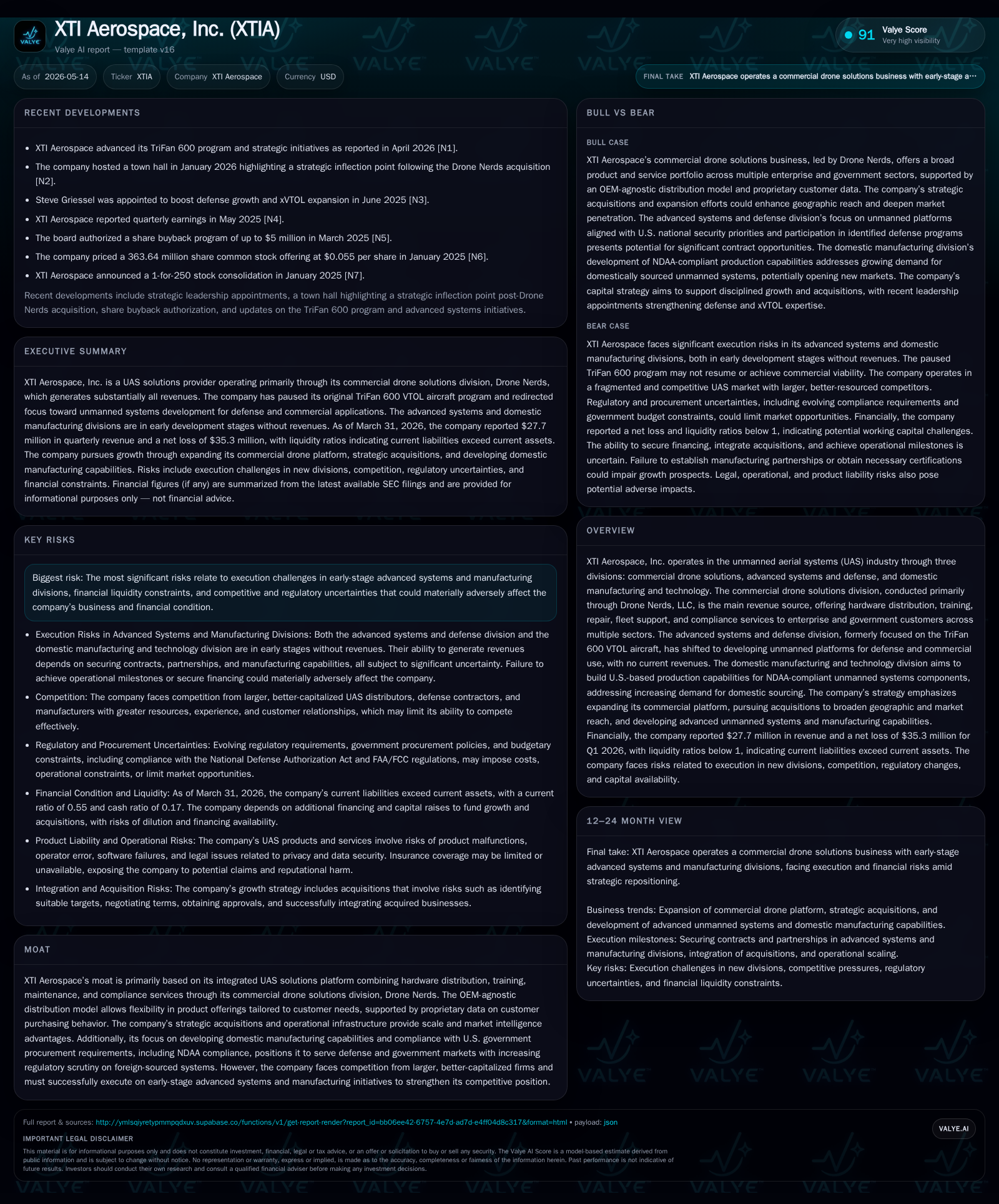
In the first quarter of 2026, XTI Aerospace reinforced its position through its commercial drone solutions segment, primarily via Drone Nerds. The company paused its TriFan 600 VTOL program to refocus on unmanned platforms for defense and commercial customers and is developing domestic manufacturing capabilities to meet increasing regulatory demands. Though revenue is driven by distribution, training, and service, early-stage investments in advanced systems and manufacturing offer long-term growth potential amidst litigation and liquidity risks.
Recent Operating Update: Q1 2026
XTI Aerospace's most recent quarterly filing dated May 14, 2026 ([S2]) alongside a related event filing ([S3]) underscores the company's current operational dynamics. Revenue continues to derive predominantly from the commercial drone solutions segment operated through its majority-owned subsidiary Drone Nerds. Advanced systems & defense (ADS) and domestic manufacturing divisions remain pre-revenue but represent strategic growth pillars. Notably, the company has formally paused further development of the TriFan 600 vertical takeoff & landing (VTOL) aircraft program originally conceived in earlier years. The underlying intellectual property from TriFan 600 is retained as a technology asset applicable to emerging unmanned platform designs ([S1], [S24]).
The filings also disclose ongoing legal proceedings stemming from Legacy XTI’s prior joint venture agreements connected to the TriFan 600 program. These lawsuits have progressed into extensive discovery phases with material financial exposure not yet fully quantifiable ([S20], [S21]). Liquidity metrics reported as of March 31, 2026 show approximately $15.2 million in cash against current liabilities totaling roughly $90.9 million—resulting in a current ratio near 0.55—and total debt estimated at $450,000 as of late 2025 ([F1]).
Business Model
XTI Aerospace operates a tripartite business model comprising:
Commercial Drone Solutions: This division constitutes the bulk of current revenues via Drone Nerds LLC and Anzu Robotics LLC. It acts as an OEM-agnostic distributor selling drone hardware alongside complementary services including training programs (operator certification, mission planning), repair and maintenance support, fleet sustainment services (logistics and warranty processing), compliance assistance under evolving FAA regulations (such as BVLOS operations), software enablement (fleet management integration), and financing facilitation ([S1], [S22], [S12]). The revenue mechanics are volume-driven from product sales coupled with recurring service contracts enhancing operating margin potential through value-added offerings.
Advanced Systems & Defense (ADS): Formerly the XTI Aircraft division focused on TriFan 600 manned VTOL aircraft development now redirected towards unmanned aerial systems for defense/commercial uses. This division is currently pre-revenue but invests heavily in R&D encompassing autonomous flight systems, propulsion technologies adaptable from legacy IP assets, and defense-oriented platform design compliant with stringent government specifications ([S1], [S9], [S24]). Revenue will depend on securing prime government contracts or co-development partnerships amid a lengthy procurement process.
Domestic Manufacturing & Technology: This emerging segment targets scalable U.S.-based production lines for NDAA-compliant unmanned system components responding to rising regulatory demand for domestically sourced platforms amidst national security scrutiny ([S1], [S17], [S13]). Its mandate includes forming manufacturing partnerships or acquisitions that satisfy federal procurement regulations under Section 848 of the NDAA. As with ADS, this division is early stage with uncertain timing for revenue generation.
Industry Structure and Competitive Position
The UAS industry combines rapid technological innovation with complex regulatory oversight. Commercial markets have matured faster than advanced air mobility or defense sectors but remain fragmented across use cases such as agriculture, construction inspection, energy utility monitoring, mining operations oversight, insurance claims verification, security surveillance, and public safety missions ([S6], [S16]).
XTI’s core strength lies in Drone Nerds’ integrated platform: offering multi-manufacturer hardware selection reduces reliance on any single OEM while broad-based training and lifecycle services build stickiness among enterprise/government customers ([S1], [S22]). Proprietary data capturing purchasing behaviors informs targeted marketing and acquisition decisions—a notable competitive advantage within this fragmented landscape.
However, competition is intense from larger distributors with greater capital resources as well as vertically integrated UAV manufacturers seeking end-to-end dominance. Dependency on OEM suppliers poses supply chain risks; DJI accounts for nearly half of purchases but faces geopolitical/regulatory pressures that could disrupt availability or terms ([S4]).
The ADS and domestic manufacturing efforts place XTI against established aerospace primes and specialty contractors possessing deeper engineering expertise and existing defense relationships—barriers that require successful execution on technical milestones and certification processes to overcome ([S8]).
Regulatory trends favor companies like XTI that emphasize compliance with FAA operational standards as well as U.S.-based sourcing mandated by increasingly protective government procurement policies around unmanned systems ([S17]). Yet these regulations simultaneously raise entry barriers through costly compliance obligations.
Growth Drivers
Expanding Commercial Drone Solutions Growth
- Leveraging the broad OEM-agnostic portfolio lets XTI tailor solutions per enterprise operational needs while cross-selling higher-margin services such as training certifications and fleet management support.
- Enhancing repair & maintenance infrastructure reduces customer downtime improving retention.
- Introducing financing options increases accessibility for mid-market customers requiring deferred payment structures ([S5],[S12],[S22]).
- Proprietary customer purchasing behavior data enables precision marketing and supports identifying attractive acquisition candidates to consolidate market share.
Targeted Acquisitions & Partnerships
Given the fragmented UAS distribution landscape that remains dominated by smaller operators across localized geographies or vertical niches, active M&A offers tactical expansion pathways. Strategic acquisitions can deepen penetration into government/public safety sectors where specialized certifications/capabilities are critical ([S5],[S22]).
Advanced Systems & Defense Development Potential
Although still nascent in commercialization stage, technological innovation in autonomous platforms aligned with current defense modernization initiatives offers multi-year potential revenue streams contingent upon landing prime contracts or key partner co-development awards. The preserved technology from TriFan 600's developmental efforts provides reusable IP assets applicable within this pivoted strategy ([S9],[S13],[S24]).
Domestic Manufacturing Capabilities Building
Responding directly to tightening NDAA sourcing requirements creates structural demand advantages if XTI successfully establishes compliant production capacity domestically. With numerous federal agencies expressing preference for American-made solutions because of cybersecurity concerns linked to foreign hardware components—especially Chinese-origin—the ATM division's focus aligns neatly with evolving market conditions ([S17],[S13]). Execution here may unlock substantial contract opportunities tied to an estimated combined $1.5 billion downstream addressable market if programs scale beyond R&D phases ([S13]).
Risks / Watchpoints / Growth Constraints
- Execution Risks: Early-stage ADS and manufacturing divisions face typical scaling challenges including technical certification delays, supplier qualification obstacles, large capital requirements without immediate revenues; failure to secure government contract awards would hinder progress significantly ([S8],[S13],[S20]).
- Legal Uncertainties: Lingering litigation related to TriFan 600 JV disputes introduces operational distractions along with unpredictable financial exposure potentially affecting stock price performance or capital allocation decisions ([S20],[S21]).
- Financial Constraints: The company holds approximately $15 million in cash and equivalents against minimal total debt near $450,000, while current liabilities exceed current assets resulting in a current ratio of about 0.55—indicating liquidity pressure that may affect working capital availability amid planned acquisitions or production investments ([F1],[S18],[S25]).
- Supplier Dependency: Reliance on DJI for nearly half of product procurement represents concentration risk compounded by prevailing geopolitical trade tensions restricting certain foreign-sourced drone components affecting supply stability or pricing structures ([S4]).
- Regulatory Complexity: FAA rules evolve rapidly especially around BVLOS operations which impacts customer adoption curves; non-compliance risks extend also into FCC equipment authorization domains creating additional cost burdens or delays in solution rollouts ([S1],[S24]).
- Competition: Larger competitors benefit from greater scale economies both in commercial distribution networks and advanced aerospace/defense platforms manufacturing challenging XTI’s ability to differentiate strictly through integrated services alone without broader balance sheet muscle or long-standing governmental relationships ()
What to Watch Next
- Quarterly updates on revenue trajectory from commercial drone solutions reflecting success in service expansion beyond hardware sales.
- Progress announcements regarding government contracts or partnership agreements within ADS or ATM divisions given their zero-current revenue status but substantial strategic importance.
- Milestones tied to FAA regulatory approvals for enhanced operational roles like BVLOS flights enabling broader enterprise adoption.
- Resolution updates around ongoing legal disputes tied to past technology ventures impacting the company's IP estate or financial obligations.
- Financing activities including potential equity or debt raises aimed at bolstering working capital for acquisition-fueled growth or manufacturing scale-up.
- Integration outcomes following recent acquisitions providing clarity on margins improvement or cross-selling efficiencies within Drone Nerds ecosystem.
Financial Profile Snapshot (As of Q1 2026)
Latest financial snapshot
| Metric | Value | Period |
|---|---|---|
| Cash & equivalents | $15mm | |
| 2026-03-31 | ||
| Total debt | $450000 | |
| 2025-12-31 | ||
| Net debt | $-15mm | |
| 2025-12-31 | ||
| Current assets | $50mm | |
| 2026-03-31 | ||
| Current liabilities | $91mm | |
| 2026-03-31 | ||
| Current ratio | 0.55x | |
| 2026-03-31 |
Source: SEC companyfacts cache [F1].
*Derived = Current Assets / Current Liabilities[F1]
Operating income remains negative reflecting ongoing investments in R&D and operating infrastructure crucial to executing longer-term vision beyond immediate profitability goals.[F1]
Disclaimer: This analysis is based solely on information publicly disclosed through SEC filings and related official sources as of May 14, 2026. It does not constitute investment advice or recommendations but aims at providing a grounded understanding of XTI Aerospace's business dynamics within its industry context.
Disclaimer: This is research-only, informational analysis and not investment advice. It may include AI-generated interpretation and general industry context. Always verify important details using primary sources.

Comments