
Tradewinds Universal Expands Nightlife Sector Amid Elevated Operating Costs and Liquidity Constraints
Tradewinds Universal’s strategic pivot toward licensing, distribution, and hospitality marks a transformative growth phase fraught with financial and execution risks.
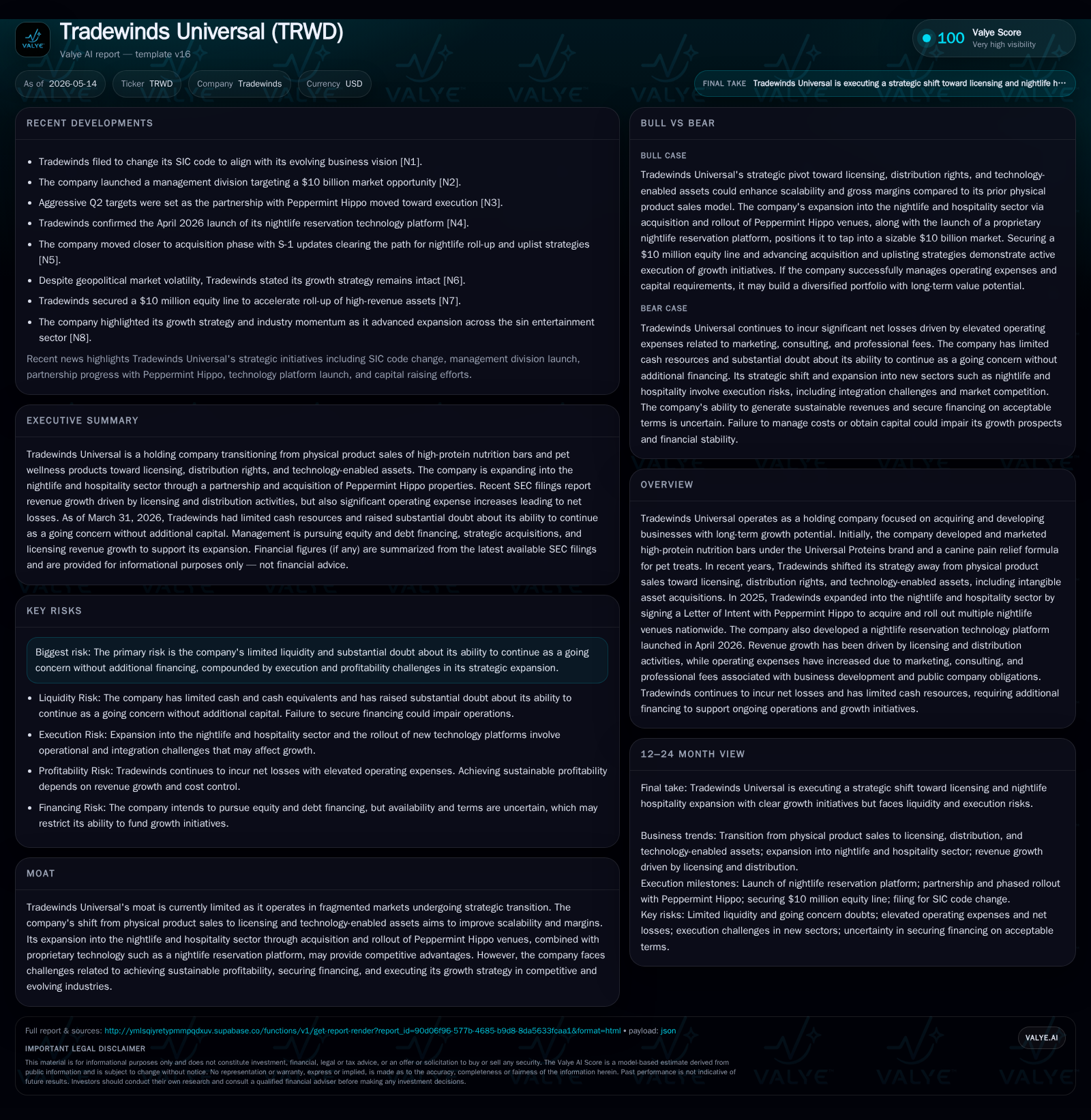
In its latest quarter ended March 31, 2026, Tradewinds Universal increased revenue by 68% driven by licensing and distribution activities, yet net losses widened due to sharply higher operating expenses. The company is aggressively expanding into the nightlife and hospitality sector through acquisition of Peppermint Hippo venues and launching proprietary reservation technology while continuing to develop its high-protein nutrition bars and canine pain relief products. Despite strong gross margins from intangible-driven revenue, Tradewinds faces substantial liquidity risk, needing capital infusion to sustain operations as it navigates multiple strategic pivots in fragmented markets.
Recent Operating Update
Tradewinds Universal's latest quarterly filing for the period ending March 31, 2026 [S2] reveals a clear strategic pivot that continues shaping its operating profile. The company reported revenue of $21,800 for Q1 2026 versus $12,972 in Q1 2025—a roughly 68% increase—primarily attributable to intensified licensing, distribution arrangements, and related business activities. Critically, Tradewinds reports no cost of goods sold during the period due to its focus on intangible asset transactions such as licensing rights instead of direct product sales. This translated into gross profit matching total revenues at a full 100% gross margin.
However, operating expenses ballooned more than tenfold from $14,084 to $147,141 year-over-year. The expense increase was driven by elevated marketing ($64K), consulting ($44K), professional fees ($24K), amortization ($10K), and general administrative costs amidst ongoing business development and public company obligations. Consequently, the net loss widened sharply to $125K from a negligible $1K one year prior. The weighted average shares outstanding also increased significantly due to equity issuances supporting expansion efforts.
Cash resources remain scant with cash and equivalents standing at $15.6K against current liabilities of $52K as of March-end [S2], [F1]. Management has expressly flagged substantial doubt about the company's ability to continue as a going concern without additional financing. Plans center on pursuing equity or debt raises alongside growing licensing income streams and forming strategic partnerships.
Business Model
Tradewinds started as a developer of edible insect protein-based nutritional bars under the Universal Proteins (UP) brand along with a proprietary canine pain relief formula [S1], [S2]. Over time, it progressively transitioned away from physical product sales towards monetizing licensing agreements and distribution rights along with acquiring technology-enabled intangible assets [S1]. This shift eliminates direct manufacturing costs—explaining zero cost of goods sold—and aims for scalability via recurring revenue contracts.
Recently (August 2025), Tradewinds entered the nightlife sector through a Letter of Intent with Peppermint Hippo to acquire clubs beginning with the Toledo location followed by a national rollout encompassing eight venues plus affiliated brands [S2]. Complementing this move is the April 2026 launch of a proprietary nightlife reservation platform intended to digitize venue bookings and enhance customer engagement [N2]. This novel technology asset potentially creates long-term value upon scaling.
Revenue generation thus divides mainly between:
- Licensing fees for portfolio assets including UP brand product formulations and canine treat formulas.
- Distribution rights sales providing upfront non-recurring or recurring revenues without inventory risk.
- Ventures in nightlife/hospitality leveraging venue acquisitions combined with platform subscriptions or service fees.
Margins benefit materially from absence of production/fulfillment costs but are offset in short term by high operational investments in marketing licenses growth channels plus technology development.
Industry Structure and Competitive Position
Each core focus area presents distinct competitive dynamics:
Nutritional products: The specialty edible insect protein bar niche remains nascent but crowded among startups vying for consumer acceptance. Distribution is fragmented between e-commerce platforms and selective retail chains. Tradewinds currently lacks robust retail presence beyond initial distributor agreements [S1].
Pet health treats: Market fragmentation persists; many incumbents dominate chewables/pain relief segments backed by FDA or regulatory approvals. Tradewinds's canine formula offers differentiation if proving efficacy but commercialization scale hinges on successful licensing or white labeling partnerships.
Nightlife/Hospitality: Highly localized industry with significant barriers of entry around location selection, brand recognition, local regulations/licensing permits alongside trend-driven customer preferences. Peppermint Hippo's existing footprint could grant initial scale advantage but competition from entrenched operators is intense.
Competitive moat remains nascent with Tradewinds leveraging:
- Intangible assets generating recurring income without inventory.
- Tech-enabled reservation system distinguishing hospitality offerings.
- Multi-sector exposure possibly hedging against cyclical downtrends in any single vertical. However substantial challenges persist around execution discipline across these divergent fields.
Growth Drivers
Key growth vectors identified from filings include:
- Expanding the UP protein bar range into additional SKUs post initial launch successes in Chocolate Almond & Peanut Butter Fruit flavors developed with partner YouBar [S2], [S19].
- Commercializing the canine pain relief formula into pet treat formats supported by ongoing licensing discussions beyond initial Mexico market deals [S2], [S11].
- Aggressive rollout of Peppermint Hippo venues nationally following initial acquisitions supplemented by active promotion via the newly developed reservation technology platform [S2], [N1], [N2].
- Pursuit of licensing/distribution agreements aiming for scalable non-capex revenue streams allowing margin improvement versus direct sales models [S1].
Monitoring booking volumes via their tech platform alongside increases in licensed intellectual property revenue will be crucial indicative KPIs for sustainable momentum.
Risks / Watchpoints / Growth Constraints
- Liquidity Risk: With only $15.6K cash on hand versus $52K current liabilities and accumulated deficits atop $1.3 million [F1], Tradewinds faces severe funding pressures threatening operational continuity absent timely capital raises [S2]. Reliance on uncertain equity/debt markets adds vulnerability.
- Execution Complexity: Managing simultaneous pushes across nutritional supplements, veterinary products, and nightlife entails operational strain risking dilution of management focus or strained resource allocation impacting delivery effectiveness [S2], [N4].
- Market Adoption Uncertainty: The insect protein bar market remains experimental; sizable distribution deals remain unconfirmed limiting top-line ramp [S14], [S19]. Similarly canine treat product adoption outside Mexico hinges on successful commercialization partnerships which lack firm commitments.
- Competitive Pressures: All targeted industries are competitive with better-funded or entrenched players present. Hospitality market especially sensitive to economic downturns impacting discretionary spending which could reverberate negatively on venue profitability.
- Elevated Operating Expenses: Increased marketing/professional/consulting fees have amplified quarterly cash burn drastically limiting runway ahead of scaling revenues [S9].
What to Watch Next
Critical near-term milestones include:
- Ability to secure meaningful equity or debt financing on acceptable terms to extend operational runway beyond mid-term horizons [S2].
- Execution pace of Peppermint Hippo venue acquisitions including commencement dates for new locations and operational metrics like reservations usage showing user traction [N1], [N2].
- Expansion velocity and market acceptance progress for both UP nutrition bars including new SKU development status and canine pain relief treat commercialization agreements progressions.
- Quarterly revenue trends demonstrating sustainable topline growth balancing intensifying operating spend.
- Any changes in regulatory classifications or industry code updates signaling strategic realignment as flagged in recent SIC code change filings targeting exchange uplisting preparations [N4], [N5].
Financial Profile Overview (Latest Quarter as Context)
Latest financial snapshot
| Metric | Value | Period |
|---|---|---|
| Current assets | $77492 | |
| 2026-03-31 | ||
| Current liabilities | $52000 | |
| 2026-03-31 | ||
| Current ratio | 1.49x | |
| 2026-03-31 |
Source: SEC companyfacts cache [F1].
Revenues show improvement yet remain minimal overall reflecting early-stage nature. Operating losses widened proportionally owing to investment loadouts supporting strategy shifts. Cash balances insufficient relative to near-term obligations heightening risk unless funding secured promptly.
Conclusion
Tradewinds Universal is at a pivotal juncture marked by strategic evolution away from legacy physical product sales toward a multi-pronged approach involving intangible asset monetization and expansion into diversified sectors such as nightlife hospitality powered by proprietary technology solutions. While these initiatives promise enhanced scalability potential theoretically offering improved margins absent production burdens—the company must contend with fragmented markets lacking entrenched moats coupled with critical liquidity constraints imposing execution risks that could retard growth realization.
Continued monitoring should focus on how effectively management navigates fundraising challenges while successfully expanding commercial footprints across its nutrition lines and hospitality portfolio before profitability materializes amid industry competitiveness and consumer adoption uncertainty.
This analysis is based solely on data available as of May 14th, 2026 including SEC filings referenced herein. It does not constitute investment advice.
Disclaimer: This is research-only, informational analysis and not investment advice. It may include AI-generated interpretation and general industry context. Always verify important details using primary sources.

Comments