
UMeWorld Advances Wellness Oil Sales and Biofuel Ambitions Despite Operational Constraints
Q2 FY2026 results highlight growth in DAGola™ sales alongside emerging biofuel efforts, tempered by supplier concentration and liquidity challenges.
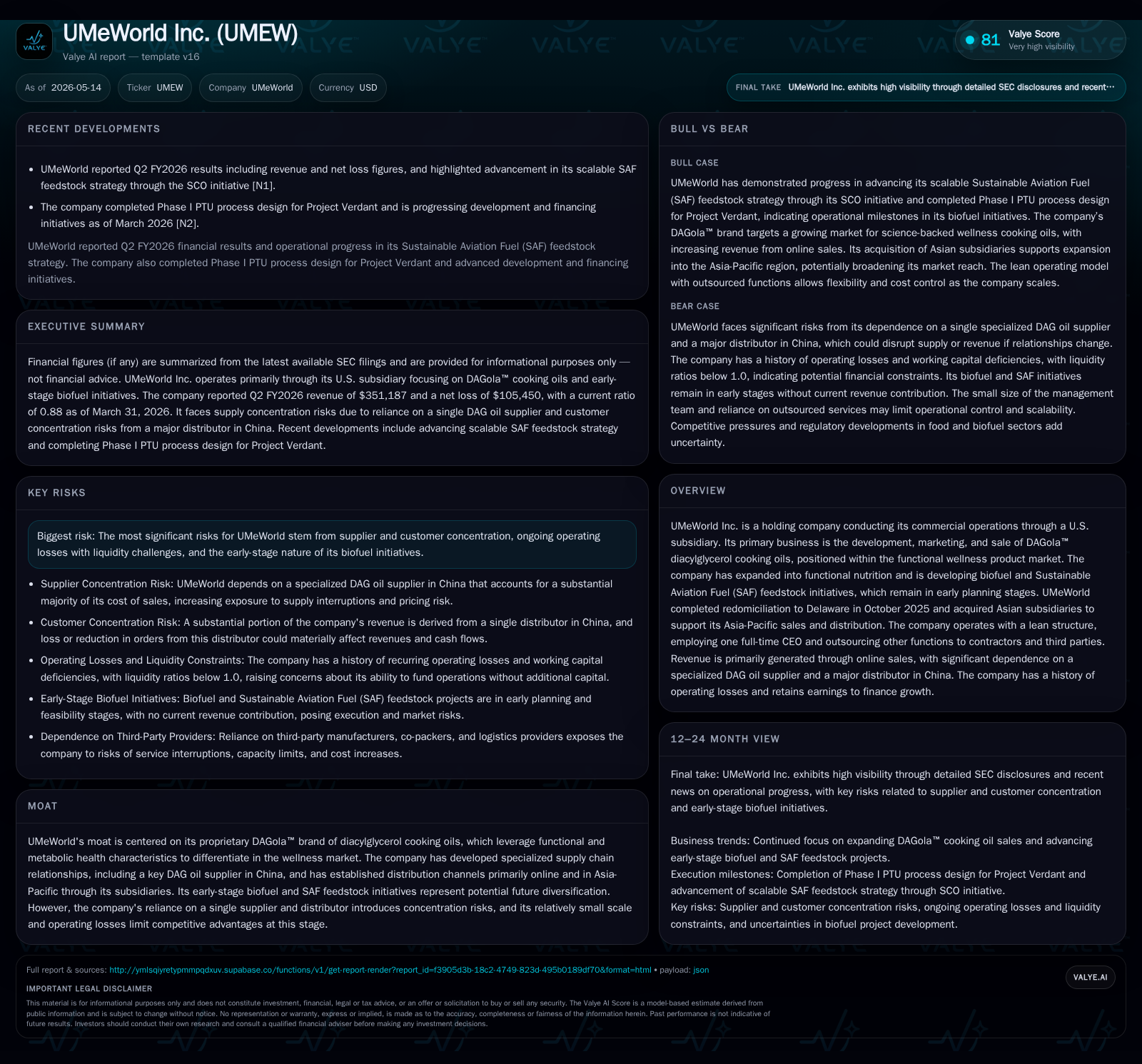
UMeWorld’s latest quarterly report shows a progressive increase in revenue from its proprietary DAGola™ diacylglycerol cooking oil driven by e-commerce expansion and Asia-Pacific distribution footholds. The company simultaneously advances early-stage biofuel and Sustainable Aviation Fuel (SAF) feedstock initiatives, representing potential future growth vectors. However, concentrated supplier and customer relationships pose operational risks, while ongoing operating losses and a working capital deficit underscore liquidity pressures. The redomiciliation to Delaware and acquisition of Asian subsidiaries support strategic realignment but do not materially alter the financial profile yet.
Latest Quarterly Update: Revenue Growth and Operational Highlights
UMeWorld’s Q2 FY2026 filing dated May 14, 2026 [S2] confirms that revenue growth remains concentrated in sales of its DAGola™ diacylglycerol cooking oil products. While absolute revenue remains modest at around $2.2K for full fiscal 2025 [F1], it more than doubled from the prior year’s $941, reflecting successful penetration of online channels primarily targeting health-conscious consumers. This uptick aligns with ongoing brand marketing efforts despite the company's fairly small current scale.
Operationally, the company notes significant supplier concentration risk: one Chinese supplier accounted for most of the costs of goods sold during the quarter ending March 31, 2026 [S14]. This supplier holds crucial technological expertise vital for DAG oil production, limiting alternatives and increasing pricing or availability vulnerability. Similarly, a single China-based distributor generated a substantial portion of revenue in the quarter [S14], underscoring customer dependency that could materially affect future cash flows if disrupted.
Alongside core wellness product sales expansion, UMeWorld has begun advancing early-stage Sustainable Aviation Fuel (SAF) feedstock activities through its SCO initiative [N1]. Although these remain pre-commercial with no recognized revenue yet [S1], management frames this as a strategic diversification to tap into low-carbon fuel markets potentially synergistic with their existing botanical oil expertise.
The company’s statutory continuation from British Virgin Islands to Delaware was completed post-fiscal year on October 2, 2025 [S1], enabling streamlined corporate governance under US law without operational interruption.
UMeWorld’s Business Model and Product Quality in Functional Wellness
UMeWorld monetizes via direct-to-consumer online sales largely concentrated on DAGola™, a branded line of diacylglycerol cooking oils distinguished by their functional metabolic benefits promoting wellness [S1]. These oils are positioned within a niche growing science-backed functional nutrition sector where metabolic health claims drive premium prices versus conventional cooking oils.
Sales depend heavily on consumer adoption through digital marketing funnels, where conversion rates hinge on advertising efficiency, platform algorithms, and fulfillment logistics costs. The company outsources many operational functions beyond its CEO-led leadership structure [S1], which enables cost containment but limits rapid scale-up capabilities and internal control over execution.
Raw materials rely predominantly on one qualified supplier in China holding unique manufacturing processes required for DAG oil production [S14]. This creates input quality dependency risks that could impact product consistency or margins. Packaging, freight import duties, and e-commerce fulfillment fees also markedly influence unit economics due to international supply chain complexity.
The discontinuation of legacy sports supplement lines such as Cellugizer eliminated non-core distractions but incurred an inventory write-off charge impacting reported losses last fiscal year [S1].
Competitive Dynamics and Industry Structural Factors
Within the functional nutrition and specialty cooking oil space, UMeWorld faces limited competition owing partly to specialized production requirements for diacylglycerol oils. However, this scarcity also heightens supplier bargaining power as few qualified vendors exist globally.
Distribution channels are anchored by a major partner controlling substantial volumes in China [S14], which improves regional market access but introduces counterparty concentration risks. The company has bolstered this by acquiring Hong Kong and Mainland Chinese subsidiaries post-redomicile to facilitate Asia-Pacific sales operations [S10].
Despite these moves, UMeWorld remains small relative to broader food or nutraceutical players with deep pockets. This constrains marketing reach scale and elevates fixed cost absorption challenges seen in relatively high SG&A expenses compared to revenues [S1]. The business must cautiously balance investing in market development while managing cash burn.
Regulatory oversight over metabolic health claims on food products adds complexity. Emerging requirements for clear labeling in different jurisdictions impose compliance demands potentially raising operational hurdles as product lines expand.
Growth Drivers: Expanding Consumer Base and Emerging Biofuel Initiatives
Key growth trajectories derive principally from increasing DAGola™ brand awareness and purchase frequency via enhanced digital marketing executions. Evidence from Q2 filings suggests incremental improvements in online customer acquisition supporting top-line momentum [S2].
Supply chain optimization might improve margins over time if raw material procurement diversifies or cost efficiencies unlock through expanded order volumes - currently constrained by reliance on one Chinese supplier [S14]. Efforts around logistical partnerships are essential given the high freight volatility impacting gross profit.
Strategically distinct is UMeWorld’s biofuel development program targeting the scalable cultivation of SCO (single-cell oil) as SAF feedstock [N1]. This nascent initiative leverages proprietary research partnerships aiming for commercial viability within the next several years. Though currently non-revenue generating [S1], success here could open high-growth adjacencies aligned with global decarbonization trends.
Expansion in Asia-Pacific through Dagola Hong Kong Limited and its mainland subsidiary provides an active regional platform expected to support product uptake beyond North America [S10].
Risks and Watchpoints: Supply Chain Concentration, Liquidity, and Market Challenges
Foremost operational vulnerabilities stem from concentrated supplier exposure—one Chinese vendor dominates raw material provision exposing UMeWorld to unforeseen pricing pressure or supply disruptions [S14]. Analogously, dependence on one large distributor for most revenue inflates counterparty risk dramatically should trading terms sour or orders diminish unexpectedly.
Liquidity constraints are indicated by the latest balance sheet showing current liabilities exceeding current assets ($1.74M vs $1.52M), yielding a sub-unity current ratio of 0.88 at quarter end March 31, 2026 [F1]. Cash reserves were approximately $122K as of September 30, 2024 [F1]. Continued operating losses totaling about $258K in the latest fiscal year amplify financing needs imminently per SEC disclosures [S3]. Without timely capital raises or shareholder advances (historically relied upon), sustaining operating activities faces real uncertainty.
Market factors including e-commerce platform fee changes or consumer preference shifts may induce revenue fluctuations given the dependency on digital sales funnels noted previously [S1]. Regulatory developments applicable to functional food claims or future biofuel commercialization represent additional compliance risk layers.
Execution risks abound for biofuel projects still at pilot scale with uncertain timelines or capital intensity requirements which could dilute management focus or strain limited resources further [N1].
Upcoming Milestones and Areas for Investor Monitoring
Important near-term deliverables include securing consistent raw material supplies under favorable terms while possibly exploring alternate sources to mitigate concentration risks stated repeatedly across filings [S2][S14]. Monitoring any contractual developments around the key China distributor is equally critical due to its sizable revenue contribution.
Updates on progress within the SCO-based SAF feedstock initiative will provide clarity on timeline feasibility for commercial-scale adoption or partnerships in sustainable aviation fuel markets [N1]. Advances here could signal tangible diversification benefits reducing dependence on wellness oils alone.
Further expansion metrics within Asia-Pacific operations merit attention as those subsidiaries represent new infrastructure investments poised to accelerate regional growth prospects if effectively leveraged [S10].
Finally, forthcoming quarterly guidance disclosures will offer directional cues regarding revenue trajectory adjustments or margin improvement efficacy amidst variable external cost factors like freight rates or advertising fees [S2].
Financial Snapshot: Recent Performance Metrics and Liquidity Overview
| Metric | Value | Period |
|---|---|---|
| Current assets | $1,521,485 | |
| 2026-03-31 | ||
| Current liabilities | $1,735,745 | |
| 2026-03-31 | ||
| Current ratio | 0.88x | |
| 2026-03-31 |
Source: SEC companyfacts cache [F1].
| Metric | Value (USD) | Period Ended |
|---|---|---|
| Revenue | 2,222 | |
| 2025-09-30 | ||
| Net Loss | (258,176) | |
| 2025-09-30 | ||
| Cash & Equivalents | 121,809 | |
| 2024-09-30 | ||
| Current Assets | 1,521,485 | |
| 2026-03-31 | ||
| Current Liabilities | 1,735,745 | |
| 2026-03-31 | ||
| Current Ratio | 0.88 | |
| 2026-03-31 |
Overall financials corroborate underlying challenges flagged throughout this report: limited operating scale amid active investments stresses liquidity necessitating scrutiny on capital adequacy moving forward.
This analysis is based solely on reported SEC filings up to May 14, 2026 ([S1], [S2]) supplemented with verified financial snapshot data ([F1]) and relevant news disclosures ([N1]). It excludes speculative extrapolation beyond publicly available information respecting company confidentiality protocols. The perspectives herein do not constitute investment advice but rather seek to inform industry-oriented understanding of UMeWorld Inc.’s operational context and prospects as currently disclosed.
Disclaimer: This is research-only, informational analysis and not investment advice. It may include AI-generated interpretation and general industry context. Always verify important details using primary sources.

Comments