
Pulse Biosciences Drives Cardiac Catheter Growth Amid Ongoing R&D Investments
Recent quarterly results highlight Pulse’s focus on clinical progression of cardiac catheter systems and strategic funding moves supporting its bioelectric technology platform.
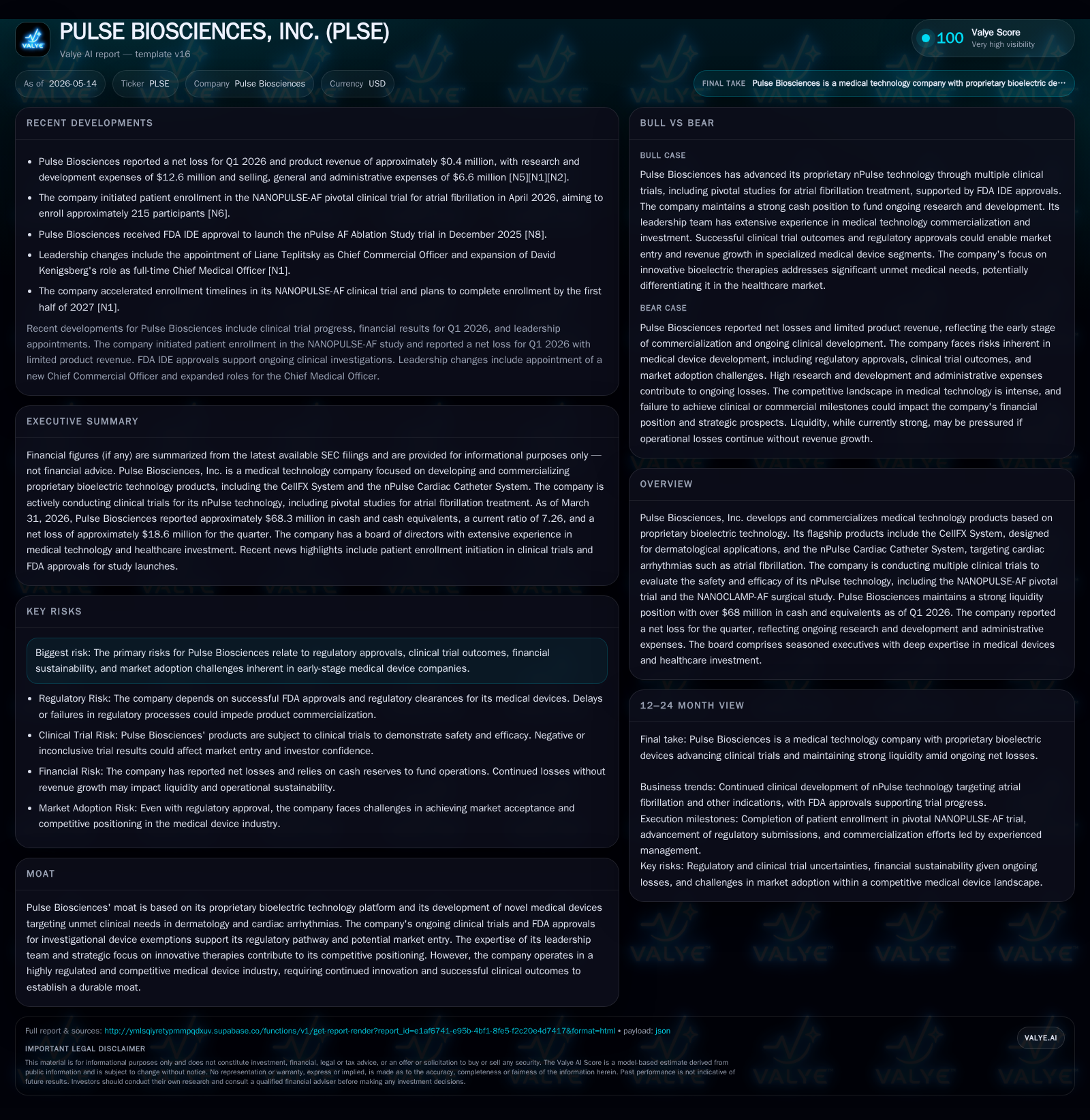
Pulse Biosciences’ latest quarter affirmed ongoing research and development efforts, especially advancing its nPulse Cardiac Catheter System for atrial fibrillation. While commercial revenue remains modest, the company’s regulatory and clinical milestones underpin potential longer-term growth opportunities. Strong liquidity and active equity distributions provide financial flexibility amid the costly clinical trial period. The firm’s business model centers on proprietary bioelectric devices targeting dermatology and electrophysiology markets, with future scale hinging on successful trial outcomes and regulatory approvals.
Recent Operating Update
Pulse Biosciences reported first quarter 2026 financials reflecting continued investment in its proprietary bioelectric technology platforms. Product revenue was approximately $0.4 million for Q1 but was offset by substantial research and development expenses of around $12.6 million and selling/general administrative costs near $6.6 million. This culminated in a net loss of approximately $18.6 million for the quarter ending March 31, 2026 [S2], [S5].
Significantly, Pulse accelerated enrollment in its NANOPULSE-AF pivotal clinical study for the nPulse Cardiac Catheter System aimed at recurrent drug-resistant paroxysmal atrial fibrillation (AFib). The study plans to enroll about 215 patients across multiple sites with primary endpoints evaluated at 6 and 12 months post-ablation for safety and efficacy metrics [S25], [N8].
To maintain operational financing flexibility, the Board approved resolutions permitting TD Securities (USA) LLC to sell shares via an equity distribution agreement directly to company affiliates without discounting from the prevailing market price. Majority shareholders including Co-Chairman Robert Duggan expressed likely participation in near-term share purchases at market or better pricing, indicating internal confidence in the business outlook [S3], [S24].
Business Model Analysis
Pulse Biosciences generates revenue primarily through sales of medical devices based on its patented nano-pulse bioelectric technology platform. The core products include the CellFX System—targeting soft tissue dermatological applications—and the longer-term strategic initiative around cardiac arrhythmia intervention via the nPulse Cardiac Catheter System.
Sales currently remain small-scale as the company is in early commercial phases while focusing heavily on clinical validation under investigational device exemptions granted by FDA procedures. Revenue generation depends on penetrating physician practices with capital equipment sales followed by recurring consumables/procedural usage fees commonly observed in medical device business models.
The high fixed costs are driven mainly by R&D for device refinement, regulatory filings, and clinical trial execution critical to market authorization. Administrative costs reflect corporate governance and ongoing business infrastructure needed to manage complex product development cycles typical in medtech innovation sectors.
Innovation-wise, Pulse’s nano-pulse technology disrupts traditional thermal ablation methods by delivering ultra-short electrical pulses causing targeted cell death without collateral tissue damage. This positions their offerings as potentially safer alternatives for dermatology lesions and AFib ablations—conditions with arguably unmet procedural effectiveness or safety profiles currently dominated by older RF or cryoablation systems.
Industry Structure and Competitive Position
The medical device space addressing cardiac arrhythmias is intensely competitive with stalwarts like Medtronic, Boston Scientific, and Abbott leading catheter-based ablation technologies with extensive installed bases globally. Even though Pulse's nano-pulse tech offers a differentiated approach with theoretical advantages in precision and reduced side effects, entrenched players benefit from established clinician relationships, reimbursement coverage, and broad deployment.
Similarly, dermatological tissue ablation is crowded but less heavily capital-centric compared to cardiac applications; Pulse's CellFX system has carved a niche offering minimally invasive treatment options for skin lesions leveraging non-thermal bioelectric mechanisms.
Regulatory pathways also impose structural barriers given stringent FDA approval processes particularly for life-critical cardiac interventions. Pulse's ongoing pivotal trials represent both an inflection point and risk factor since regulatory clearance will be a major determinant of commercial scalability.
Growth Drivers
The foremost growth driver is progress through key clinical trials—namely the NANOPULSE-AF pivotal study designed to substantiate the device’s procedural success rates and safety profile relative to conventional therapies. Accelerated patient enrollment timelines announced recently underscore management focus on meeting protocol-defined milestones expeditiously [S25], [N10].
Expanding site participation beyond US borders in follow-up NANOCLAMP-AF surgical studies broadens geographic footprint potential alongside diversified clinical indications that may enhance total addressable markets.
Technological advancement efforts highlighted in investor presentations include next-generation catheter versions promising improved usability or enhanced electrophysiological performance attributes. Successful demonstration of these improvements could support differentiated physician adoption incentives amid competitive headwinds [S22].
Additional drivers include expansion of sales/clinical teams upon regulatory progress to accelerate commercialization phases outside early adopter centers coupled with securing insurance reimbursement codes critical for procedural uptake.
Risks / Watchpoints / Growth Constraints
Pulse faces several intrinsic risks typical of early-stage medical device developers:
- Regulatory Outcomes: FDA clearance hinges on meeting rigorous efficacy/safety endpoints in pivotal trials; negative or delayed results would significantly dent commercialization prospects.
- Clinical Trial Execution: Patient recruitment pace or unforeseen adverse events could extend timelines or necessitate additional costly studies impacting cash flow and valuation.
- Competitive Intensity: Entrenched incumbents benefit from vast resources; successful penetration will require demonstrating clear superiority or cost-effectiveness.
- Financial Sustainability: Current burn rates exceeding $18 million quarterly necessitate access to capital markets or profitable operations which remain distant targets [F1].
- Market Adoption: Physician behavior shifts toward new treatment modalities can be slow especially absent reimbursement certainty or widespread guideline endorsements.
Monitoring enrollment velocity updates from NANOPULSE-AF study and any interim safety data disclosures will be crucial barometers of execution discipline.
What to Watch Next
Investors and stakeholders should track several milestones:
- Completion of NANOPULSE-AF trial enrollment expected by mid-2027 with primary endpoint assessments scheduled at six and twelve months thereafter signaling when data readouts may occur [S25].
- Regulatory submissions timing following top-line study results informing potential approval windows.
- Progress on NANOCLAMP-AF surgical catheter trial expanding clinical indications outside percutaneous procedures.
- Equity distribution activities under existing agreements possibly influencing share liquidity or insider ownership concentration dynamics [S3], [S24].
- Pipeline enhancements including next generation catheters launched or disclosed via investor communications adding qualitative value signals beyond financial metrics.
Financial Profile Summary
Latest financial snapshot
| Metric | Value | Period |
|---|---|---|
| Cash & equivalents | $68mm | |
| 2026-03-31 | ||
| Current assets | $71mm | |
| 2026-03-31 | ||
| Current liabilities | $10mm | |
| 2026-03-31 | ||
| Current ratio | 7.26x | |
| 2026-03-31 |
Source: SEC companyfacts cache [F1].
As of March 31, 2026, Pulse held cash and equivalents totaling approximately $68.3 million against negligible debt levels implying a strong liquidity position to fund ongoing R&D efforts amid significant operating losses ($18.6 million net loss reported for Q1) [F1], [S2].
Disclaimer: This is research-only, informational analysis and not investment advice. It may include AI-generated interpretation and general industry context. Always verify important details using primary sources.

Comments