
Urban One's Strategy Faces Revenue Pressures and Debt Burdens Amid Media Market Shifts
Q1 2026 results highlight ongoing losses and leverage challenges despite targeted acquisitions and multi-platform growth efforts.
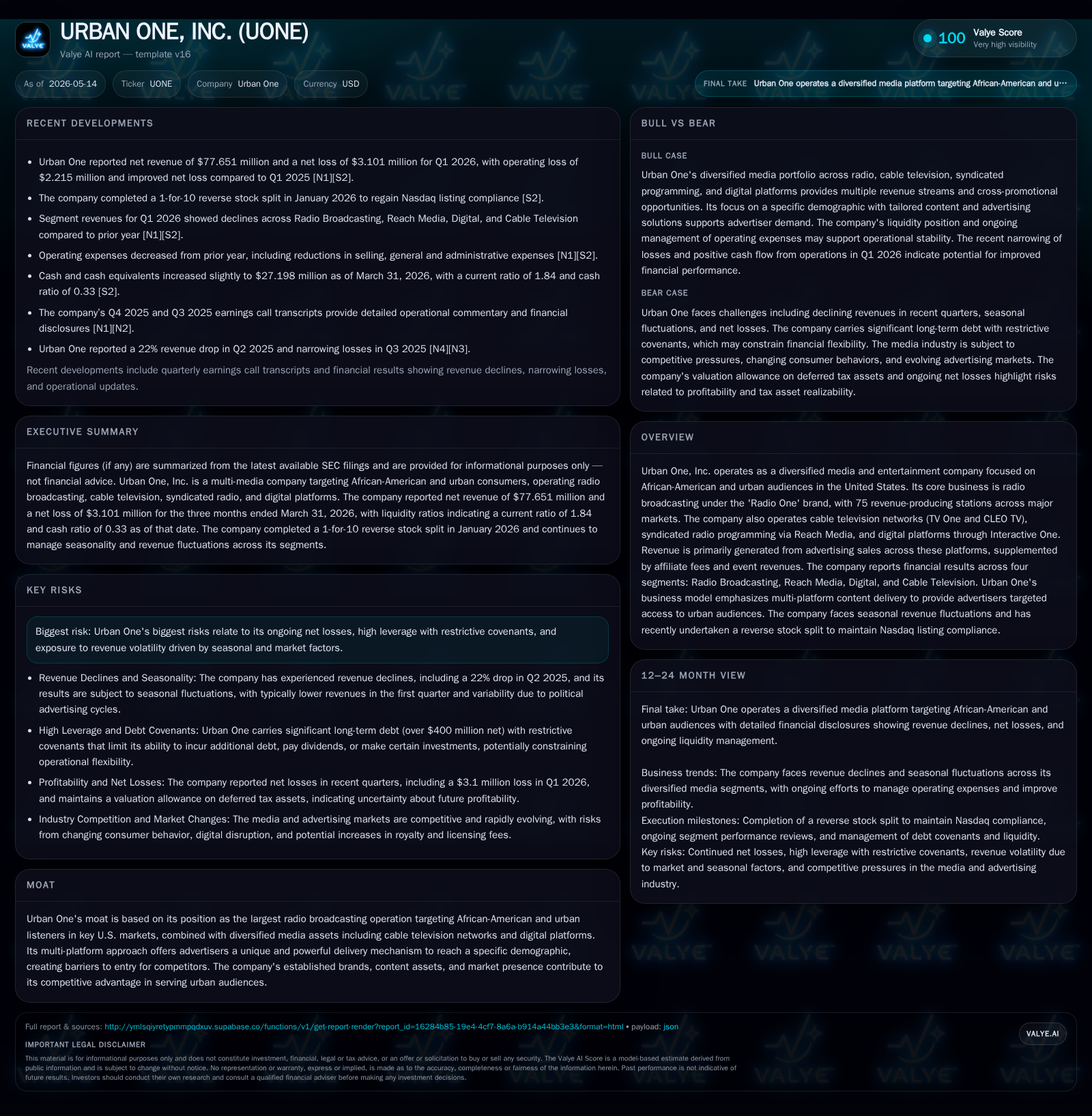
Urban One, Inc. reported a Q1 2026 net loss of $3.1 million, narrowing from a larger loss in the prior year quarter, driven by lower revenue amid core radio advertising declines. The company is actively reshaping its media footprint with strategic acquisitions and divestitures to bolster its position as the leading multi-platform urban and African-American media brand. However, persistent high leverage and seasonal advertising volatility constrain near-term financial flexibility. Urban One's diverse assets in radio, cable TV, syndicated programming, and digital platforms provide a moat through targeted audience delivery, yet sustaining revenue growth depends on navigating advertising demand shifts and FCC regulatory risks.
Recent Operating Update: Q1 2026 Results
Urban One's first-quarter 2026 filing [S2] revealed a net loss of $3.1 million, an improvement compared to the $11.7 million loss in the year-ago period. Net revenue declined to $77.7 million from $92.2 million, marking a significant top-line contraction driven by weaker advertising demand across its core platforms. Operating expenses declined moderately but rising depreciation and amortization reflect increased investments in content assets and other capitalized costs.
The company reported selling, general & administrative expenses reduced from $50.8 million to $43.7 million year-over-year but faced increased depreciation costs of $6.2 million versus $2.3 million previously. Interest expense was halved owing partly to debt refinancing gains recognized during the quarter.
Management highlighted that core radio pacings for Q1 were down approximately 5.4%, underscoring continuing pressures in its foundational broadcast advertising segment [S4]. Despite these headwinds, Urban One is pursuing portfolio adjustments; notably it entered agreements in early May 2026 to acquire two Dallas radio stations (KKDA and KRNB) while selling another local station (KZMJ), aiming at extracting value via market repositioning subject to FCC approvals [S3].
Business Model Overview
Urban One operates as an urban-focused multimedia platform with deep roots in radio broadcasting under the "Radio One" brand—the largest such network targeting African-American audiences in key U.S. markets [S1]. With ownership or operation of 76 broadcast stations across major urban regions, its base revenue stream is local and national advertising sold against these highly segmented urban listeners.
Complementing this are cable television channels—including TV One and CLEO TV—that address African-American viewers through tailored entertainment and informational content [S1]. Reach Media syndicates popular African-American-oriented programming such as the Rickey Smiley Morning Show nationally across other broadcasters.
The wholly owned Interactive One digital platform extends reach into social content and news websites including iONE Digital and Bossip catering specifically to urban audiences.
Revenue generation is predominantly advertising-driven across all segments; however, affiliate fees from cable carriage agreements and event revenues also supplement income streams [S1]. This multi-platform design allows bundled offerings for advertisers seeking cohesive access to a concentrated demographic segment with high cultural affinity—a strategic advantage difficult for competitors lacking scale or audience alignment.
Industry Structure and Competitive Position
Urban One occupies a specialized niche within U.S. media focused on African-American and urban consumers—a demographic underserved by mainstream networks yet highly attractive for advertisers targeting diversity-conscious marketing strategies.
The company’s scale in radio broadcasting—75+ revenue-producing stations—and complementary cable TV assets form a moat bolstered by well-known brands like "Radio One" and "TV One" [S1]. As digital consumption trends shift media usage habits, Urban One’s investment in diversified digital platforms positions it favorably against pure traditional competitors.
However, the multimedia space is intensely competitive with pressure from national television networks expanding diversity initiatives plus digital pure plays capturing mobile-first audiences. Urban One’s ability to maintain customer loyalty through exclusive content and regional top-of-mind presence is central to defending its market share.
Regulatory oversight adds complexity; FCC rules govern ownership limits, licensing renewals, and operational standards particularly relevant for concentrated urban station clusters [S1]. Potential policy shifts could constrain acquisition appetites or increase compliance costs.
Growth Drivers
- Strategic Acquisitions: The recent deal to acquire two Dallas radio assets aims at augmenting presence within a large urban market with strong advertiser appeal [S3]. Portfolio optimization through selective disposals allows sharper focus on high-return assets.
- Multi-Platform Bundling: Offering advertisers integrated access across radio, television, syndication, and digital channels enhances value propositions vs single-medium sellers [S1].
- Digital Expansion: Growing Interactive One platforms capitalize on shifting consumership toward online social content targeting African-American youth demographics.
- Event Revenues: Supplementary event-driven income streams diversify reliance on volatile advertising cycles.
- Political Advertising Uplift Potential: Election cycles can temporarily bolster ad revenues relevant to Urban One's demographic focus [S4].
Risks and Growth Constraints
- Advertising Revenue Volatility: Urban One faces cyclical downturns linked to broader economic conditions impacting advertiser budgets; Q1 pacings declined notably (-5.4%) indicating sensitivity [S4].
- High Leverage: Total long-term debt stood near $327 million as of March-end with net debt exceeding $299 million after cash offsets [F1]; interest costs weigh on cash flows limiting reinvestment capacity.
- NASDAQ Listing Compliance: The company recently undertook a reverse stock split to meet minimum bid price standards impinging future flexibility [S1], risking delisting consequences impacting share liquidity.
- Regulatory Risks: FCC licensing rules evolve unpredictably posing threats to ownership consolidation strategy or operational practices [S1].
- Internal Control Issues: Past material weaknesses in financial reporting controls could impede timely accurate disclosures affecting investor confidence [S1].
- Audience Fragmentation: Changing media consumption habits challenge incumbent broadcast-centric models.
What To Watch Next
Stakeholders should monitor:
- FCC approvals for Dallas station transactions that may reshape Urban One’s regional footprint [S3].
- Advertising pacings updates beyond Q1 trends indicating stabilization or further declines [S4].
- Debt reduction progress given active buybacks reported for various notes at favorable discounts [S16][S17].
- Any updated corporate guidance or strategic announcements regarding capital allocation priorities amid persistent operating headwinds.
- Regulatory developments impacting license renewals or acquisition capabilities.
Financial Profile Snapshot
Latest financial snapshot
The balance sheet reflects substantial leverage relative to liquidity though a modestly healthy current ratio suggests sufficient near-term working capital coverage [F1]. The company continues disciplined capital management with active debt repurchase programs reducing high-interest obligations while adapting operating costs amidst shifting revenue patterns [S20][S16][S17].
Disclaimer: This analysis is intended for informational purposes only and does not constitute investment advice or recommendations regarding Urban One, Inc.'s securities or prospects.
Disclaimer: This is research-only, informational analysis and not investment advice. It may include AI-generated interpretation and general industry context. Always verify important details using primary sources.

Comments