
Resideo Technologies Posts Strong Q1 Results Ahead of ADI Spin-Off
Resideo’s robust Q1 2026 performance and strategic ADI segment spin-off set the stage for its refocused growth in smart home sensing and control markets.
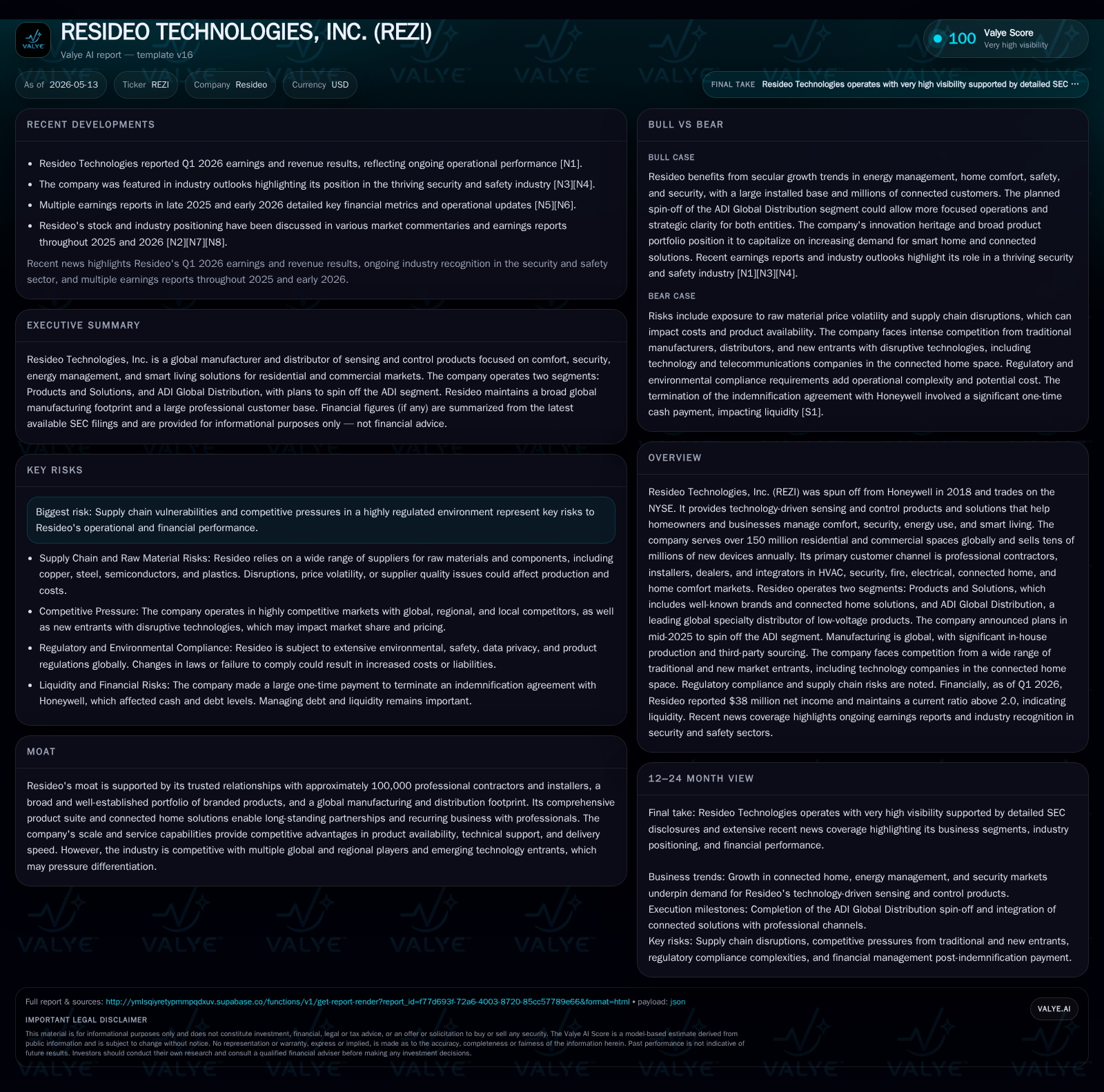
Resideo Technologies reported stronger-than-expected revenue and profitability in Q1 2026, reinforcing confidence ahead of the planned tax-free spin-off of its ADI Global Distribution segment. The company’s core Products and Solutions business leverages a broad portfolio of connected home technologies sold predominantly through a loyal base of professional contractors, establishing a durable competitive moat. Growth is supported by secular trends in energy management, smart living, and security, though risks from supply chain volatility and regulatory environments persist. Investors and industry watchers should focus on post-spin-off financial disclosures, margin trajectories, and customer engagement metrics as key near-term milestones.
Q1 2026 Operating Update: Earnings Beat and Strategic Developments
Resideo Technologies’ first quarter 2026 results announced in the May 12 filing [S2], [S3], alongside market reports [N1], revealed notable beats on both revenue and earnings metrics. This performance provides an encouraging operational backdrop as the company prepares to execute the announced tax-free spin-off of its ADI Global Distribution segment within the year. The filings confirm that the ADI spin-off remains on track with expected completion by mid- to late-2026 [S2]. This corporate reorganization aims to create two separately listed entities — one focused exclusively on Resideo’s Products and Solutions business concentrated on smart home sensing/control technologies, and the other an independent global distributor specializing in low-voltage products.
The Q1 results underscore Resideo’s ability to sustain strong demand across its core offering despite macroeconomic uncertainties. Management commentary suggests ongoing investments in product innovation and enhanced contractor-facing services contribute to both top-line growth and margin leverage. Operational commentary also hints at streamlined focus post-spin-off as Resources are reallocated toward digital platform maturation within Products & Solutions [S2].
Overview of Resideo’s Business Model and Product Ecosystem
Resideo operates through two main segments: Products and Solutions, which houses its proprietary sensing/control products spanning residential HVAC controls, smoke/CO detectors, water/air quality solutions, bi-directional security devices, video surveillance equipment, cloud software services, installation tools, and related smart home ergonomics; alongside ADI Global Distribution — a premier specialty distributor serving telecommunications, security integrators, electrical contractors globally [S1], [S20].
Its business model centers on trusted B2B relationships with roughly 100,000 professional contractors/installers/dealers who drive adoption in HVAC, fire & security markets — these professional channels account for nearly all new device placements annually. This embedded contractor network creates significant switching costs while promoting recurring sales through retrofit upgrades or system expansions. Brands such as Honeywell Home (legacy Honeywell heritage), First Alert (smoke alarms), BRK Safety Systems (fire detection), Braukmann (water products), among others enhance brand loyalty.
Revenue mechanics depend primarily on volume of units sold to these professional installers combined with some recurring income from software subscriptions related to cloud-based connected home solutions [S1]. The proprietary nature of many products plus ongoing service contracts underpin stable margins relative to commoditized hardware suppliers.
Further competitive moat derives from Resideo’s vertically integrated global manufacturing footprint complemented by efficient logistics enabling dependable product availability — a critical factor for contractors who value speed and reliability for installations.
Competitive Environment and Industry Structure Dynamics
The smart home sensing & controls industry that Resideo serves is characterized by intense competition across multiple product categories. Key competitors include traditional industrial players with broad building controls expertise as well as emerging technology entrants deploying disruptive direct-to-consumer models or alternative channel strategies. Cable providers and telecom firms have increasingly ventured into connected home ecosystems offering bundled services [S1], [S28].
Resideo’s competitive advantages stem largely from:
- Scale leadership enabling extensive inventory stocking and rapid delivery,
- Deep-rooted trusted relationships with sizable contractor/installers base,
- Comprehensive technical support infrastructure,
- Well-regarded brands for safety/security products.
Nevertheless, pricing pressures persist in certain commodity-driven product lines while new entrants challenge differentiation through software integrations or user experience innovation.
Moreover, industry-wide regulatory scrutiny around product safety standards (especially fire/smoke detection) adds complexity to development cycles influencing time-to-market [S12]. Margins can be sensitive to compliance costs.
Growth Drivers: Professional Contractor Relationships and Product Innovation
Several secular tailwinds underpin Resideo's growth outlook:
- Rising consumer awareness about energy efficiency stimulates demand for advanced HVAC control systems capable of granular temperature/humidity/air quality management.
- Growing retrofit market opportunities as homeowners upgrade legacy mechanical thermostats with connected digital devices incorporating IoT capabilities.
- Expansion of safety/security systems installation tied to multi-family housing renovations.
- Increasing integration of AI/cloud-enabled software platforms enhancing user engagement with real-time alerts and remote management features.
The loyal professional channel drives recurring aftermarket sales as contractors regularly update existing customers’ systems or recommend newer products during maintenance calls. Software initiatives introduced over recent years are beginning to enhance customer stickiness by adding cloud subscription revenue potential beyond one-time hardware purchases [N3], [S2]. Snap One acquisition has further expanded Resideo’s reach into complementary smart living convenience offerings aligned with evolving consumer preferences.
Risks and Constraints: Supply Chain, Regulatory, and Competitive Pressures
A key risk remains elevated commodity price volatility impacting raw materials like copper, steel, aluminum as well as components such as semiconductors critical for IoT device manufacturing [S1], [S12]. While contract terms often allow some cost pass-through to customers, partial absorption has been noted potentially compressing margins.
Supply chain disruptions remain an operational watchpoint given global geopolitical tensions affecting logistics timelines. Given the high volume throughput (~tens of millions units per year), even minor interruptions could impact fulfillment reliability.
Regulatory compliance is another challenge—products must meet stringent safety certifications especially regarding fire/smoke/carbon monoxide detection functionalities with evolving standards prompting continuous R&D investments.
Competitive landscape threats include:
- Technology companies leveraging direct-to-home models bypassing professional installer channels,
- Cable/telecom firms bundling solutions,
- Smaller niche entrants innovating rapidly in connected lifestyle apps.
Legal contingencies exist but are not currently deemed materially impactful according to filings [S12].
Upcoming Catalysts: Monitoring Post-Spin-Off Performance and Market Signals
The completion timeline for the ADI spin-off remains a key near-term milestone expected mid-to-late 2026; subsequent financial reporting will provide clearer visibility into standalone profitability dynamics for both entities [S2],[S3]. Investors should monitor:
- Margins trajectory in the standalone Products & Solutions business,
- Bookings/backlog changes reflecting contractor activity levels,
- Customer retention rates amid increasing software-driven recurring revenues,
- Capital allocation shifts including share repurchase programs or acquisition strategies post-spin-off.
Enhancement of cloud/software platforms remains a growth KPI to track given its potential impact on longer-term economics.
Financial Snapshot: Balance Sheet Strength and Liquidity Position
Latest financial snapshot
| Metric | Value | Period |
|---|---|---|
| Cash & equivalents | $438mm | |
| 2026-04-04 | ||
| Total debt | $3.23bn | |
| 2026-04-04 | ||
| Net debt | $2.79bn | |
| 2026-04-04 | ||
| Current assets | $3.17bn | |
| 2026-04-04 | ||
| Current liabilities | $1.53bn | |
| 2026-04-04 | ||
| Current ratio | 2.07x | |
| 2026-04-04 |
Source: SEC companyfacts cache [F1].
As of early April 2026 ([F1]), Resideo maintains liquidity supportive of ongoing operational investments. Focus will be on deleveraging cadence following structural shifts post-spin-off.
Disclaimer: This is research-only, informational analysis and not investment advice. It may include AI-generated interpretation and general industry context. Always verify important details using primary sources.

Comments