
FB Bancorp Advances Portfolio Optimization Post-Asset Sale
The company streamlines operations after divesting its NOLA mortgage assets, rededicating focus on core regional banking.
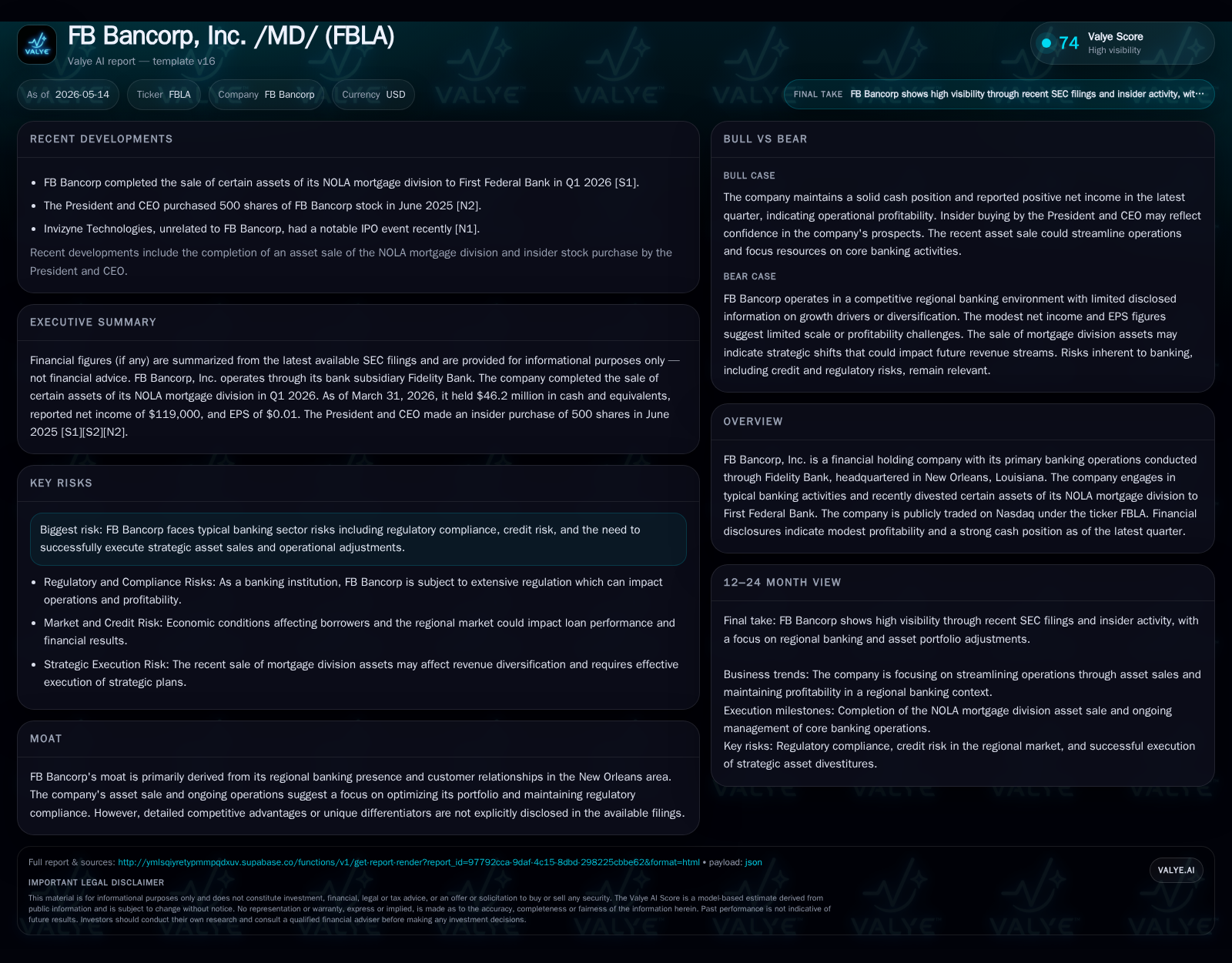
FB Bancorp, through its subsidiary Fidelity Bank, concluded the sale of the NOLA mortgage division assets to First Federal Bank in early 2026, as conveyed in its latest 10-Q filing. This transaction marks a strategic shift emphasizing operational efficiency and core banking services in the New Orleans market. The company maintains modest profitability and a solid cash base as it navigates typical regulatory and credit risks inherent to regional banks.
Latest Quarterly Update Drives Strategic Refocus
FB Bancorp's May 14, 2026, 10-Q filing establishes a pivotal moment in its operational narrative with the official closure of the asset sale for its NOLA mortgage division to First Federal Bank, completed on March 1, 2026 [S2][S15]. This divestiture follows an Asset Purchase Agreement announced late December 2025 with closing anticipated for Q1 2026 and consummated early March [S14][S15]. By shedding non-core mortgage assets from this division, FB Bancorp has effectively sharpened its strategic focus toward its primary regional banking operation under Fidelity Bank in New Orleans.
This structural shift aligns with management’s intent to optimize their balance sheet composition and business concentration. The latest quarterly disclosures emphasize modest profitability levels consistent with past performance and reveal no material changes in risk factors relative to the prior annual reports [S2]. Notably, the company reported maintaining a strong liquidity position with $46.2 million in cash and equivalents as of March 31, 2026 [F1], affording operational flexibility amid transition.
Importantly, quarterly commentary reflects continuity in legal or regulatory contingencies without new material litigation or compliance costs emerging post-transaction [S2], reinforcing that execution of this sale was smooth and accretive to strategic objectives. Additionally, a recent board chair realignment agreement underlines the company's governance evolution alongside operational refocus [S27][S29].
Business Model: Regional Banking with Emphasis on Customer Relationships
FB Bancorp’s business model revolves principally around Fidelity Bank’s dual role as a community bank serving individuals and small-to-medium enterprises primarily in the New Orleans metropolitan area [S1]. Revenue generation is concentrated within net interest income derived from lending activities—commercial, consumer, and residential loans—and supplemented by fee income from deposit services.
The sale of NOLA mortgage division assets reflects a deliberate retreat from potentially more volatile or scale-sensitive mortgage origination segments back to entrenched banking activities where relationship depth and local knowledge yield more stable returns [S1][S3]. The company's lending portfolio benefits from longstanding customer ties and personalized service models favoring retention.
Fee-based deposit products bolster margins while also creating valuable cross-selling platforms for ancillary financial services. The localized nature of FB Bancorp’s footprint imparts an informal moat through regulatory familiarity and customer loyalty though lacks significant technological or scale-based differentiation compared to national banks. The portfolio restructuring via asset sales thus aims to concentrate capital resource allocation where established competitive positioning exists.
Industry Structure and FB Bancorp’s Competitive Positioning
Operating within the regional banking sector centered on Louisiana presents a mixed landscape of opportunity and challenge. Competition includes other community banks with similarly localized strategies but also larger institutions leveraging technology scale advantages. Regulatory frameworks impose rigorous compliance burden disproportionately affecting smaller banks given fixed overheads tied to capital adequacy, stress testing, and consumer protection mandates [S4][S7].
FB Bancorp does not disclose unique proprietary advantages but leverages customer relationships nurtured over decades in New Orleans. Pricing power remains constrained by market competition though mitigated somewhat by personal service reputations. Credit risk remains geographically concentrated which can elevate portfolio volatility during economic downturns affecting local sectors such as energy or hospitality.
Thus, FB Bancorp's competitive stance depends heavily on maintaining strong community ties while prudently managing operational costs amidst sectorwide regulatory pressures. The recent strategic divestiture appears tailored to reduce exposure where scale disadvantages are pronounced.
Growth Drivers: Optimizing Core Operations and Market Penetration
Looking ahead, FB Bancorp’s growth vectors appear anchored in incremental expansion within existing markets supported by enhanced operational efficiency post-divestiture [S2][S3]. The rationalization of the balance sheet should improve capital deployment effectiveness enabling greater focus on expanding lending volumes within commercial and consumer segments served by Fidelity Bank.
Cross-selling opportunities across depositors also present avenues for fee income growth while digitization efforts—though not specifically detailed—would logically aim at improving client acquisition costs relative to larger digital-first competitors.
While broad economic prospects for regional banks carry cyclical elements linked to interest rate trends and loan demand cycles, FB Bancorp’s growth trajectory appears structurally oriented towards solidifying its core franchise before considering outside expansion or acquisitions.
Risks and Constraints: Regulatory, Credit, and Execution Challenges
FB Bancorp faces conventional risks typical of mid-sized regional banks including rigorous regulatory compliance requirements that may increase systemic cost structures [S4][S7]. Credit risk concentrations related to local market economic conditions require vigilant portfolio monitoring especially given New Orleans' exposure to cyclical industries.
Execution risk arises from transitioning post-mortgage asset divestitures which could distract management resources or impact revenue stability if client migration is not well managed. Management's explicit statement that no material new risks have appeared since year-end reinforces confidence in steady-state risk profiles but naturally mandates continued surveillance [S2].
Governance transitions via phased board chair role adjustments add another layer requiring close observation as leadership continuity is critical during such strategic shifts [S27][S29]. Capital deployment discipline is currently evidenced through controlled share repurchase activity indicating balanced shareholder return prioritization against internal investment needs [S8][S22].
Key Developments to Monitor Next
Investors and analysts should watch for forward guidance updates in upcoming quarterly releases which will elucidate how management intends to capitalize on streamlined operations for growth acceleration [S2][S3]. Key metrics will include loan volume growth rates, deposit inflows, net interest margin trends, and efficiency improvements.
Additionally, further commentary on any changes in regulatory capital buffers or advances in digital banking capabilities could provide insight into long-term competitive evolution. Shareholder return program updates including any alterations to repurchase authorizations would reflect corporate confidence levels in cash flow generation capacity.
Monitoring leadership communications about integration follow-through post-asset sale will be informative regarding execution discipline during this transition window. Lastly, potential announcements regarding geographic or product scope expansions would mark a significant strategic pivot warranting close attention.
Financial Profile Snapshot (Supplementary)
As of March 31, 2026, FB Bancorp held $46.2 million in cash and equivalents [F1], underscoring robust liquidity supporting ongoing operations and strategic investments. The latest reported quarter reinforces modest profitability consistent with stable but unspectacular returns aligned with regional bank characteristics [S13].
Overall balance sheet health appears sound with no disclosed material leverage concerns or debt refinancing pressures reported in recent SEC filings [S2][F1]. Capital deployment remains measured balancing internal needs against controlled share repurchases initiated earlier in 2026 [S8][S22]. This prudent financial stance complements the company’s current strategic emphasis on portfolio optimization over aggressive growth gambits.
This analysis synthesizes publicly filed disclosures without offering investment advice. It aims solely to inform understanding of FB Bancorp’s recent developments within industry context grounded in verified data sources. All referenced documents are SEC filings available through official repositories.
Disclaimer: This is research-only, informational analysis and not investment advice. It may include AI-generated interpretation and general industry context. Always verify important details using primary sources.

Comments