
Aimco Accelerates Asset Dispositions and Capital Return in Execution of Liquidation Plan
Aimco advances the wind-down of its multifamily real estate portfolio through active asset sales, sustained lease-up efforts, and capital return initiatives following stockholder approval of its liquidation strategy.
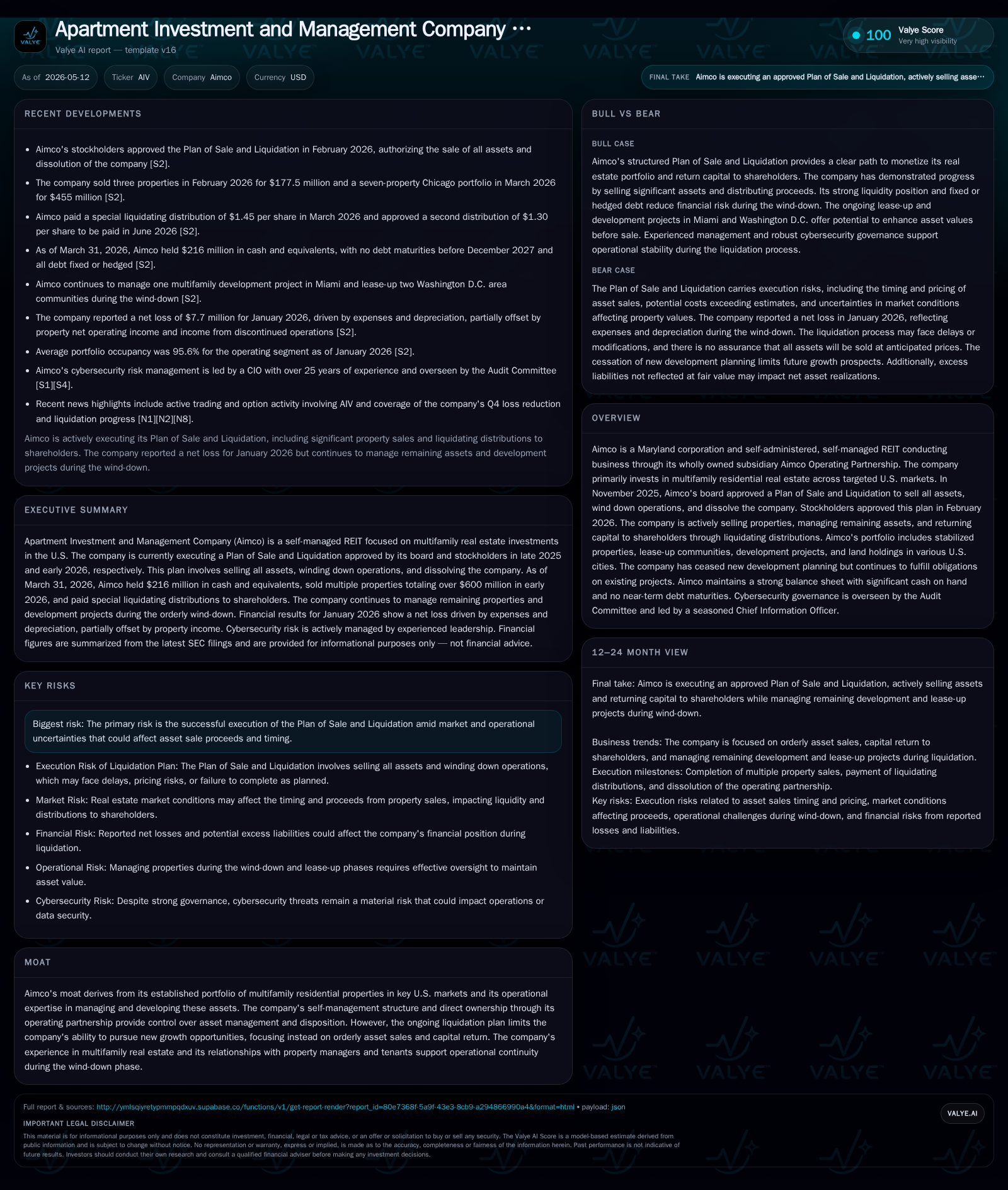
In its latest 10-Q filing dated May 11, 2026, Apartment Investment & Management Co (Aimco) reported continued progress executing its Plan of Sale and Liquidation approved by shareholders in February 2026. The company is actively selling properties under contract, maintaining liquidity adequacy, and fulfilling obligations for remaining development and lease-up projects while winding down operations. Aimco’s business model has shifted from growth-oriented multifamily asset management to value realization and orderly dissolution. The competitive moat stems from its established portfolio and operational expertise; however, execution risks around timing and proceeds of asset sales dominate near-term prospects. Key near-term milestones include closing pending sales contracts, lease-up stabilization targets in Miami and Washington D.C., ongoing capital distributions to shareholders, and anticipated dissolution filings.
Latest Quarterly Update Confirms Progress on Liquidation Strategy
Apartment Investment & Management Co (Aimco) disclosed in its May 11, 2026 Form 10-Q [S2] that it is actively advancing the execution of its previously approved Plan of Sale and Liquidation. Following stockholder approval in February 2026 [S1], the company began winding down its operations by selling its multifamily real estate assets. As of March 31, 2026, Aimco reported multiple property sale agreements under contract valued at approximately $680 million gross [S7]. This includes large portfolio deals such as a Chicago seven-property package agreed upon in December 2025 [S24] and other sales announced in early 2026 [S3].
The Aimco Operating Partnership — through which all assets are owned and operated [S1] — was dissolved in March per the partnership agreement, marking an essential legal step in the liquidation process [S2], [S3]. Despite ceasing new development planning [S7], Aimco continues to fulfill remaining contractual obligations including ongoing development projects and lease-ups [S2]. Notably, there are no substantive debt maturities until late 2027 after considering extension options [S5].
Overall, the quarterly report confirms Aimco’s transition from an acquisition-growth REIT to a managed wind-down vehicle focused on disciplined asset monetization and capital return.
Aimco’s Business Model: Multifamily Real Estate Management to Strategic Sell-Off
Historically Aimco operated as a self-managed REIT specializing in multifamily residential real estate primarily across targeted U.S. markets [S1]. Ownership through its wholly owned subsidiary Aimco Operating Partnership allowed direct managerial control over portfolio operations spanning stabilized properties, lease-ups, development projects, and land holdings. This structure enabled operational efficiencies through aligned incentives between Aimco corporate and underlying entities.
However, the November 2025 board-approved Plan of Sale and Liquidation marked a fundamental shift away from growth or active development ambition towards full portfolio disposition and corporate dissolution [S1], [S2]. New development initiatives have been halted [S7], with investments focused only on completing the existing ultra-luxury Miami tower under construction—34th Street—and finishing leasing efforts on two Washington D.C.-area communities recently completed but still in lease-up stages [S7].
This phased approach reflects an explicit trade-off: foregoing future growth for capital return maximization within a defined liquidation horizon. The Plan authorizes broad transactional flexibility without further shareholder approvals as long as actions align with wind-down objectives [S1].
Competitive Positioning Within the Multifamily REIT Landscape During Wind-Down
Aimco’s established multifamily portfolio in primary U.S. markets combined with self-administration confers an operational moat grounded in asset quality control, tenant relationships, and management expertise. While this historically supported competitive positioning against other REITs with externally managed structures or fragmented portfolios, the current liquidation focus recalibrates this dynamic.
With the portfolio fully exposed to asset disposition pressures rather than acquisitive growth or refinancing flexibility typical of peer multifamily REITs, Aimco faces execution risk related to market absorption volumes and pricing amidst broader real estate cycles. Regulatory considerations around dissolution filings introduce additional timing uncertainty.
The company mitigates risk through fixed-rate non-recourse property-level financing averaging a low-to-mid-4% interest cost and hedging via interest rate caps where appropriate [S5]. The healthy cash balance enhances operational resilience even if transaction timing varies. Furthermore, stable tenant demand fundamentals underpin near-term rent collections sustaining lease-ups despite management’s cessation of growth-oriented initiatives.
Capital markets appetite for bulk multifamily portfolios remains critical to ongoing disposition pace given size and geographic diversity. Aimco’s decades-long relationships provide some advantage in navigating these complex transactions at scale.
Growth Drivers and Value Maximization in Remaining Development and Lease-Up Assets
Though broader growth strategies have been shelved under the liquidation plan, selective near-term investments continue aimed at value preservation:
- The Miami ultra-luxury waterfront tower known as 34th Street remains on track construction-wise for initial occupancy scheduled Q3 2027 with stabilization projected Q4 2028 [S7]. Approximately $22 million was invested during Q1 ’26 reflecting commitment to completing this flagship asset.
- Two recently completed Washington D.C.-area multifamily communities—comprising about 689 apartment homes—are being actively leased up with lease-up expected completion by Q3 2026. These assets are also being marketed for sale to capitalize on lease-up curve progress beyond pre-stabilization discounting [S7].
While these projects do not represent new pipeline flow but instead completion work under existing contracts or entitlements, their successful fulfillment will significantly influence residual asset valuation during liquidation. Lease-up momentum can drive higher net operating income (NOI) enhancing sale proceeds potential.
Risks and Operational Constraints Amidst Ongoing Liquidation
Central risks predominantly relate to execution complexity inherent in large-scale asset sales with interspersed regulatory steps:
- Timing risk: Delays or adverse market shifts could extend transaction timelines or depress sale prices reducing liquidity available for distribution.
- Market risk: Fluctuating real estate capitalization rates or rental demand changes may affect net proceeds achievable on portfolio sales.
- Regulatory: State-level approvals required for corporate dissolution impose procedural constraints; amendments or delays could impact wind-down pace.
- Operational continuity: Managing tenant relations, staff retention at properties and maintenance during transit from owner/operator to eventual disposition demands careful oversight.
- Debt exposure: Although leverage is moderate-to-low with most debt fixed rate or hedged at roughly a 4.6% weighted average cost, refinancing or repayment obligations must be met amid liquidating operations which restrict flexibility relative to traditional REIT life cycles.
- Absence of pipeline: Ceasing all new developments eliminates traditional organic growth avenues leaving only rental income maximization from existing leased properties until sale completion.
These factors underscore that while management claims sufficient liquidity coverage for twelve months plus liquidation horizon needs [S4], volatility around external conditions could impinge execution certainty.
Key Milestones to Monitor: Asset Sales, Capital Returns, and Dissolution Timeline
Upcoming catalysts providing operational clarity include:
- Closing dates for properties under contract announced earlier such as Chicago seven-property portfolio closing aimed Q1/Q2 2026 contingent on mortgage loan assumptions [S24], plus additional contracts inked by February addendum totals [$680M aggregate] [S7].
- Second quarter liquidating distribution guidance derived from existing contracts signals continuing capital returns; prior $1.45/share payment executed March 13 linked directly to proceeds availability sets a baseline for further payouts dependent on sale cadence [S13], [S7].
- Lease-up stabilization milestones expected by late third quarter 2026 for Washington D.C.’s Upton Place complex which will affect marketability premium potential ahead of resale [S7].
- Monitor final filing activity related to voluntary dissolution under Maryland law anticipated post-majority asset disposition signaling corporate termination finality per board authorization without further shareholder votes needed [S1],[S23].
Consolidating these markers against actual transaction close announcements will illuminate liquidating timeline adherence or reveal bottlenecks warranting reevaluation.
Summarized Financial Snapshot Anchoring Liquidity and Capital Structure
As of March 31, 2026 snapshot data reveals:
- Cash & Cash Equivalents: $216 million with additional $8.3 million restricted cash primarily tied to tenant deposits/escrow accounts supporting operational norms during wind-down [F1],[S4].
- Debt Profile: Total debt details from September 30, 2022 data approximate $955 million total debt balanced against cash yielding net debt near $739 million proxy estimate; updated maturity schedule indicates no materially pressing maturities before December 2027 factoring extensions and predominantly fixed-rate non-recourse liabilities at ~4.6% weighted average cost reflecting prudent matched-risk financing environment [F1],[S5].
- Construction Loan Capacity: Approximately $70.9 million unfunded commitments remain on one active Miami project complemented by additional technology investment obligations [$0.9 million] underscoring narrowly scoped capex requirements during wind-down phase [S4],[S5].
- Operating Cashflow: Operating activities saw net cash usage early January mostly tied to income tax settlement from recent property sale gains illustrating proper fiscal closure practices concurrent with limited operating income generation from stabilizing segments versus prior expansion phases [S16],[S18].
This financial positioning consolidates adequate liquidity headroom supporting ongoing contractual duties alongside disciplined capital return policies integral to shareholder value realization amid liquidation transition.
This analysis focuses exclusively on disclosed SEC filings through May 11, 2026 combined with validated companyfacts numeric evidence without speculative forecasts or opinions beyond stated management commentary. No investment advice or recommendations are made herein.
Disclaimer: This is research-only, informational analysis and not investment advice. It may include AI-generated interpretation and general industry context. Always verify important details using primary sources.

Comments