
CVB Financial’s Growth Acceleration Through Strategic Acquisition and Market Expansion
CVB Financial’s recent quarterly update underscores the transformative impact of its Heritage Commerce acquisition, setting a new scale for community banking in California.
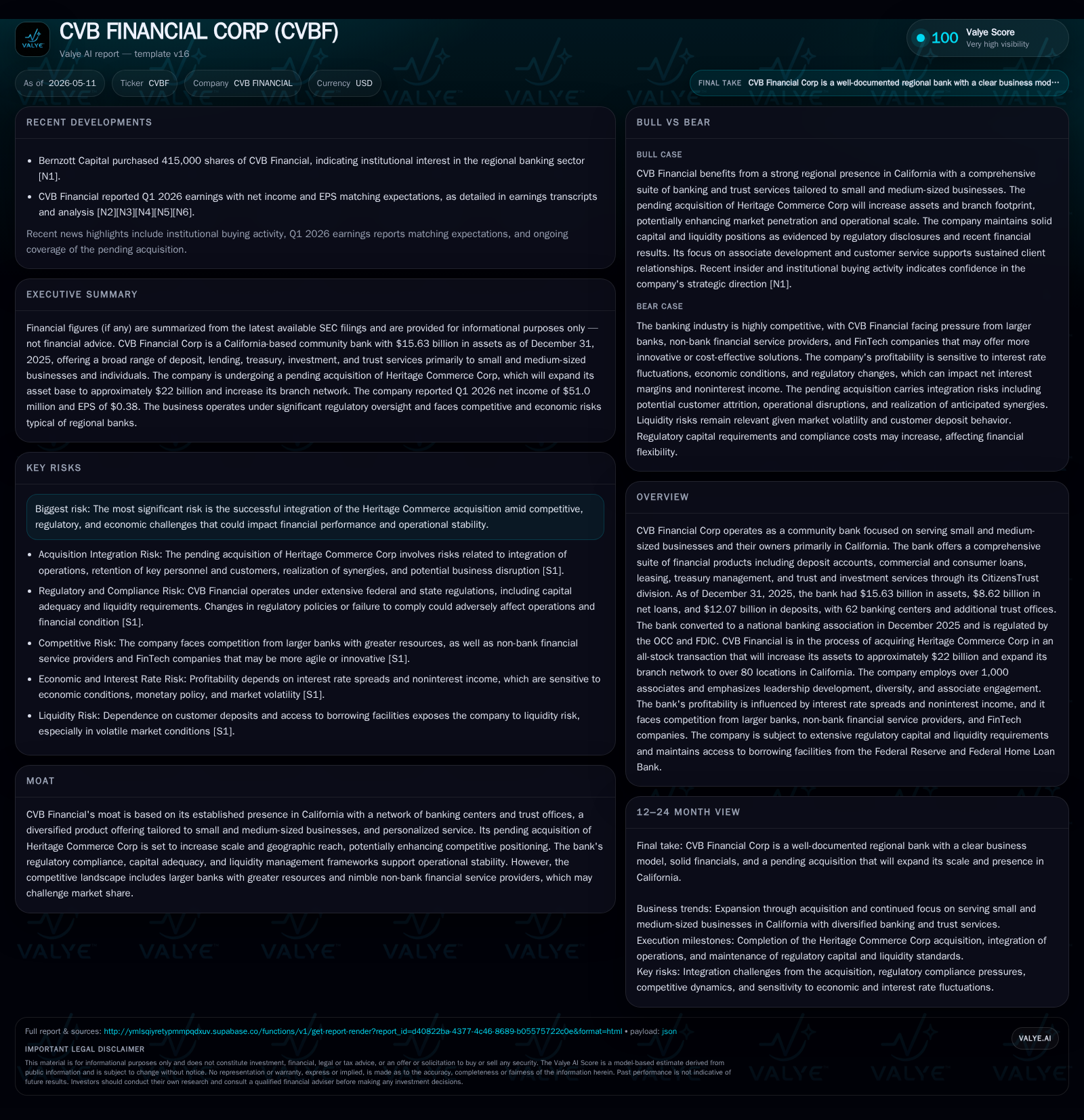
In its latest 10-Q filing, CVB Financial Corp highlights the near-term operational evolution prompted by its pending merger with Heritage Commerce Corp, expected to close in Q2 2026. This all-stock transaction will expand CVB’s assets to roughly $22 billion and increase its branch network beyond 80 locations, strengthening its position in California’s small and medium-sized business (SME) banking sector. The bank’s comprehensive product mix—ranging from commercial loans to trust services—targets SMEs with a localized approach amidst competitive pressures from both large banks and fintech entrants. While the acquisition offers scale and diversification benefits, risks around integration execution and economic headwinds in California’s real estate market remain pivotal.
Latest Quarterly Operating Highlights and Recent Developments
CVB Financial’s most recent quarterly filing dated May 8, 2026 [S2] reveals that the company has secured all necessary regulatory approvals—a key milestone in advancing its all-stock merger with Heritage Commerce Corp. The acquisition marks a pivotal expansion: CVB's asset base will expand from $15.63 billion at year-end 2025 to approximately $22 billion upon completion. Similarly, the branch footprint is set to grow from 62 banking centers to more than 80 throughout California [S3][S10]. Official closing is anticipated around April 17, 2026 [S16], subject to customary conditions.
The quarterly performance released contemporaneously aligns closely with consensus estimates [N2][N3]. While detailed Q1 financial metrics remain under review within filings and earnings transcripts [N1], the company emphasizes that this transformational deal materially shifts its near-term operating posture. Importantly, CVB completed its December 15, 2025 transition from a state-chartered entity to a national bank under OCC oversight [S1], positioning the institution for enhanced regulatory oversight consistent with larger-scale operations.
Comprehensive Community Banking Model Serving California SMEs
CVB Financial operates a diversified community banking platform primarily targeting small- and medium-sized enterprises (SMEs) within California's dynamic economy. The company's product suite encompasses deposit accounts (checking, savings, money markets), alongside a wide array of lending options including commercial lines of credit, SBA loans, agribusiness financing specific to dairy farms and livestock operations, municipal lease financing, as well as commercial real estate loans covering both owner-occupied and investor properties [S1].
This breadth caters explicitly to varied SME needs—from working capital flexibility through receivables financing to equipment leasing—that drive client retention via embedded service relationships. Treasury management solutions augment these offerings by facilitating efficient cash flow operations tailored to business complexities.
Beyond core banking, CVB leverages CitizensTrust to deliver trust and investment management services including fiduciary roles, mutual funds, annuities, retirement plans like 401(k)s, and direct investment accounts. These higher-margin wealth services deepen client engagement and create natural cross-sell avenues while diversifying revenue streams [S1].
Personalized attention delivered through its network of branches and trust offices underpins a value proposition focused on local expertise—a critical differentiation against larger regional or national banks that often lack granular community connectivity.
Competitive Landscape: Regional Banks Meeting Tough Market Dynamics
In California’s competitive regional banking arena, CVB Financial contends with pressure both from scale-heavy incumbents—such as Bank of America or Wells Fargo—and disruptive fintech providers offering niche digital financial solutions. Whereas mega-banks wield pricing power through expansive capital bases and technology platforms, CVB counters with intimate customer relationships and specialized knowledge of sectoral lending niches like agribusiness.
Switching costs are elevated among SME clients accustomed to tailored product packages bundled with proactive advisory services; this stickiness contributes substantively to CVB’s moat alongside regulatory discipline maintained post-national bank conversion [S1]. However, regulatory compliance—particularly adherence to evolving CRA criteria that weigh retail lending patterns and community development commitments—is resource-intensive but also acts as an entry barrier for smaller competitors.
Digital transformation remains a strategic area where CVB must continuously invest due to changing client expectations around mobile banking usability and payment processing speed; the company signals ongoing prioritization without disclosing aggressive tech overhaul plans yet [S1].
Strategic Growth Catalysts Centered on Heritage Commerce Acquisition
The acquisition of Heritage Commerce presents an unmistakable inflection point for CVB Financial’s growth ambitions. The all-stock deal not only expands assets into the low-$20 billion territory but also broadens branch density over diverse Californian markets that overlap partially with CVB’s existing strongholds [S10]. This consolidation is anticipated to enhance scale advantages enabling greater pricing flexibility on both lending spreads and deposit rates due to increased customer reach.
Furthermore, Heritage brings complementary loan portfolios that may improve overall credit risk diversification while boosting deposits—an essential funding source underpinning loan growth capacity. The enlarged footprint enhances CVB’s potential for operational leverage by rationalizing overlapping administrative functions post-integration [S4].
Potential revenue synergies include cross-sales between expanded SME client bases leveraging CitizensTrust services as well as coordinated treasury solutions adoption across a wider business network.
Nonetheless, cautious tones are evident around integration execution with explicit acknowledgment of risks related to deposit attrition or unexpected operating cost inflation during the transition phase [S4][S26]. Careful retention of personnel and customers remains a top priority given competitive poaching risks in California's largely saturated banking landscape.
Risks and Operational Challenges Ahead Post-Merger
The risk profile following completion is dominated by integration complexities common in mid-sized bank mergers but amplified here due to geographic scale increase and regulatory shifts stemming from national bank status attained late last year [S1][S4]. Potential for customer churn especially among retail depositors or business clients arises amid system migrations or service disruptions.
Economic sensitivity is another watchpoint; given CVB's substantial exposure to California real estate—both residential construction loans and commercial property financing—the firm is exposed materially to any downturns or slowdowns in these sectors [S4][S26]. Prolonged market softness could pressure credit quality metrics or constrain new loan originations.
Moreover, heightened regulatory scrutiny post-merger coupled with increased compliance costs tied to Basel III frameworks demands ongoing capital discipline despite CVB's solid capital ratios reported at year-end 2025 [S8][S13]. Ensuring seamless adherence without impairing strategic initiatives requires tight risk governance.
Finally, competition from technologically sophisticated non-bank financial providers continues as a backdrop that could erode market share if CVB lags in digital innovation deployment.
Key Near-Term Milestones to Monitor
Critical event-driven milestones include the anticipated closing of the Heritage Commerce merger expected around mid-April 2026 following satisfaction of remaining conditions [S16][S3]. Beyond closing:
- Progress on integration plan execution will be key; monitoring expense run rate against synergy targets provides insight into operational efficiencies realized.
- Deposit retention rates serve as immediate demand markers reflecting customer acceptance.
- Subsequent quarterly earnings releases likely will incorporate pro forma combined results giving clearer pictures on revenue trajectory shifts attributable to expanded scale [N1].
- Regulatory updates such as results of upcoming CRA examinations or OCC review letters potentially inform compliance standing post-merger.
- Pay attention also to any commentary on incremental tech investments aimed at digitizing client interfaces aiding competitiveness.
Current Financial Profile Snapshot Supporting Operating Narrative
CVB maintains a robust liquidity posture evidenced by cash & equivalents totaling approximately $452 million as of March 31, 2026 [F1], which provides ample buffer for merger-related expenditures plus ongoing operational needs. Net debt positioning is effectively negative given modest total debt levels versus cash balances reported at earlier periods [F1], underscoring financial flexibility amid expansion initiatives. This liquidity profile supports confidence in managing integration complexities without material funding strain.
This analysis is based on publicly available SEC filings including the company’s latest Form 10-Q dated May 8, 2026 [S2], related current reports, investor communications, and companyfacts data snapshot as of March quarter-end 2026 [F1]. It aims solely to provide an informed industry perspective without offering investment advice.
Disclaimer: This is research-only, informational analysis and not investment advice. It may include AI-generated interpretation and general industry context. Always verify important details using primary sources.

Comments