
Gyre Therapeutics Advances Commercial and Pipeline Growth with Cullgen Acquisition and China Market Integration
Gyre Therapeutics' latest quarterly report highlights operational expansion through acquisition and concentrated customer revenues within China's evolving pharmaceutical procurement landscape.
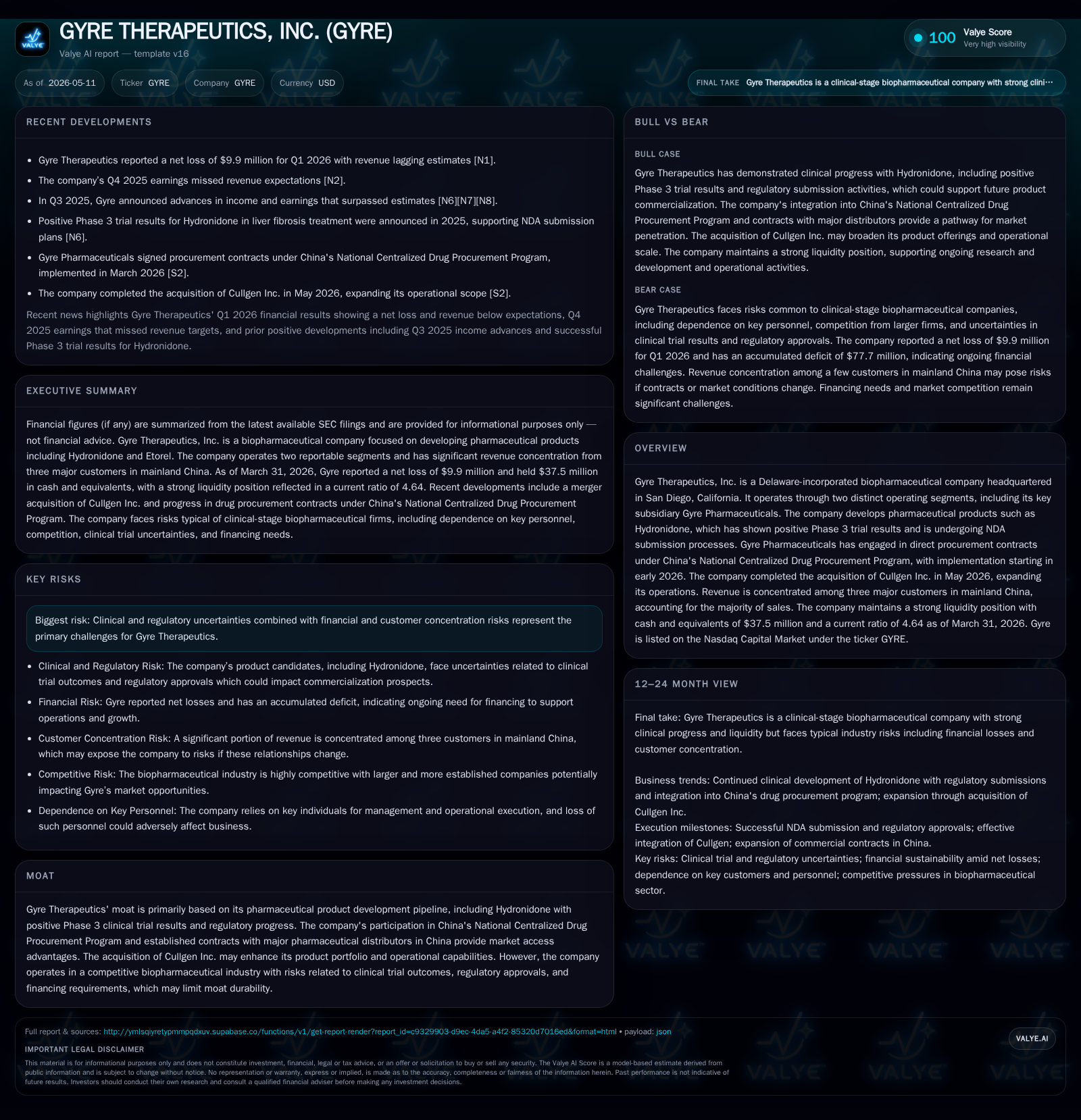
Gyre Therapeutics, a commercial-stage biopharmaceutical company focused on anti-fibrotic and inflammatory disease therapies, reported its latest quarterly update emphasizing key customers concentrated in the Chinese pharmaceutical market. The company completed the acquisition of Cullgen Inc., bolstering its pipeline and operational capabilities. Revenue remains heavily dependent on three main Chinese pharmaceutical distributors under government procurement programs. Gyre’s strategy combines leveraging its established commercial products with advancing clinical-stage therapeutics like Hydronidone for sustainable growth amid significant competitive and regulatory risks.
Recent Operating Update
Gyre Therapeutics’ Q1 2026 filings illuminate several pivotal developments shaping its near-term trajectory. Notably, the company’s revenues remain heavily dependent on three major customers located in mainland China: Sinopharm Group accounted for approximately 42.8% of total revenue during the quarter ended March 31, 2026, followed by China Resources Pharmaceutical at 14.4%, and Shanghai Pharmaceuticals at 13.2% [S2]. This concentration underscores Gyre's deep exposure to China's pharmaceutical distribution ecosystem governed by centralized drug procurement policies.
Simultaneously, Gyre consummated the acquisition of Cullgen Inc. on May 4, 2026, marking a strategic milestone designed to enhance its product development pipeline and operational scale [S5]. This transaction aligns with Gyre’s stated intent to strengthen its diversified portfolio targeting significant unmet medical needs in fibrosis and related inflammatory diseases.
Moreover, Gyre Pharmaceuticals commenced implementation of direct procurement contracts under China’s National Centralized Drug Procurement Program starting March 2026 [S5]. This program exerts substantial influence over pricing dynamics and distribution channels within China’s public healthcare market.
Despite these operational advances, the company reported a net loss of $9.9 million for Q1 but generated $3.2 million in net cash from operating activities [S5]. Management maintains confidence that existing liquidity — cash and cash equivalents stood at $37.5 million as of March 31, 2026 — alongside expected cash flow from operations will sustain ongoing activities for at least another year [S5][F1].
Business Model
Gyre Therapeutics operates predominantly through its majority indirectly owned subsidiary Beijing Continent Pharmaceuticals Co., Ltd. (d/b/a Gyre Pharmaceuticals) in China alongside U.S.-based operations headquartered in San Diego [S1]. The core business focuses on developing and commercializing small-molecule therapies addressing organ fibrosis and inflammatory diseases—a field characterized by complex pathobiology requiring multifaceted therapeutic approaches.
Revenue generation hinges primarily on sales of approved products such as ETUARY® (pirfenidone) targeting pulmonary fibrosis in China’s public hospital system via bulk tenders under national procurement schemes [S1][S5]. These contracts are secured through participation in centralized drug procurements with major pharmaceutical distributors acting as key customers — a dynamic that imposes pricing pressure but grants broad market access.
In parallel, Gyre invests heavily in clinical-stage R&D—most notably Hydronidone (F351), an innovative product candidate for liver fibrosis which recently completed positive Phase 3 studies and is undergoing NDA submission processes both domestically (NMPA) and potentially for broader markets [S1][S2]. The company balances commercial revenues with forward-looking pipeline programs aimed at expanding indications for existing drugs as well as developing novel agents.
Product sales depend upon centralized bidding success, government healthcare reimbursement policies, physician adoption rates, and hospital formulary inclusion — all factors governed by regulatory agencies including the NMPA in China. For incremental growth, Gyre relies on its ability to extend existing product indications while launching late-stage candidates supported by robust clinical evidence.
Industry Structure and Competitive Position
Gyre operates within the global biopharmaceutical market segment specializing in anti-fibrotic therapies—a niche marked by high unmet medical need but intense competition from established multinational companies with extensive portfolios [S1]. Within China’s pharmaceutical ecosystem, participation in National Centralized Drug Procurement confers advantages by providing scale but also compresses margins due to aggressive price negotiations.
Competitively, Gyre leverages localized market knowledge via its China-centric subsidiary alongside U.S.-based development expertise to bridge commercialization with innovation pipelines. Its moat derives from approved products generating consistent revenues domestically coupled with emerging late-stage assets such as Hydronidone poised to address broader geographies and indications [N1][S1].
However, customer concentration risk remains elevated due to dependence on a small number of distributors controlling hospital supply chains [S2]. Regulatory complexities across multiple jurisdictions add barriers for new entrants but also present potential bottlenecks delaying approvals or launches.
Growth Drivers
Pipeline Advancement and Regulatory Milestones
Hydronidone stands out as a primary growth vector following favorable Phase 3 results supporting NDA submissions prospectively expanding treatment options beyond pulmonary fibrosis into liver fibrosis indications [S1][S2]. Success here could open access to sizable patient populations underserved by current therapies.
Expansion Under Centralized Procurement Program
The government's National Centralized Drug Procurement Program provides extensive access opportunities albeit challenged by pricing pressures requiring volume execution excellence [S5]. Successfully navigating tenders will be critical to maintaining competitive sales volumes for ETUARY® and newly approved assets.
Strategic Acquisition Synergies
Completion of the Cullgen merger introduces platform technologies or product candidates which could accelerate R&D productivity or broaden therapeutic reach post-integration [S5]. It also signals management’s intent toward inorganic growth complementing organic research efforts.
Geographic Diversification Efforts
While currently heavily weighted towards China sales, ongoing development activities highlight aspirations to penetrate U.S. markets leveraging San Diego headquarters’ clinical infrastructures for late-stage trials [S1]. Successfully registering products internationally diversifies revenue streams geographically.
Risks and Watchpoints
Customer Concentration and Tender Reliance
With three customers comprising over two-thirds of revenue, any adverse changes in contract terms or procurement outcomes pose material threats to sales stability [S2]. Dependency on government-driven tender processes introduces volatility driven by policy shifts.
Clinical Development Uncertainties
Pipeline products face inherent risks typical of biopharma—clinical trial setbacks or regulatory disapprovals would impede growth prospects considerably given few alternatives currently commercialized [S1][S2].
Financing Requirements Amid R&D Expansion
Though recent reports indicate sufficient liquidity, continued funding needs are substantial given ongoing trial costs plus merger-related expenses [S5][F1]. Should capital raise conditions deteriorate or operating losses grow larger than expected, constraints could emerge restricting progress.
Competitive Pressures From Established Peers
Larger multinational pharmaceutical companies possess deeper balance sheets enabling aggressive pricing tactics or broader product offerings which challenge standalone players like Gyre within crowded fibrotic disease markets.
Regulatory Compliance Complexity Across Jurisdictions
Navigating differences between Chinese NMPA regulations versus U.S. FDA requirements complicates commercialization timing affecting launch sequencing or investment prioritization [S1].
What to Watch Next
Key milestones over the next several quarters include:
- Progress updates on Hydronidone NDA review outcomes across jurisdictions,
- Execution success within China’s ongoing National Centralized Drug Procurement Program tenders,
- Integration progress with Cullgen post-acquisition concerning pipeline enrichment,
- Quarterly financial results tracking revenue trends from core Chinese customers,
- Clinical trial progression updates for other candidate products within fibrosis or inflammatory disease franchises,
- Commentary from management regarding financing plans or strategic partnerships enhancing R&D capacity.
These indicators will shed light on Gyre's ability to translate pipeline promise into commercial momentum while mitigating client-concentration risks inherent in their current revenue base.
Financial Profile Snapshot as of Q1 2026[F1][S2]
Latest financial snapshot
*Note: Latest effective total debt reported was zero; net debt position is cash positive.[F1]
Cash burns reflected by a $9.9 million net loss offset somewhat by positive operating cash flows ($3.2 million) suggest prudent liquidity management though capital needs remain important given clinical development ramp-ups [S5].
Disclaimer: This analysis is based solely on publicly available SEC filings as of May 11, 2026, company disclosures, and relevant news articles without providing any investment advice or recommendations.
Disclaimer: This is research-only, informational analysis and not investment advice. It may include AI-generated interpretation and general industry context. Always verify important details using primary sources.

Comments