
Harvard Ave Acquisition Corp's Strategic Path Without an Identified Target
The latest quarterly filing confirms Harvard Ave Acquisition Corp remains without a business combination target, underscoring the operational and capital challenges facing this SPAC.
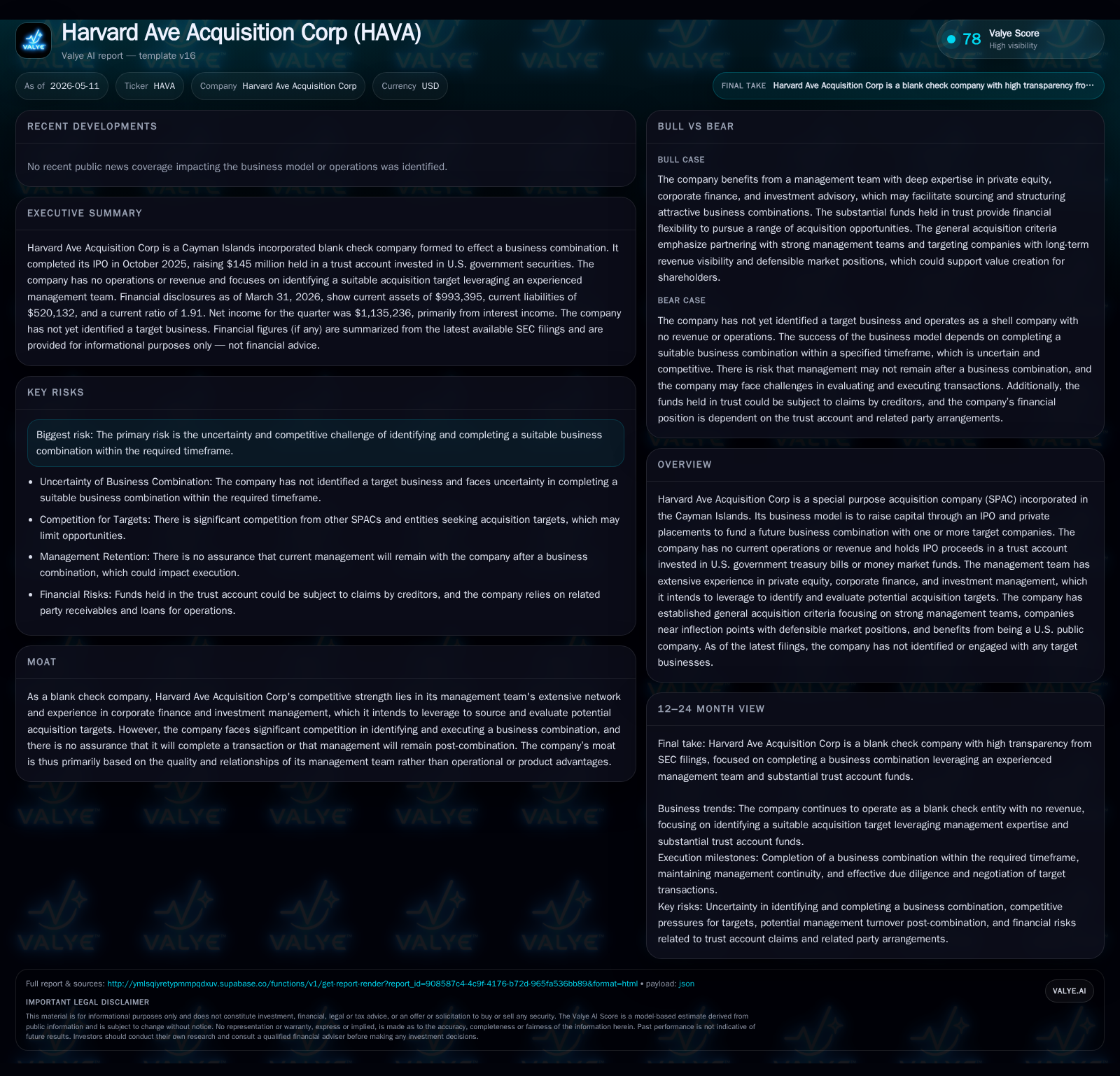
As of its May 2026 10-Q, Harvard Ave Acquisition Corp (HAVA) has yet to identify or engage with a target company for its initial business combination, maintaining $145 million in trust from its IPO proceeds. This blank-check vehicle leverages a management team with deep private equity and corporate finance experience to source acquisition opportunities but faces intense competition and timeline pressure inherent in the SPAC model. The company’s growth and value creation hinge on successfully executing a merger or acquisition before its deadline while managing public company costs and potential dilution. Liquidity remains healthy given the trust account structure, but execution risks are elevated given no announced transaction progress.
Latest Quarterly Filing Update: Status Quo on Business Combination
Harvard Ave Acquisition Corp’s most recent 10-Q filing dated May 8, 2026 [S2] confirms the company remains a classic blank check entity with no operating business or revenues. Critically, it has not identified or engaged any merger or acquisition target since its IPO completed in October 2025 [S1]. All approximately $145 million raised through public units plus private placements remain largely untouched in the trust account invested conservatively in U.S. Treasury bills or money market funds meeting SEC Rule 2a-7 conditions [S1][S2].
The filing reiterates that the firm continues to incur typical public company expenses such as legal, accounting, compliance costs, and due diligence efforts despite the lack of operations or top-line revenues [S2]. No new risk factors have emerged since the prior annual report [S2], underscoring that the operating picture remains stable but inactive regarding business combinations.
This state is material because the clock ticks down for SPACs to complete their initial business combination within defined deadlines (usually within two years), beyond which liquidation plans must be triggered. Idle capital in trust earns only modest interest income while carrying ongoing cash burn pressures for corporate overhead — highlighting the imperative for management to efficiently source and close a deal.
SPAC Business Model Fundamentals and Managerial Expertise
Harvard Ave functions as a Cayman Islands-incorporated special purpose acquisition company structured to raise capital through an initial public offering of units priced at $10 each [S1]. Each unit comprises one Class A ordinary share plus associated rights convertible upon consummation of a qualifying business combination. In tandem with the IPO, sponsors purchased additional private placement units and shares at the same price to align interests [S1].
Post-IPO proceeds totaling $145 million were placed into a U.S.-based Trust Account managed by Continental Stock Transfer & Trust Company [S1][S2]. This legally segregated fund is invested almost exclusively in short-duration U.S. government securities to preserve capital until deployment on an acquisition.
Harvard Ave’s revenue model will only activate post-merger when the acquired operating company begins generating cash flows. Until then, interest income on trust assets provides minimal non-operating gains while expenses for public status compliance persist.
Management credentials form HAVA’s main competitive edge. CEO Sung Hyuk Lee brings extensive private equity investment background coupled with financial advisory expertise [S1]. CFO Hoon Ji Choi adds investment management acumen critical for rigorous due diligence and capital structuring post-combination [S1]. Their networks span corporate executives, PE funds, venture capitalists, bankers, and consultants — vital channels for sourcing viable targets.
This experience differentiates Harvard Ave from less seasoned blank check entities by increasing its likelihood of identifying quality deals aligned with investor return objectives. Nonetheless, no guarantees exist due to competitive pressures.
Competitive Dynamics in the SPAC Market
The SPAC arena remains highly competitive as numerous sponsors pursue attractive private companies seeking alternative paths to going public. This saturation creates scarcity among prime targets with defensible margins and scalable growth prospects. Therefore, Harvard Ave’s management must leverage relationships effectively while offering favorable deal terms reflecting sponsor-investor alignment.
Crowding also elevates valuation risk since competing bidders can drive up acquisition multiples beyond levels generating sufficient shareholder returns after transaction costs and dilution effects.
Meanwhile, public market scrutiny over sponsor incentives has intensified recently due to variable track records across SPACs. Sponsors like Harvard Ave rely heavily on reputation and execution credibility as their primary moat absent underlying operational advantage.
Thus, while Harvard Ave benefits from experienced leadership and substantial capital at hand, success hinges on differentiating access to proprietary deals and nimble closing capability under time pressure.
Near-Term Growth Drivers and Potential Transaction Pathways
The decisive near-term driver for Harvard Ave lies in announcing a business combination comprised of one or multiple targets satisfying predefined strategic criteria:
- Strong operational management teams motivated to execute long-term value creation;
- Companies near key inflection points requiring capital or expertise enhancements;
- Enterprises possessing defensible market positions favoring sustainable cash flow visibility;
- Those leveraging benefits conferred by becoming U.S.-listed public companies including enhanced equity liquidity.
Progress can be concretely monitored via milestones such as letters of intent filed publicly or shareholder meeting notices scheduled for redemptions or approvals. After target acquisition announcements, subsequent KPIs include securing regulatory approval where applicable and shareholder votes affirming deal terms.
Additionally, deployment of Trust Account funds signals transaction advancement; while potential future capital raises or debt issuance post-close may supplement working capital or fund growth initiatives [S1][F1].
Key Risks and Execution Constraints Ahead
Harvard Ave faces intrinsic risks common to all SPACs but sharpened by its current lack of concrete acquisition progress:
- Failure to conclude a merger by statutory deadline would result in mandatory liquidation and return of Trust Account monies minus expenses — detrimental to sponsors’ equity investments;
- Ongoing cost burn from public company activities without offsetting revenues pressurizes working capital reserves outside Trust Account;
- Dilution risk arises if additional shares or convertible instruments are issued either before or after combination completion to meet funding needs;
- Competition for attractive targets may intensify leading to adverse deal pricing or missed windows;
- Sponsor retention post-business combination is not contractually assured; loss could impair continuity especially if key managerial expertise departs;
- Regulatory changes affecting SPAC structures might impose unforeseen constraints.
These factors collectively underscore execution risk requiring vigilant cash flow management alongside agile deal sourcing.
Important Upcoming Milestones and Market Signals to Monitor
Investors tracking Harvard Ave should watch several critical near-term indicators:
- Dates when shareholder votes on proposed amendments or combinations are announced via SEC filings (commonly Form 8-Ks);
- Disclosures regarding engagement with sectors or companies possibly earmarked as targets;
- Reports on insider share transactions potentially hinting at confidence shifts;
- Variations in operating expense trends as proxy measures of merger preparation activity levels;
- Any announcements related to waiver extensions or changes in redemption terms signaling timeline adjustments.
Given that quarterly filings maintain steady messaging without fresh risks but show continuous operational expenditures supporting search efforts [S2], upcoming event filings remain key for detecting movement toward deal closure.
Current Financial Snapshot and Liquidity Analysis
Latest financial snapshot
| Metric | Value | Period |
|---|---|---|
| Total debt | $328,910 | |
| 2026-03-31 | ||
| Net debt | $328,910 | |
| 2026-03-31 | ||
| Current assets | $993,395 | |
| 2026-03-31 | ||
| Current liabilities | $520,132 | |
| 2026-03-31 | ||
| Current ratio | 1.91x | |
| 2026-03-31 |
Source: SEC companyfacts cache [F1].
Though operating without revenues pending business combination success, Harvard Ave maintains a sound liquidity profile anchored by its trust account structure:
| Metric | Value (USD) | As of |
|---|---|---|
| Total Debt | 328,910 | |
| 2026-03-31 | ||
| Current Assets | 993,395 | |
| 2026-03-31 | ||
| Current Liabilities | 520,132 | |
| 2026-03-31 | ||
| Current Ratio | 1.91 | |
| 2026-03-31 | ||
| Trust Account Cash* | ~146M approx | Late Q1/early Q2 |
Trust account cash referenced from filings [S1][F1]
The small amount of debt likely represents nominal borrowings related to transactional expenses or working capital bridging outside Trust Account assets; this does not materially weigh on balance sheet strength considering the segregated $145 million principal held in trust plus accrued interest earning about $1 million annually pre-tax [S1][F1].
Negative operating income reflects ongoing administrative expenses forced by public entity status but consistent with expectations for this stage [F1].
Disclaimer: This is research-only, informational analysis and not investment advice. It may include AI-generated interpretation and general industry context. Always verify important details using primary sources.

Comments