
Akamai’s 2026 Q1: Edge Network Scale Counters Revenue Growth Pressures Amid Intensifying Competition
Robust security and cloud services propel Akamai’s resilience despite delivery revenue headwinds and macroeconomic uncertainties.
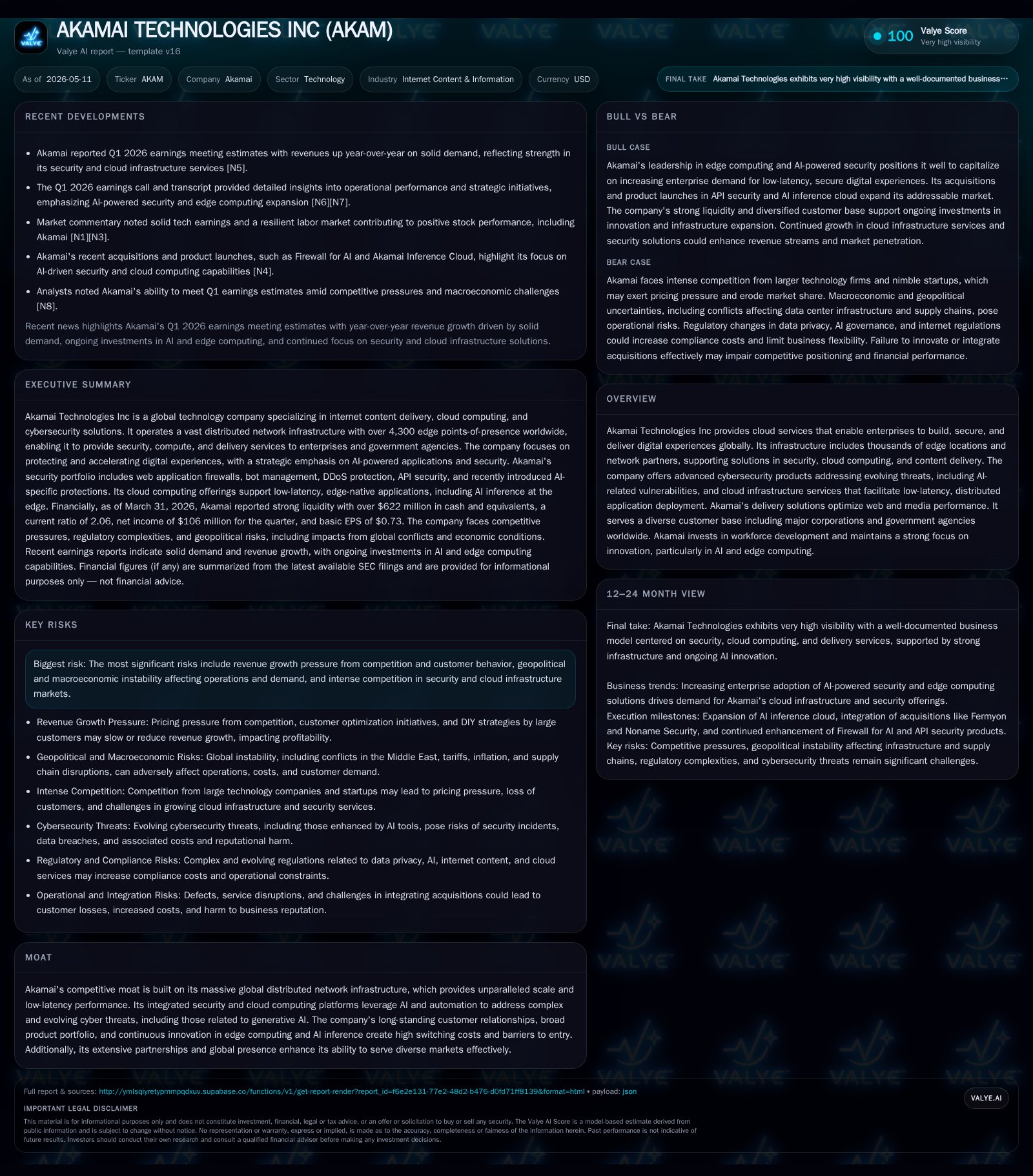
Akamai Technologies’ latest quarterly report reveals ongoing challenges in its content delivery solutions offset by solid demand in security and cloud offerings. The company leverages a massive global edge network and AI-powered security to maintain competitive differentiation amidst pricing pressures and evolving customer DIY initiatives. Growth prospects hinge on expansion in cloud computing infrastructure and AI-enablement, though heightened competition from hyper-scalers and regulatory complexities remain key risks. Financially, Akamai exhibits strong liquidity with a healthy current ratio and no outstanding borrowings under credit lines as of Q1 2026.
Recent Operating Update
Akamai Technologies reported its first-quarter 2026 financial results on May 7, highlighting persistence of long-term industry headwinds alongside pockets of growth [S2], [S3]. The delivery solutions segment continues to face challenges from pricing pressure exacerbated by customers shifting traffic via "do-it-yourself" strategies and platform optimization efforts that reduce reliance on third-party content delivery networks (CDNs). While this has historically caused revenue declines within delivery services, the rate of erosion has moderated recently. Conversely, the security segment remains the largest revenue driver for the company, underpinned by heightened demand for advanced cybersecurity products leveraging adaptive AI to mitigate emerging threats including attacks related to generative AI systems [S2], [S3]. Cloud computing solutions are also exhibiting growth momentum as Akamai expands its distributed compute platform at the edge aimed at supporting low-latency applications powered by artificial intelligence.
Despite these positive trends in security and cloud infrastructure services, overall revenue growth may slow or stagnate due to competitive pricing environments and macroeconomic factors such as inflation, geopolitical tensions, trade barriers, and regulatory costs affecting customer spending patterns [S2], [S10]. Akamai also disclosed no borrowings as of quarter-end against its enlarged credit facilities ($1.0 billion revolving credit line plus an additional $150 million facility), indicating a robust liquidity position supporting continued investment in innovation without elevating financial risk [F1], [S15].
Business Model
Akamai Technologies generates revenue primarily through three solution categories: security services, cloud computing infrastructures (including edge compute), and digital content delivery networks (CDNs) [S1]. Customers—which span global enterprises across industries including media, commerce, government agencies, and technology firms—pay Akamai through contracts that combine committed usage fees with variable charges based on traffic volumes or application usage. This model exposes revenues to fluctuations in internet traffic patterns and customer platform decisions.
Revenue growth is driven by volume expansion from more traffic/content delivered or compute utilized on Akamai's network; price changes related to contract renewals or new offerings; and product mix shifts favoring higher-margin or rapidly growing segments like security or cloud computing. Margins are supported by economies of scale from operating one of the largest distributed edge networks globally—over 4,300 points-of-presence spanning more than 130 countries plus integration with about 1,200 network partners—which enables efficient delivery close to end users with low latency.
Security offerings leverage sophisticated AI analytics and automation layered upon this vast data stream to detect and mitigate cyber threats rapidly. Akamai provides web application firewalls, bot management platforms, API security tools, DDoS defenses, zero trust networking architectures, DNS protection services, and emerging controls tailored for AI-related vulnerabilities—all designed to secure modern hybrid multi-cloud enterprise environments.
Cloud computing services emphasize full-stack distributed computation primarily at the network edge. This platform supports enterprises developing AI-driven applications requiring high throughput and real-time responsiveness for end users worldwide. Akamai’s ability to integrate edge compute with its global network delivers customer benefits including reduced infrastructure complexity, improved application performance, enhanced security posture via built-in protections at multiple network layers, and higher scalability.
Customer adoption is supported through a combination of direct salesforce engagement and broad channel partnerships spanning system integrators, technology distributors (e.g., Microsoft Azure partnership), referral networks, and marketplaces [S9]. Long-standing enterprise relationships create switching costs reinforced by integration depth into business-critical digital operations.
Industry Structure and Competitive Position
The market landscape is fiercely competitive with participants ranging from traditional CDNs (e.g., Fastly), large hyperscale cloud providers that aggressively augment security/cloud stacks (such as AWS, Microsoft Azure, Google Cloud), telecommunications companies offering localized edge services, niche cybersecurity firms innovating rapidly on AI-driven defenses, to customers internalizing infrastructure via DIY approaches [S5], [S16], [S25].
Akamai’s moat rests heavily on infrastructure scale unparalleled by most competitors: a truly global footprint delivering superior latency performance combined with extensive traffic visibility enabling advanced analytics-based security. This distributed architecture creates significant switching costs due to entrenched network effects—enterprise digital experience reliability depends heavily on consistent performance across geographies.
However, hyper-scalers pose an existential challenge especially in cloud computing where their vast data center investments afford preferential access to server components (memory/CPU), co-location space near enterprise endpoints, bundled product suites reducing total cost of ownership for customers while complicating Akamai's competitive stance [S16], [S25]. Additionally, improvements in open-source caching technologies allow some customers to reallocate workloads internally or diversify providers.
To counterbalance these risks Akamai invests heavily in R&D focused on next-generation edge innovations incorporating AI inference capabilities directly into networks improving threat detection speeds and enabling new application categories relying on ultra-low latency processing (e.g., real-time gaming streaming or autonomous vehicle communication). Tactical acquisitions complement organic development adding niche security technologies or expanding geographic reach.
Pricing power is challenged by these competitive dynamics; but differentiated capabilities especially in zero trust security frameworks aligned with hybrid multi-cloud realities sustain customer retention rates. Enterprise buying cycles lengthen due to complexity but strategic vendor lock-in persists given regulatory compliance needs around data sovereignty/security which favor established global providers like Akamai capable of navigating nuanced legal regimes worldwide.
Growth Drivers
- Expansion of Cloud Computing Infrastructure: Accelerating adoption of distributed edge compute platforms as enterprises pursue AI-powered applications needing local processing combined with security guarantees drives incremental sales segments beyond traditional CDN delivery.
- Enhanced Security Solutions Leveraging AI: Rising frequency/severity of cyber-attacks especially those exploiting generative AI weaknesses increase demand for adaptive automated defense products within large-scale networks.
- Global Network Expansion: Increasing density of Points-of-Presence further reduces latency enhancing attractiveness for latency-sensitive enterprise use cases.
- Strategic Partner Alliances: Partnerships with major cloud platforms and system integrators broaden market reach providing cross-selling opportunities into adjacent verticals.
- Regulatory Compliance Services: Growing complexity around privacy/data sovereignty laws increases need for secure hybrid-cloud connectivity solutions addressing law-dependent deployment requirements.
- Shift Toward Pay-as-You-Go Models: Flexible billing facilitates customer entry encouraging initial trials that can expand into larger contracts upon proven ROI realization.
Risks / Watchpoints / Growth Constraints
- Revenue Growth Pressure: Pricing pressure from competitors plus customer optimization efforts including DIY approaches limit upside potential especially in delivery services; variability in content popularity influences traffic-dependent revenues adversely.
- Intense Competition: Large hyperscalers’ deep pockets enable aggressive pricing/promotions bundling cloud/security products compromising market share; ability to match investment pace critical yet challenging.
- Macro/Micro Geopolitical Instability: Trade restrictions/tariffs/sanctions affect supply chain reliability/costs impacting performance; political tensions may restrict cross-border data flows reducing addressable markets.
- Evolving Regulatory Environment: Privacy regimes (GDPR variants), cross-border data localization mandates increase engineering overhead; emerging AI regulations (EU Artificial Intelligence Act) add compliance burdens possibly restricting service functionality or raising liabilities.[S10], [S20]
- Technological Execution Risks: Failure to deliver innovative capabilities timely or maintain platform reliability could cause client attrition; integration challenges post-acquisitions can expose vulnerabilities.[S17]
- AI Initiative Uncertainty: Investment returns depend on successful commercialization of AI infrastructure; misuse or external perception issues around machine learning may impact reputation/legal standing.[S21]
- Revenue Volatility from Contract Model Shifts: Movement toward pay-as-you-go elasticity enhances volatility complicating forecasts impacting operational planning.[S22]
- Supply Chain Constraints: Server component shortages (memory/CPU) affect capacity expansions limiting responsiveness versus competitors.[S25]
What To Watch Next
- Execution progress on expanding edge compute deployments directly supporting AI-powered applications will be an important milestone signaling tangible growth traction beyond legacy CDN models.
- Security product renewal rates particularly in emerging areas like API protection and zero trust implementation will gauge competitive positioning against hyperscalers ramping similar offerings.
- Customer adoption metrics tied to pay-as-you-go billing approach adoption will reflect changing market receptivity influencing future revenue visibility.
- Regulatory developments particularly updates on EU’s Artificial Intelligence Act enforcement post-August 2026 effective date could materially impact compliance-related costs or limit offerings.[S10]
- Quarterly guidance revisions provide leading signals around demand environment improving or deteriorating amid macro headwinds.
- Further strategic partnerships augmenting cloud ecosystem integrations might unlock incremental channels fueling expansion opportunities.[S9]
Financial Profile Briefly Contextualized
Latest financial snapshot
| Metric | Value | Period |
|---|---|---|
| Cash & equivalents | $622mm | |
| 2026-03-31 | ||
| Current assets | $2.1bn | |
| 2026-03-31 | ||
| Current liabilities | $1036mm | |
| 2026-03-31 | ||
| Current ratio | 2.06x | |
| 2026-03-31 |
Source: SEC companyfacts cache [F1].
As of March 31, 2026 Akamai held approximately $622 million in cash & equivalents alongside total current assets of $2.13 billion against current liabilities near $1.04 billion representing a healthy current ratio above 2x evidencing strong short-term liquidity [F1]. No borrowings were outstanding against expanded revolving credit facilities aggregating $1.15 billion providing financial flexibility for ongoing innovation investments.[S15] Profitability remains supported but is sensitive to revenue fluctuations given fixed cost structure inherent in large-scale network operations.[S2]
This analysis synthesizes recent SEC filings and publicly available disclosures up to May 2026 without offering investment advice.
Disclaimer: This is research-only, informational analysis and not investment advice. It may include AI-generated interpretation and general industry context. Always verify important details using primary sources.

Comments