
TruBridge Faces Merger Crossroads with Q1 Results and Operational Constraints
The company’s Q1 2026 earnings and merger announcement with Inventurus Knowledge Solutions underscore operational focus amid potential integration challenges.
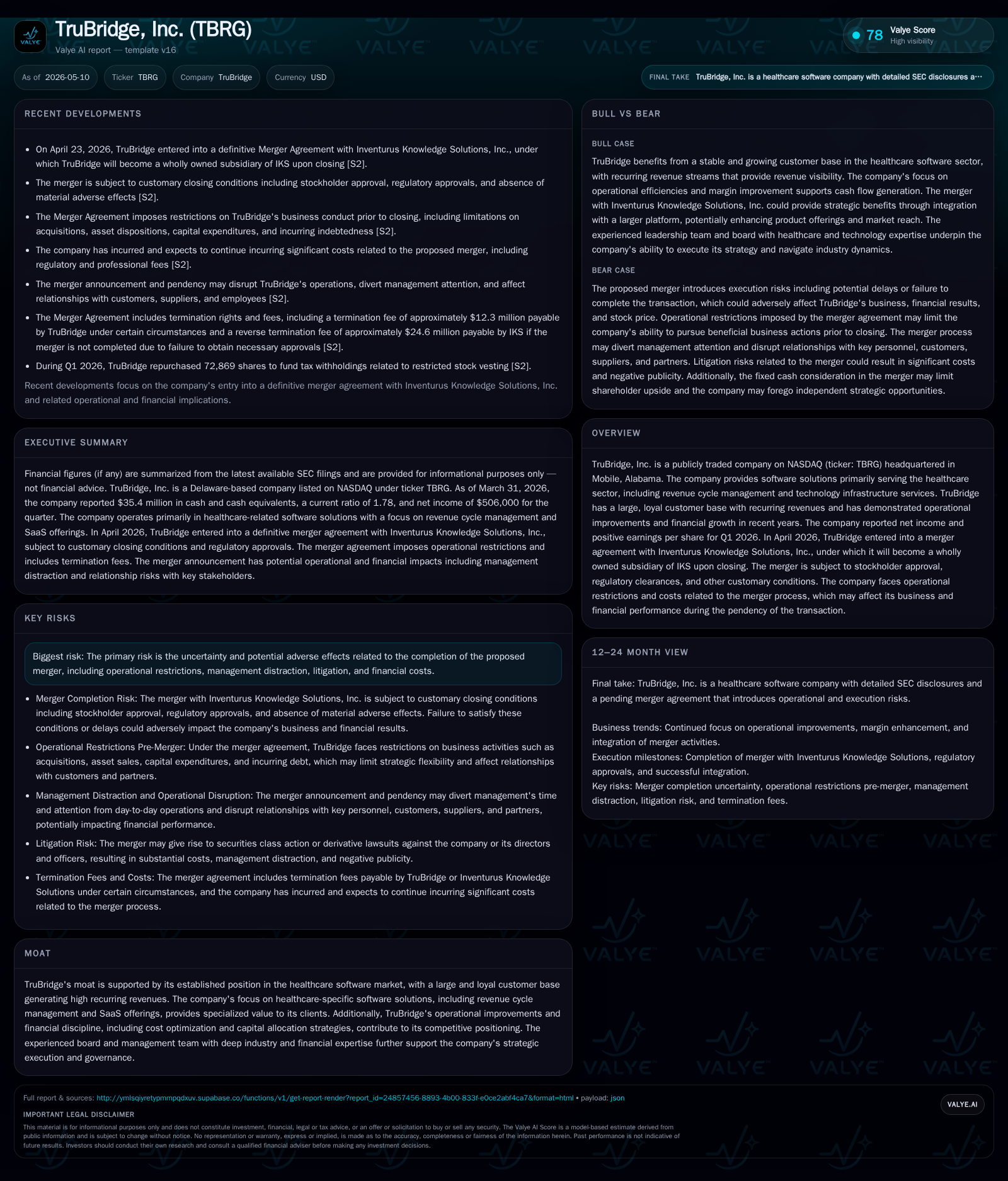
TruBridge, Inc. reported net income and positive EPS for Q1 2026 alongside announcing a significant merger agreement with Inventurus Knowledge Solutions. This merger, pending regulatory approval and stockholder consent, introduces operational and financial constraints that may affect near-term performance. TruBridge’s core strength lies in its specialized healthcare software offerings with stable recurring revenues and a loyal customer base. However, merger-related execution risks and market uncertainties present critical watchpoints in the coming quarters.
Q1 2026 Operating Update: Earnings and Merger Developments
TruBridge’s latest 10-Q filing for the quarter ended March 31, 2026, illuminates a pivotal period defined by both steady financial performance and significant strategic advancement. The company reported positive net income for the quarter, signaling ongoing operational stability [S2]. While exact top-line numbers from the quarter are not publicly disclosed in this filing, management confirmed progress benefiting from improved efficiencies and disciplined cost management.
Concurrently, TruBridge formally entered into a definitive merger agreement with Inventurus Knowledge Solutions (IKS) on April 23, 2026 [S2]. Under terms of this transaction, upon closing, TruBridge will become a wholly owned subsidiary of IKS. The deal is contingent on several factors: shareholder approval requiring a majority vote; expiration or termination of the statutory waiting period outlined by the Hart-Scott-Rodino Antitrust Improvements Act; absence of any legal injunctions; and no material adverse effect impacting the company [S2].
This merger introduces near-term operational restrictions notably around integration planning and compliance oversight. Additionally, associated transaction costs are expected to weigh on expenses during the pendency of the deal [S2], underscoring a blend of opportunity and caution in TruBridge’s immediate outlook.
Business Model Overview: Specialized Healthcare Software Solutions
At its core, TruBridge generates revenue through specialized software offerings primarily tailored to healthcare providers' revenue cycle management (RCM) and technology infrastructure needs [S1]. These solutions encompass SaaS platforms facilitating comprehensive billing, coding compliance, claims processing, and reimbursement workflows. Importantly, this positioning affords the company a substantial recurring revenue base driven by contract renewals among an entrenched client community.
The subscription-based nature of their offerings means customers pay periodic fees aligned with service usage or licensing terms, which imparts predictable cash flows critical for financial planning [S1]. Moreover, TruBridge’s proactive executive retention programs—which have been described as competitive—aim to sustain leadership continuity that bolsters strategic execution in this specialized niche [S1]. This focus on talent stability pairs with ongoing investments in technology innovation tailored to evolving healthcare regulations.
Industry Positioning: Competitive Moat and Customer Loyalty in Healthcare Tech
TruBridge operates within a fragmented yet highly regulated healthcare IT market where compliance complexity heightens switching costs for clients. Their moat chiefly derives from delivering specialized SaaS products honed for healthcare RCM intricacies plus technology infrastructure support that competitors might find challenging to replicate quickly [S1] [F1].
A loyal customer base receiving customized solutions strengthens pricing power amidst moderate competitive pressure. TruBridge’s operational discipline enhances its ability to maintain margins even as pricing dynamics within healthcare IT stay sensitive to policy changes.
Additionally, the company's board composition enriched by seasoned industry veterans contributes governance rigor that supports ongoing competitive advantage in product development and market positioning [S1]. This strategic stewardship combined with an entrenched client ecosystem underpins TruBridge’s differentiation relative to more generalized software providers.
Operational and Financial Strengths Driving Growth
Management highlights cost optimization initiatives aligning expenses closely with revenue generation capabilities [S2]. Enhancements in operating margins reflect these efforts as well as improved efficiencies realized through platform modernization projects executed over recent periods.
Recurring revenue streams underpin stability while capital allocation emphasizes targeted investments that preserve cash flow flexibility during the merger process [S2] [F1]. This conservative financial approach helps mitigate downside risks from transaction uncertainty.
Operational improvements also extend to customer service layers driving adoption stickiness—a key lever in sustaining renewal rates essential for organic growth in subscription models [S1]. These strengths collectively indicate a robust internal foundation capable of weathering near-term disruption while preserving long-term growth vectors.
Risks Around Merger Execution and Market Dynamics
The foremost risk revolves around the possibility that the proposed merger might not complete within expected timelines or at all, potentially triggering adverse financial consequences including transaction costs without strategic benefit [S2]. Factors such as failure to obtain stockholder approval or regulatory clearance—particularly under antitrust review provisions—could derail plans.
Triggers allowing termination include non-completion by October 23, 2026; final binding laws preventing consummation; lack of shareholder votes approval; or failure of top-level financing consents required under Indian law given IKS’s corporate structure [S2]. In such cases, considerable termination fees—$12.3 million payable by TruBridge or a reverse fee of $24.6 million owed by IKS—incur financial penalties disrupting expected outcomes.
Furthermore, operational focus may be diluted during integration preparations causing distraction at management levels with knock-on effects on execution quality for ongoing business activities [S2]. Monitoring these risks will be essential until resolution.
Outlook: Key Milestones and What Investors Should Watch Next
Key upcoming benchmarks include the shareholder vote anticipated before mid-2026 reflecting proxy solicitations tied to the merger approval process [S2][S3]. Concurrently, expiration or early termination options related to Hart-Scott-Rodino antitrust waiting periods should be closely tracked given their direct influence on deal timing.
Investors would also do well to monitor quarterly results following close of Q1 which may reveal merger-related costs or efficiency savings adjustments impacting underlying operating metrics. Additional updates regarding regulatory status or legal challenges could materially shift perspectives surrounding deal completion probability.
Latest Financial Snapshot
Latest financial snapshot
| Metric | Value | Period |
|---|---|---|
| Cash & equivalents | $35mm | |
| 2026-03-31 | ||
| Current assets | $110mm | |
| 2026-03-31 | ||
| Current liabilities | $62mm | |
| 2026-03-31 | ||
| Current ratio | 1.78x | |
| 2026-03-31 |
Source: SEC companyfacts cache [F1].
| Metric | Value |
|---|---|
| Cash & Equivalents | $35.4 million |
| Current Assets | $109.7 million |
| Current Liabilities | $61.5 million |
| Current Ratio | 1.78 |
This snapshot underscores adequate liquidity positioned to fund near-term obligations despite broader deal-related uncertainties [F1].
This analysis has synthesized recent SEC filings up through May 8, 2026 (10-Q) alongside event disclosures concerning TruBridge’s announced merger with Inventurus Knowledge Solutions. The company maintains strategic focus on recurrent revenue streams within an industry demonstrating elevated switching costs due to regulatory complexity while navigating short-term risks arising from integration contingencies. Investors should observe successive milestone developments against operational metrics as decisive indicators shaping TruBridge's trajectory beyond this inflection point.
Disclaimer: This article is for informational purposes only based on publicly available filings and does not constitute investment advice or recommendations.
Disclaimer: This is research-only, informational analysis and not investment advice. It may include AI-generated interpretation and general industry context. Always verify important details using primary sources.

Comments