
Calumet Accelerates Specialty and Renewable Fuel Production While Managing Leverage Challenges
Recent Q1 results highlight operational gains and strategic shifts amid sustained debt leverage.
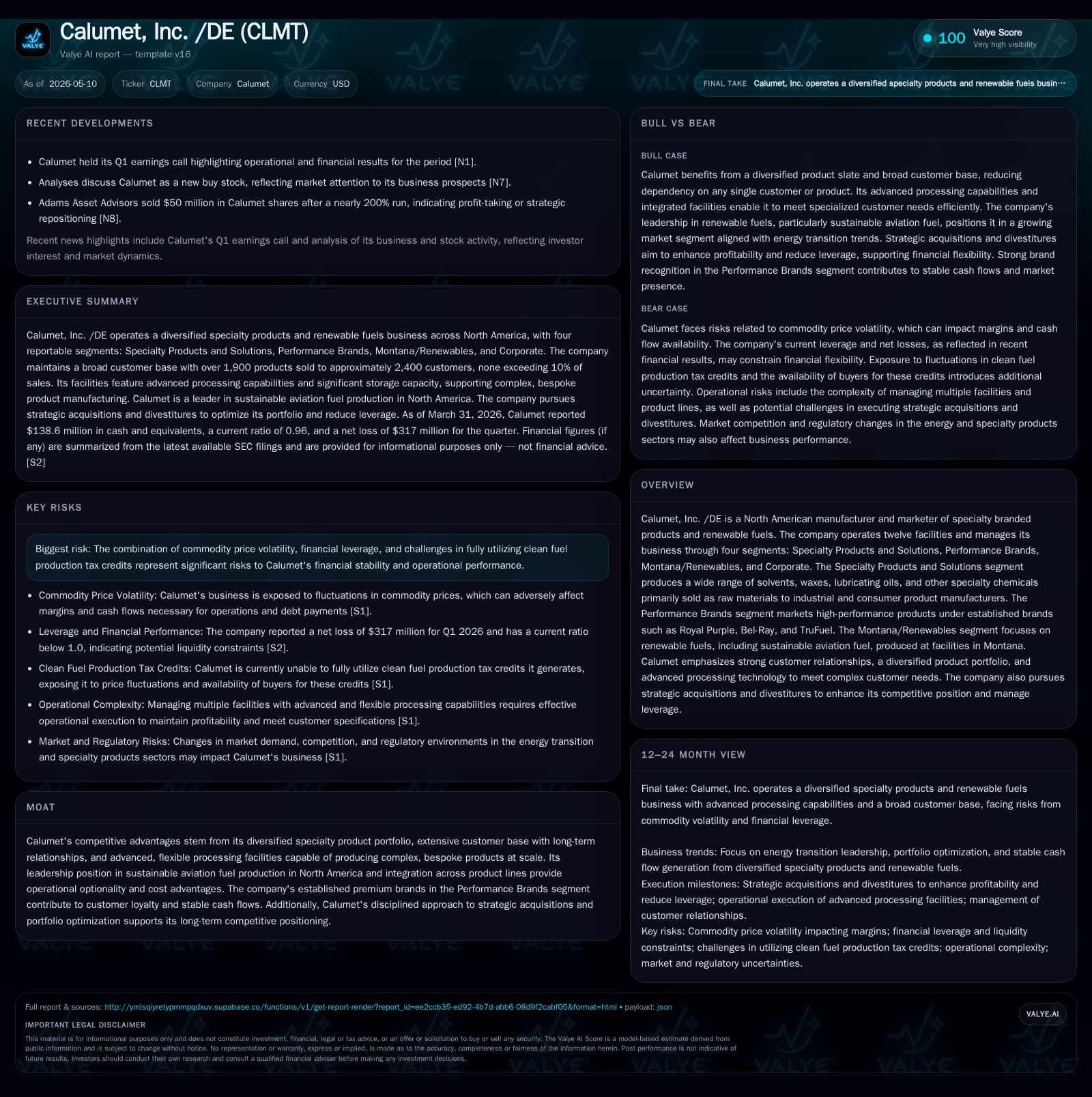
Calumet, Inc. reported its Q1 2026 results showcasing continued growth in specialty chemical production and renewables throughput, which underpin its diversified revenue model. The company’s business is structured across four segments with a strong focus on specialty products and renewable fuels, leveraging advanced processing capabilities and branded performance products. While operational improvements and cost reductions remain key growth pillars, elevated leverage and commodity price volatility present ongoing financial risks. Calumet’s strategy emphasizes portfolio optimization, disciplined acquisitions, and expansion in sustainable aviation fuel to drive long-term value.
Recent Operating Update
Calumet’s latest SEC quarterly filing for Q1 ended March 31, 2026 ([S2]) reveals continuing operational momentum. The company achieved a record level of output in its Specialty Products and Solutions segment complemented by higher throughput at the Montana Renewables facility. Management highlighted approximately $100 million in operating cost reductions year-over-year driven by efficiency projects implemented recently ([S27]). These improvements come amid an ongoing focus on balancing cash flow generation with asset reliability enhancement.
The accompanying May 8, 2026 8-K ([S3]) confirms the company’s proactive communication around these developments and showcases a steady execution of strategic priorities.
Business Model Overview
Calumet operates through four reportable segments ([S1]):
- Specialty Products and Solutions: Produces solvents, waxes, lubricants, synthetic oils, and chemicals — more than 1,900 specialty products — sold mainly as raw materials to about 2,400 industrial customers across North America ([S21]). This segment benefits from longstanding relationships often involving complex approval processes that establish significant switching costs.
- Performance Brands: Markets well-known branded lubricants and fuels such as Royal Purple, Bel-Ray, and TruFuel. These premium brands generate stable cash flows through high customer loyalty supported by their established reputations ([S25]).
- Montana/Renewables: Focuses on renewable diesel and sustainable aviation fuel (SAF) production using diverse feedstocks including renewable natural gas and propane. This segment is a North American leader in the SAF space with facilities capable of tailored renewable hydrogen production supporting refining operations ([S27]).
- Corporate: Encompasses corporate overheads not allocated to operating units.
Revenues derive primarily from the sale of finished specialty chemicals or fuels to industrial manufacturers or end-consumers via branded products. Pricing within specialty segments ties closely to feedstock costs passed through to clients but benefits from product differentiation that protects margins somewhat from pure commodity pricing cycles ([S25]). Performance Brands depend more on brand strength to command premium pricing. The Montana/Renewables business adds value by integrating complex processing technology with growing demand for cleaner fuels.
Industry Structure and Competitive Position
Calumet occupies a unique niche combining traditional specialty chemical manufacturing with renewable fuels production. Its competitive advantages include:
- Diversified product slate spanning over 1,900 items allowing penetration into multiple specialized markets.
- Long-term embedded customer relationships fostering recurring revenue streams resistant to easy substitution due to certifications or product integration complexities ([S21]).
- Proprietary processing technology enabling flexible feedstock usage critical for renewable fuel production scalability ([S1]).
- Ownership of premium brands under the Performance Brands segment commanding loyal end user bases.
- An integrated value chain that reduces exposure to crude oil price volatility relative to pure commodity players while benefiting from certain hedging arrangements ([S24],[S25]).
The renewables segment's focus on sustainable aviation fuel positions Calumet advantageously amid growing regulatory pressures for decarbonization in transportation sectors. However, the business faces competition both from traditional refiners pivoting toward renewables and pure-play biofuel producers.
Growth Drivers
Expansion of Renewable Fuels Capacity
The Montana Renewables facility is undergoing plans for expansion targeting increased throughput capacity for renewable diesel and SAF production ([S27]). Rising mandates for low-carbon fuels in North America provide structural demand support beyond cyclical energy markets.
Enhanced Product Mix in Specialty Chemicals
Efforts to refine product offerings toward higher-margin specialty chemicals are underway via targeted investments aimed at improving processing efficiency and product complexity ([S25]). Offering technical support and bespoke formulations helps deepen customer engagement.
Strategic Acquisitions & Portfolio Optimization
While focusing prudently on deleveraging the balance sheet over the near term, Calumet continues to explore low-risk acquisitions that complement its specialty products portfolio or improve operational margins ([S1],[S21]). Divestitures of non-core assets remain part of strategy to recycle capital efficiently.
Operational Efficiency Initiatives
Ongoing streamlining efforts have already reduced operating costs by approximately $100 million year-over-year with further gains expected from logistics improvements and asset repurposing ([S27]). Enhancing asset reliability also reduces downtime risks.
Risks and Constraints
Commodity Price Exposure & Volatility
Although Calumet passes through feedstock costs in its specialty segment contracts mitigating some volatility impact, earnings remain susceptible to swings in raw material prices affecting margins especially in renewables where input costs can be significant ([S2],[S25]).
Financial Leverage & Debt Servicing Burden
Net debt stood around $2.24 billion as of March 31, 2026 with total debt near $2.38 billion against cash reserves under $140 million ([F1]). With a current ratio below parity at approximately 0.96, working capital tightness coupled with fixed interest obligations may restrict financial flexibility during market downturns or investment cycles.
Regulatory & Tax Credit Dependencies
Reliance on government incentives such as clean fuel production tax credits introduces operational uncertainty if policies shift or if Calumet fails to fully utilize available credits due to capacity limits or compliance issues ([S2]).
Customer Concentration & Market Cyclicality
While diversified across thousands of customers with no single client exceeding 10% sales contribution annually ([S21]), specialized industrial customers are sensitive to broader economic cycles affecting demand stability.
What to Watch Next
- Execution progress on Montana Renewables capacity expansion projects as a leading indicator of ramped-up green fuel volumes.
- Changes or extensions in federal/state clean fuel tax credits impacting renewables profitability.
- Quarterly updates on specialty products sales volume growth reflecting adoption trends of bespoke chemical solutions.
- Any strategic acquisition announcements that could alter product mix or geographic reach.
- Balance sheet evolution focusing on debt reduction pace given sizable leverage levels reported at quarter-end.
Financial Profile Context (Q1 2026 Snapshot)
Latest financial snapshot
| Metric | Value | Period |
|---|---|---|
| Cash & equivalents | $139mm | |
| 2026-03-31 | ||
| Total debt | $2.4bn | |
| 2026-03-31 | ||
| Net debt | $2.2bn | |
| 2026-03-31 | ||
| Current assets | $928mm | |
| 2026-03-31 | ||
| Current liabilities | $963mm | |
| 2026-03-31 | ||
| Current ratio | 0.96x | |
| 2026-03-31 |
Source: SEC companyfacts cache [F1].
| Metric | Value (USD) | Period |
|---|---|---|
| Cash & equivalents | 138.6 million | Mar 31, 2026 |
| Total debt | 2.375 billion | Mar 31, 2026 |
| Net debt | ~2.236 billion | Mar 31, 2026 |
| Current assets | 927.9 million | Mar 31, 2026 |
| Current liabilities | 963.1 million | Mar 31, 2026 |
| Current ratio | 0.96 | Mar 31, 2026 |
Operating income most recently was $108.7 million for full year ended December 31, 2025; net income registered a loss of $33.8 million for the same period reflecting heavy financing charges among other factors ([F1]). The leveraged capital structure bears watching particularly as the company invests in growth initiatives while contending with commodity cycles.
This analysis is based solely on publicly available filings as of May 10th, 2026 without any forward-looking investment advice or recommendations. It aims to provide an informed perspective grounded in operational facts and industry context specific to Calumet Inc.'s latest disclosed data.
Disclaimer: This is research-only, informational analysis and not investment advice. It may include AI-generated interpretation and general industry context. Always verify important details using primary sources.

Comments