
Grayscale Zcash Trust Updates Valuation Method; Navigates Custody and Regulatory Nuances in Q1 2026
Grayscale Zcash Trust revised its operational valuation benchmark in Q1 2026, impacting NAV calculation amid ongoing regulatory and market challenges.
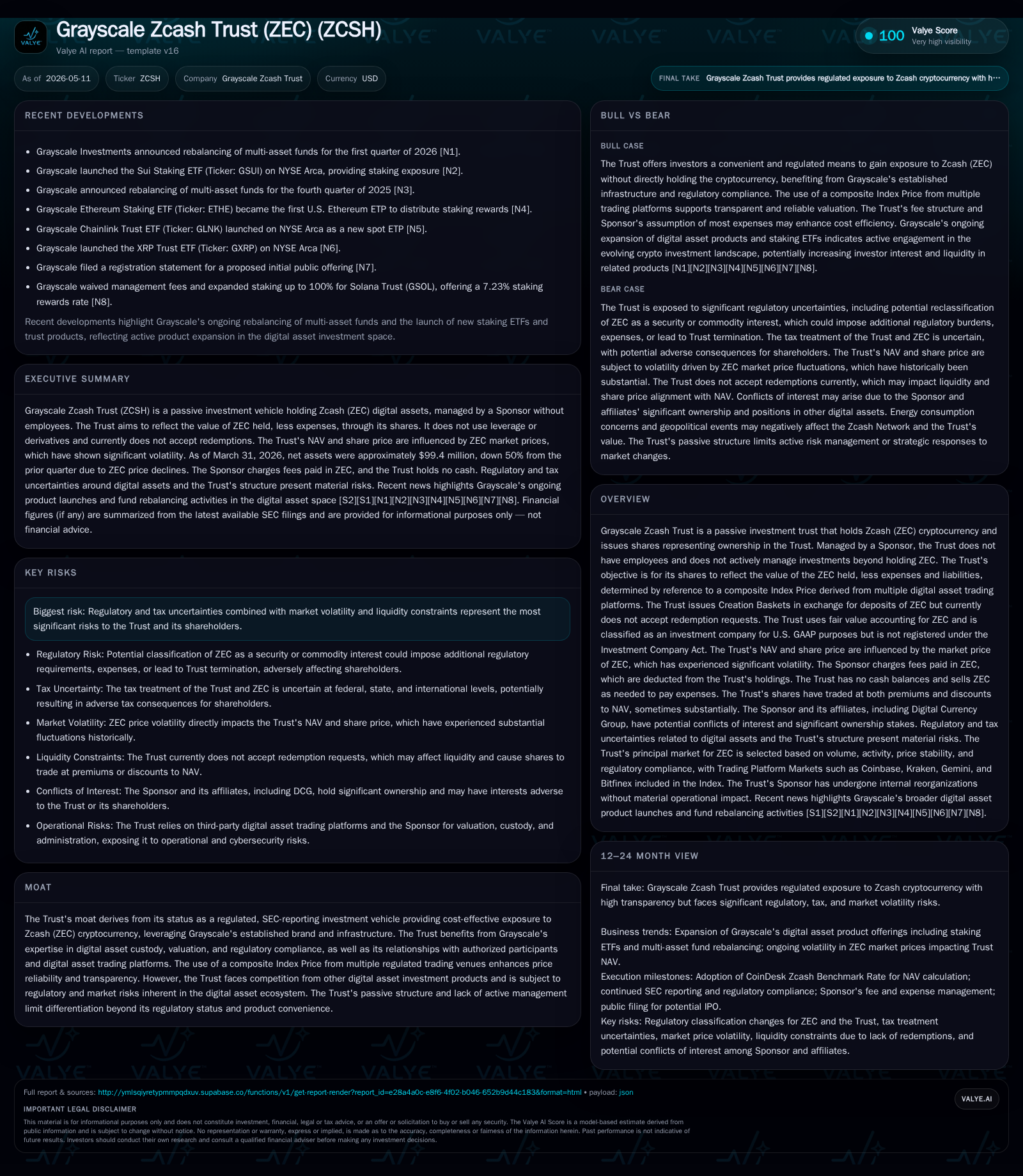
In its latest quarterly filing dated May 8, 2026, Grayscale Zcash Trust implemented a significant change by adopting the CoinDesk Zcash Benchmark Rate as its new index price for valuing ZEC assets, replacing the prior CoinDesk Zcash Price Index. This move aims to enhance price reliability and fair value measurement under evolving market conditions. The Trust operates as a passive vehicle offering investors exposure to ZEC through shares but currently does not permit redemptions, contributing to liquidity premiums and discounts. Regulatory uncertainties, including potential reclassification of digital assets and compliance costs, remain key risk factors, while Grayscale's strong custody infrastructure and regulatory reporting status underpin its competitive moat. Monitoring index methodology adjustments, liquidity programs, regulatory developments, and market acceptance will be critical near-term.
Latest Quarterly Operating Developments: Index Price Realignment and Market Implications
The May 8, 2026 Form 10-Q [S2] confirms a pivotal operational update for Grayscale Zcash Trust with the adoption of the CoinDesk Zcash Benchmark Rate effective April 1, 2026. This replaced the previously employed CoinDesk Zcash Price Index (ZCX), which had served as the primary reference for valuing the Trust’s underlying ZEC holdings for operational purposes. The switch reflects an ongoing refinement in how fair value is determined under U.S. GAAP ASC Topic 820-10 for investment companies like this Trust.
Critically, this methodology excludes over-the-counter (OTC) markets and derivatives venues due to atypical premiums or discounts that would otherwise skew prices. An algorithmic weighting system actively discounts anomalous price movements at any individual venue to limit distortions from transient spikes or limited liquidity events [S3]. This index evolution aims to provide more reliable NAV estimations crucial for investor confidence given past occasional discrepancies between share prices on OTCQX versus NAV per Share based on underlying ZEC values.
Trust Business Model and Passive Investment Structure
Grayscale Zcash Trust operates as an investment vehicle that offers indirect exposure to the privacy-centric cryptocurrency Zcash (ZEC) through publicly traded shares. It functions passively without active management or trading strategies; its sole material asset is the held inventory of ZEC coins associated with Creation Baskets issued when investors deposit ZEC [S1], [S2].
Shares represent pro-rata interests in the Trust’s net assets calculated via NAV per Share derived from the index price minus expenses such as the Sponsor’s Fee payable in ZEC. Unlike actively managed funds or ETFs with daily redemption mechanisms helping align share prices closely with NAVs, Grayscale’s model lacks a built-in arbitrage mechanism due to absent redemptions coupled with holding period restrictions [S1]. As a result, shares often trade at material premiums or discounts relative to NAV depending on market liquidity conditions and investor sentiment—a common structural challenge inherent to trusts holding volatile digital assets.
The Sponsor absorbs many ordinary expenses of the Trust but earns fees through deduction of a portion of ZEC holdings as remuneration [S2]. The absence of leverage or derivative overlays underscores a strict adherence to passivity.
Regulatory Environment, Compliance Burdens, and Industry Positioning
Operating within an environment marked by regulatory uncertainty around digital assets places significant compliance demands on the Sponsor and Authorized Participants. Governed primarily by U.S. federal laws as well as state-level financial asset regulations (e.g., New York's BitLicense), the Sponsor must maintain extensive AML/KYC programs overseen by experienced cybersecurity personnel including a dedicated CISO [S1].
Legislation classifying ZEC either as a commodity interest or security materially affects registration obligations—potentially triggering registrations such as commodity pool operator status with CFTC or investment adviser registration under SEC jurisdiction. Such changes could impose extraordinary nonrecurring costs or even force trust termination if compliance becomes untenable [S1], [S3].
Despite these headwinds, being a regulated SEC-reporting entity lends credibility unmatched by unregulated funds or direct coin holdings—offering investors enhanced transparency around valuation methods and custody protocols executed via established third-party custodians vetted by Grayscale’s infrastructure.
Competitive Landscape: Peer Digital Asset Investment Products and Market Access
The Trust competes against a growing array of crypto investment products ranging from spot ETFs (where permitted), other single-asset trusts focusing on major cryptocurrencies like Bitcoin or Ethereum, multi-asset crypto funds managed actively or passively via DeFi protocols.
In this commoditized passive niche targeting digital assets exposure without active management complexity, Grayscale benefits distinctly from its brand reputation built over years across token custody expertise, regulatory adherence rigor, and established relationships with authorized participants enabling creation basket issuance at scale.[S1], [S2]
However, challenges surround pricing power given no redemption program constrains arbitrage efficiency; wide trading premiums/discounts reflect structural illiquidity risks which competitors offering daily liquidity may better mitigate. Moreover, evolving regulatory interpretations may allow new entrants with clearer licensing models posing longer-term competition.
Growth Catalysts: Adoption Curve, Market Demand, and Operational Enhancements
Interest in privacy-focused digital assets like ZEC remains a niche yet growing segment within the wider blockchain adoption curve—spurred by heightened awareness around data privacy post-global regulation tightening on personal information.
Institutional appetite for regulated access points into privacy coins—hitherto challenging due to AML concerns—is increasing gradually as entities seek diversified exposure beyond flagship tokens. The Trust’s transparent valuation method enhancement via the updated benchmark facilitates investor trust crucial for drawing incremental inflows despite continuing macro volatility.
Operationally, ongoing refinement of exclusion criteria for constituent trading platforms minimizes market anomalies affecting index pricing accuracy [S3]. Additionally recent Grayscale announcements note multi-asset fund rebalancing activity that could indirectly impact allocation preferences among individual trusts including this one [N1].
Risks and Constraints: Valuation Volatility, Regulatory Uncertainty, and Redemption Limitations
Price volatility intrinsic to ZEC significantly influences NAV variations quarter-to-quarter; for example the three months ended March 31 saw net realized/unrealized losses over $100 million tied directly to a halving of underlying token prices [$254 vs prior quarter highs] [S23]. This amplifies investment risk distinct from traditional equity funds.
Regulatory classification ambiguity persists with potential repercussions including extraordinary expense burdens or forced liquidation if deemed security under federal law—a scenario outlined explicitly during annual disclosures [S1], [S24].
Share liquidity suffers from a design void of regular redemption functionality combined with holding period constraints under Rule 144 that preclude seamless arbitrage; consequently shares experience historical swings to significant discounts/premiums relative to NAV—a structural limitation impairing price efficiency [S1].
Further dependency risks arise from reliance on third-party custodians safeguarding digital assets plus external index providers conducting critical pricing determinations subject to rebalancing policies exerted under discretionary judgment [S3].
Key Milestones and Near-Term Monitoring
Investors should monitor developments around potential introduction of redemption mechanisms or expanded liquidity facilitation programs aimed at tightening share price convergence toward NAV.
Index provider reviews scheduled periodically may trigger additional methodological recalibrations refining constituent platform inclusion/exclusion criteria affecting real-time valuation inputs [S3].
Regulatory developments across U.S. federal agencies including SEC rulemaking outcome concerning definition/status of digital assets will be determinative for long-term operational viability.
Market dynamics surrounding price trends for privacy coins amid broader crypto cycles remain an important barometer influencing capital flows into regulated vehicles like this Trust.
Additionally attention should be paid to any strategic shifts announced within Grayscale’s broader product suite affecting fund allocations or sponsorship intensity toward individual trusts such as Grayscale Zcash Trust [N1].
This analysis reflects data available in current filings through early May 2026 without offering investment advice or forecasts. Readers should consider these findings alongside broader market research when evaluating exposure strategies related to cryptocurrency investment vehicles such as Grayscale Zcash Trust (ZEC).
Disclaimer: This is research-only, informational analysis and not investment advice. It may include AI-generated interpretation and general industry context. Always verify important details using primary sources.

Comments