
C & F Financial Executes Strategic Portfolio Overhaul Boosting Regional Banking Growth
A material insurance sale and securities portfolio restructuring in Q2 2026 mark a pivotal shift enhancing C & F Financial’s mortgage-driven revenue and margin profile.
In the latest quarter ending May 2026, C & F Financial completed the sale of its membership interest in Bearing Insurance Group, generating a pre-tax gain estimated at $8.3 million, alongside a strategic repositioning of its securities portfolio that, despite a near-term $7.1 million pre-tax loss, is expected to enhance yields and margins materially. The company’s business model leverages regional mortgage lending momentum combined with commercial banking in Southwest Virginia, supported by disciplined underwriting and strong customer relationships. Its competitive moat is anchored in regional presence and regulatory compliance infrastructure, while growth drivers include sustained mortgage origination expansion and portfolio yield improvement. Risks remain tied to regulatory changes, climate impacts, and management continuity. Upcoming quarters will be critical for monitoring tangible book value accretion and loan portfolio trends as these initiatives unfold.
Quarter Highlights: Sale Completion and Portfolio Restructuring Impact
C & F Financial Corporation (NASDAQ: CFFI) entered Q2 2026 with a significant strategic pivot highlighted by the completion of the sale of its membership interest in Bearing Insurance Group, LLC on May 1st, 2026 [S3][S8]. This divestiture generated an estimated pre-tax gain of approximately $8.3 million to be recognized in second quarter results [S3]. Concurrently, the company undertook a tactical restructuring of its securities available-for-sale (AFS) portfolio. This restructuring involved selling roughly $72.6 million book value of lower-yielding securities — averaging about 1.40% yield — and acquiring nearly $67.8 million in higher-yielding AFS securities with an average yield close to 4.70% [S3][S8].
While this portfolio reshuffling resulted in a recognizable pre-tax loss of roughly $7.1 million recorded in Q2, management anticipates this loss will amortize over 3.3 years [S8]. The net effect logically improves the earnings power of the balance sheet through higher recurring yields alone.
Significantly, this repositioning is expected to contribute an annualized increase in earnings per share (EPS) of approximately $0.51 and widen net interest margins (NIM) by about nine basis points — a meaningful enhancement for a mid-sized regional financial institution [S8]. Tangible book value per share is projected to climb by around $1.90 post-tax due solely to the Bearing transaction impact [S8]. Such developments clearly signal operational agility and a commitment to optimizing asset mix aligned with shareholder value creation.
Core Business Model: Mortgage Lending and Commercial Banking Dynamics
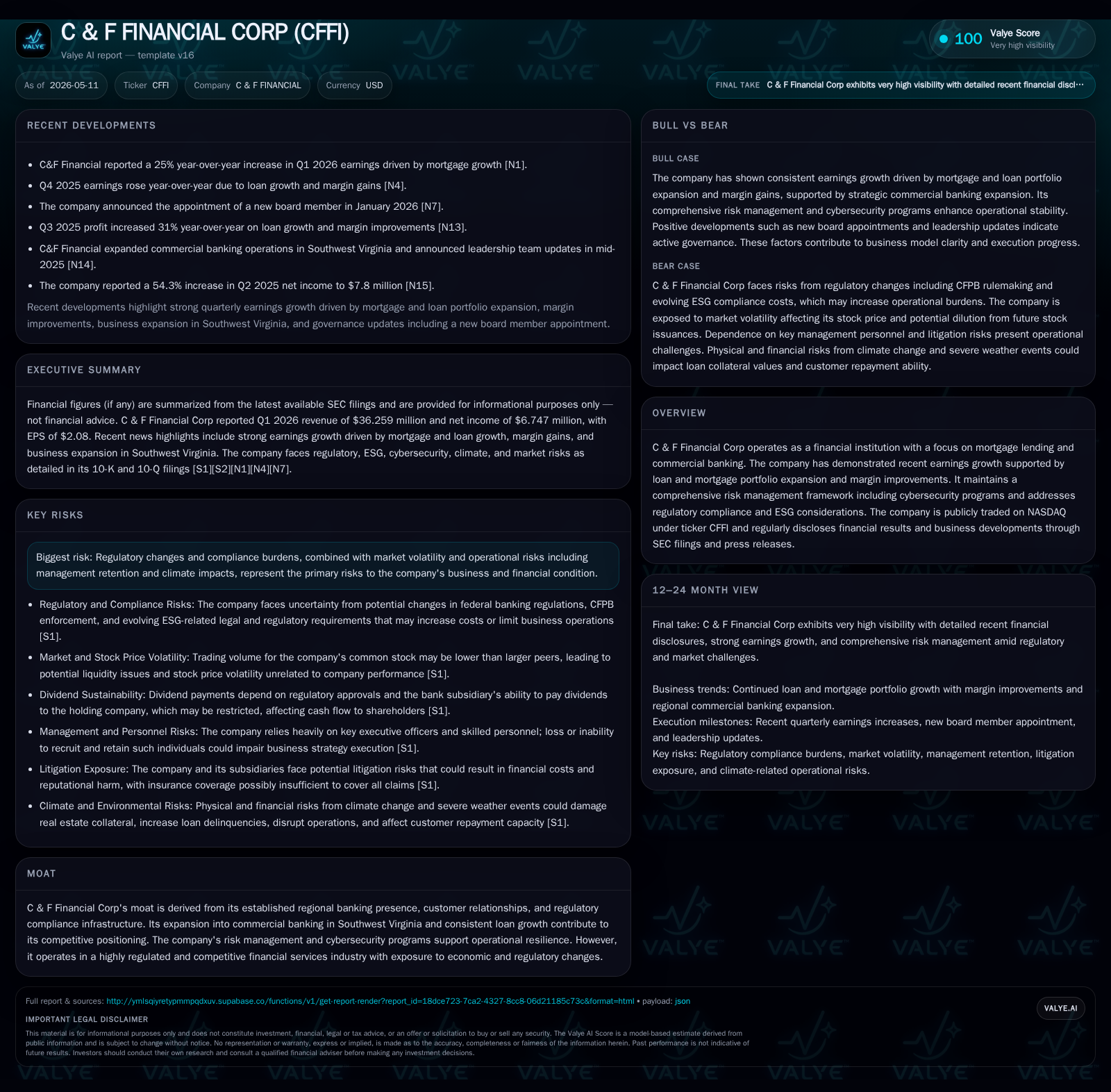
C & F Financial’s fundamental business model rests on two intertwined revenue streams: consumer mortgage lending and commercial banking operations concentrated primarily in Southwest Virginia [S1]. The first quarter press release detailed a robust +25% year-over-year uplift in earnings heavily attributable to mortgage portfolio expansion — underscoring strong customer adoption amid favorable regional housing market dynamics [N1].
Mortgage origination capabilities hinge on localized underwriting expertise calibrated for credit quality preservation, which forms the backbone for sustainable loan growth while controlling nonperforming assets risks [S1]. Meanwhile, commercial banking services cater specifically to small- and medium-sized enterprises within their core geographic footprint, driving deposit gathering and relationship-based fee income.
This dual-channel approach provides diversification benefits while leveraging embedded customer loyalty inherent to well-established regional banks — often translating into sticky deposits and cross-selling opportunities that support incremental credit extensions.
Competitive Positioning in Regional Banking Market
Within the competitive landscape of Southeastern U.S. regional banking, CFFI’s moat is multifaceted yet distinctly anchored by its long-standing local presence paired with a comprehensive risk and regulatory compliance infrastructure [S1][S3]. Regulatory compliance burdens are mounting industry-wide; thus, C & F’s proactive stance on cybersecurity programs serves as an operational resilience differentiator that aids retention among risk-averse borrowers and institutional counterparties alike.
Moreover, the recent divestment from Bearing Insurance Group signals focused capital redeployment into core banking areas rather than ancillary insurance ventures—a move suggesting sharpening of strategic priorities aligned with regulatory capital efficiency [S3]. Despite intense competition driven by larger national banks expanding regionally via technology-enabled platforms, C & F benefits from nuanced knowledge of local markets often inaccessible or less prioritized by larger peers.
Pricing power remains constrained overall due to regulatory oversight.
Drivers Fueling Loan Growth and Margin Expansion
Mortgage loan demand continues as a structural growth vector fueled by demographic trends including population retention in Southwest Virginia’s suburban areas plus relocations favoring affordability versus coastal metros—tailwinds reflected directly in recent earnings gains [N1]. Simultaneously, the elevated portfolio yield following securities reposition amplifies margin improvement prospects over subsequent years [S8].
Operationally, these yield enhancements embody not just rate hikes but also an active balance sheet tilt toward higher-return investment-grade securities supplying predictable income flows without markedly increasing credit risk profiles.
The approximately three-year horizon for recovering transactional losses from the portfolio restructuring suggests managerial confidence that market conditions will remain sufficiently stable or improve moderately over this period.
Collectively, measured loan pipeline health combined with an optimized asset mix supports positive net interest income leverage — vital for driving incremental profitability especially as fee income faces headwinds amid evolving payment landscapes.
Risk Factors: Regulatory Compliance, Market Volatility, and Climate Exposure
The company’s risk disclosures reiterate significant ongoing challenges such as potential regulatory intensification led by Consumer Financial Protection Bureau rulemaking that could heighten compliance costs or limit consumer finance offerings [S1][S5][S9]. Furthermore, physical risks associated with climate change—ranging from severe weather events impacting collateral values to macroeconomic disruptions within their geographic market—compound operational uncertainties [S9][S11].
Legal exposure remains present given periodic litigation actions common across financial services entities; reputational risks consequent to ESG missteps or non-compliance are explicitly flagged owing to stakeholder scrutiny variability [S11]. The firm also acknowledges talent acquisition and retention hurdles that could impair strategic execution under competitive labor market conditions [S22].
Volatility in capital markets might affect access cost or investment valuations; nonetheless, current public filings do not indicate immediate liquidity or leverage distress.
Outlook: Upcoming Milestones and Performance Indicators to Monitor
Attention will converge around forthcoming Q2 earnings disclosure where recognition of both Bearing sale gains and securities restructuring losses materialize explicitly within results — providing clear benchmarks for evaluating management’s forward strategy execution [S2][S3][N1]. Tracking tangible book value per share progression will serve as a tangible measure of cumulative capital return effects attributed directly to such transactions.
Additional metrics like loan origination volumes relative to deposit inflows will offer insights into balance sheet expansion sustainability amidst competitive pressures. Regulatory developments remain fluid; hence changes impacting permissible consumer products or capital requirements should be monitored closely given potential implications for cost structures.
Maintaining robust credit quality underpins confidence that accelerated loan growth does not come at the cost of inflated risk exposure.
Concise Financial Synopsis Reflecting Latest Quarter Trends
Though granular current financials are sparse beyond transaction-related guidance, companyfacts data as of September 30, 2014, indicates a net cash position with cash and equivalents of approximately $145.3 million exceeding total debt of about $133.0 million, resulting in net debt of negative $12.3 million [F1]. This net cash position supports prudent balance sheet leverage management.
Revenue infusion stems chiefly from mortgage sector growth paired with enhanced investment yields post-restructuring initiatives [N1][S8]. Net income accordingly reflects transactional gain/loss effects layered atop continuous organic profitability streams [F1][S2][S3]. Capital adequacy appears solid absent disclosures suggesting any immediate constraint or refinancing need.
Taken collectively, these financial contours substantiate C & F Financial’s capacity for measured asset growth backed by strategic capital deployment mechanisms enhancing shareholder value without elevating balance-sheet risks unduly.
This analysis synthesizes information sourced primarily from C & F Financial's SEC filings dated May 2026 (10-Q), May 2026 (8-K), March 2026 (10-K), relevant news releases, and publicly available financial snapshots up to December 2025. It aims to provide an objective assessment without expressing investment recommendations.
Disclaimer: This is research-only, informational analysis and not investment advice. It may include AI-generated interpretation and general industry context. Always verify important details using primary sources.

Comments