
Sequans Communications’ Q1 2026 Earnings Reflect IoT Focus and Strategic Shifts Post-ACP Acquisition
Sequans advances its low-power 5G IoT semiconductor solutions amid revenue pressures and Bitcoin asset monetization plans.
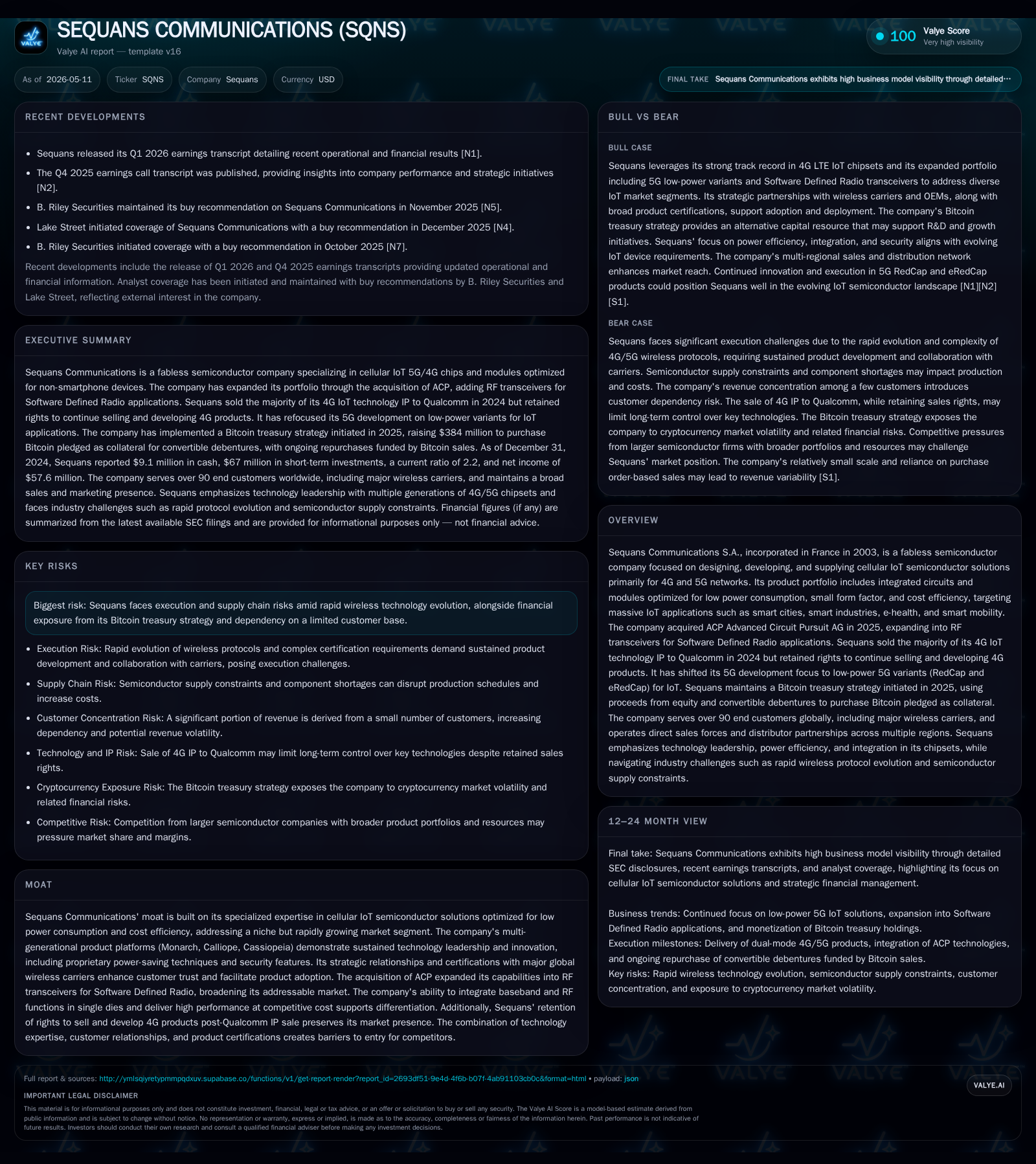
Sequans Communications reported its Q1 2026 results highlighting ongoing transformation driven by its 2025 acquisition of ACP Advanced Circuit Pursuit AG, which expanded its RF transceiver capabilities for software defined radio applications. The company continues to focus strategically on low-power cellular IoT chips optimized for massive IoT segments including smart cities and e-health. Sequans faces cyclical revenue variability due to purchase order sales dynamics with a concentrated customer base, alongside margin pressure from product mix and inventory provisions. Its Bitcoin treasury monetization strategy is transitioning from accumulation to structured asset sales supporting debt reduction and liquidity. R&D remains focused on 5G RedCap variants targeting cost-sensitive IoT devices, positioning Sequans in a niche but technically demanding semiconductor segment.
Recent Operating Update: Q1 2026 Snapshot
The core current operating lens for Sequans Communications is provided by its May 5, 2026 Form 6-K filing announcing unaudited Q1 results [S2]. While detailed line items specific to Q1 are limited, the release confirms the ongoing sequencing of strategic initiatives post the transformative acquisitions and asset sales over the prior two years. The company is navigating typical cyclicality due to purchase order-based sales channels without long-term contracts [S1], meaning quarterly revenue can swing based on customer build schedules and end-market demand.
A pivotal recent development remains Sequans' January 2025 acquisition of ACP Advanced Circuit Pursuit AG ([S1]–[S9]), a firm specialized in RF semiconductor innovation especially for software defined radio (SDR) applications such as small cells, drones, and vehicle-to-everything (V2X) systems. ACP’s technology deepens Sequans’ RF portfolio beyond baseband ICs toward integrated RF transceivers—a strategic enhancement given growing SDR adoption in wireless infrastructure where flexibility across frequency bands is critical.
Simultaneously, Sequans completed its planned monetization pivot from the majority divestiture of its legacy 4G IoT IP portfolio sold to Qualcomm Technologies at the end of Q3 2024 [S1]. While Qualcomm assumed ownership of major assets, Sequans retained rights to continue supporting existing products and further developing select LTE-M, NB-IoT (Monarch), LTE Cat-1 (Calliope), and notably low-power variants of 5G NR technology—most pertinently RedCap and eRedCap—which are purpose-built for massive IoT applications demanding ultra-low energy consumption.
Additionally, the company’s Bitcoin treasury initiative—initially financed by mid-2025 private placements aggregating over $380 million—is steadily unwinding. By early 2026, controlled sale of Bitcoin assets has funded substantial debt redemption under convertible note agreements while maintaining a reduced but meaningful crypto asset position intended for orderly monetization aligned with liquidity needs [S1].
Business Model Overview
Sequans operates a fabless semiconductor business model focused on cellular IoT chips and modules optimized for low power consumption, compact size, and cost-effectiveness tailored to massive-scale deployments in smart cities, industries, health goods, mobility, etc. Revenue streams derive primarily from:
- Product Sales: Integrated circuits combining baseband processors with radio frequency transceivers designed around LTE-M/NB-IoT/RedCap standards,
- Modules: Prevalidated systems-in-package offering ease-of-integration advantages for OEMs/ODMs,
- Licensing & Services: Product development collaborations and technology licensing related service revenues.
Sequans sells both directly to prominent OEMs/ODMs—developing telematics devices, tracking nodes, CPE/home routers—and indirectly through distributors [S1]. Substantial notable customers account for over one-third of total revenues individually though the company maintains about 90 end customers globally [S23]. This dependency yields revenue volatility as orders often follow unpredictable development cycles without binding long-term purchase commitments.
Cost structures reflect wafer fabrication outsourced mainly to major foundry players TSMC (Taiwan) and SMIC (China) since 2025 [S21], complemented by third-party assembly/testing vendors primarily in Asia. While this supports capital-light operations with flexibility across capacity planning, it exposes Sequans to supply chain fluctuations common within semiconductor foundry ecosystems. Gross margins have contracted modestly due to a higher mix shift towards modules (lower margin than bare ICs), provisioning against ageing inventory indicative of competitive pricing pressure or slower-than-expected customer uptake [S14].
The company continues to invest heavily in R&D as evidenced by increased expenditure despite overall lower revenue levels—reflecting sustained efforts in advancing its next-generation low-power cellular standards compatible chips while leveraging proprietary power-saving algorithms underpinning Monarch and Calliope platforms plus new RedCap designs targeted at cost-sensitive IoT niches [S20].
Industry Structure & Competitive Position
Sequans competes within a highly specialized segment of the semiconductor market addressing cellular IoT deployments ranging from narrowband low-throughput sensor networks (NB-IoT) up through mid-range broadband needs serviced by LTE Cat-1 and emerging low-power 5G RedCap technologies. This niche requires optimizing trade-offs between integration complexity (RF + baseband), power consumption profiles measured down to microamps during sleep states, cost per unit at massive volume scales (millions+ units), as well as regulatory carrier certifications that gate deployment internationally.
Primary competitors include larger chip vendors with diversified portfolios like Qualcomm—which acquired much of Sequans’ original IP—and smaller focused players such as Quectel and U-Blox who emphasize modules or chipset solutions balancing custom integration versus turnkey modularity. Sequans seeks differentiation via:
- Deep multi-generational platform development preserving backward compatibility,
- Proprietary low-power innovations enabling longer battery life,
- Strategic carrier relationships validated through certifications,
- Expansion into RF transceiver components through ACP acquisition enhancing control over silicon RF frontends,
- Flexibility to support multi-mode wireless protocols suited for evolving IoT use cases.
Nevertheless, escalating price competition typical for commoditized silicon at scale plus rapid standard updates compel ongoing R&D investments which are costly relative to current revenue scale.
Growth Drivers
Growth avenues for Sequans hinge chiefly on structural tailwinds governing cellular IoT market dynamics:
- Massive IoT Expansion: Proliferation of connected devices in smart cities/utilities/logistics requiring low-cost cellular connectivity,
- 5G Low Power Variants: Adoption of RedCap/eRedCap standards promising improved bandwidth/power tradeoffs suitable for wider industrial use cases,
- ACP Synergies: Leveraging ACP’s RF transceiver tech portfolio to provide more comprehensive silicon solutions potentially extending into emerging SDR applications like drones/V2X,
- New Product Innovations: Continued rollout of refined modules targeting easier integration supporting faster adoption curves among OEMs,
- Geographic Diversification: Balancing strong American customer footprints with growing exposure in China/Japan markets could mitigate regional demand swings.
Monitoring milestones like design wins with tier-one customers using RedCap offerings will help gauge market penetration trajectory along with backlog growth or recurring order volumes which traditionally mirror end-product production plans.
Risks & Watchpoints
While Sequans targets an attractive niche with focus on innovation-driven IP portfolios, several risk factors temper outlook:
- Revenue Volatility: Purchase order model causes uneven quarterly visibility; reliance on few large customers exacerbates fluctuations [S23].
- Technology Transitions: Rapid wireless standard evolution demands continuous R&D reinvestment; failure to keep pace risks obsolescence.
- Supply Chain Dependencies: Contract manufacturing reliance on TSMC/SMIC subject to geopolitical tensions or capacity constraints affects delivery timeliness.
- Profitability Pressure: Mixed shift toward lower-margin modules plus higher provisions indicate margin compression potential.
- Balance Sheet Exposure: Bitcoin holdings entail valuation volatility impacting reported earnings; asset monetization plans pose execution risk depending on crypto market cycles [S1].
- Integration Risks: ACP acquisition carries restructuring costs (~$350k) plus challenges embedding new teams/IP portfolios.
Tracking these operational markers will illuminate whether Sequans can convert its technical moat into consistent top-line growth sustainably.
Financial Profile Summary
While annual total revenues retracted from $36.8 million in 2024 down to $26.3 million in 2025 reflecting transitional impacts including Qualcomm sale proceeds disruption [S13][S19], gross margin contraction was notable—from approximately 75% gross margin down to about 54%—driven largely by higher module sales mix and inventory reserves.[S14]
Liquidity is supported by $9.1 million cash & equivalents as of December 31, 2024, with a current ratio of 2.2 reflecting solid short-term coverage [F1].
Overall, capital expenditures sharply decreased in recent years as internal capitalization paused following Qualcomm transaction but are expected to resume focusing predominantly on narrowband massive IoT technologies during scale-up phases.[S15]
This analysis is based solely on public SEC filings as referenced and does not contain investment advice or forecasts.
Disclaimer: This is research-only, informational analysis and not investment advice. It may include AI-generated interpretation and general industry context. Always verify important details using primary sources.

Comments