
Stryker’s Operational Resilience Tested by Cybersecurity and Supply Chain Challenges
A recent cyberattack disrupted Stryker's manufacturing, pressuring margins despite revenue growth, underscoring the firm's innovation moat amid short-term headwinds.
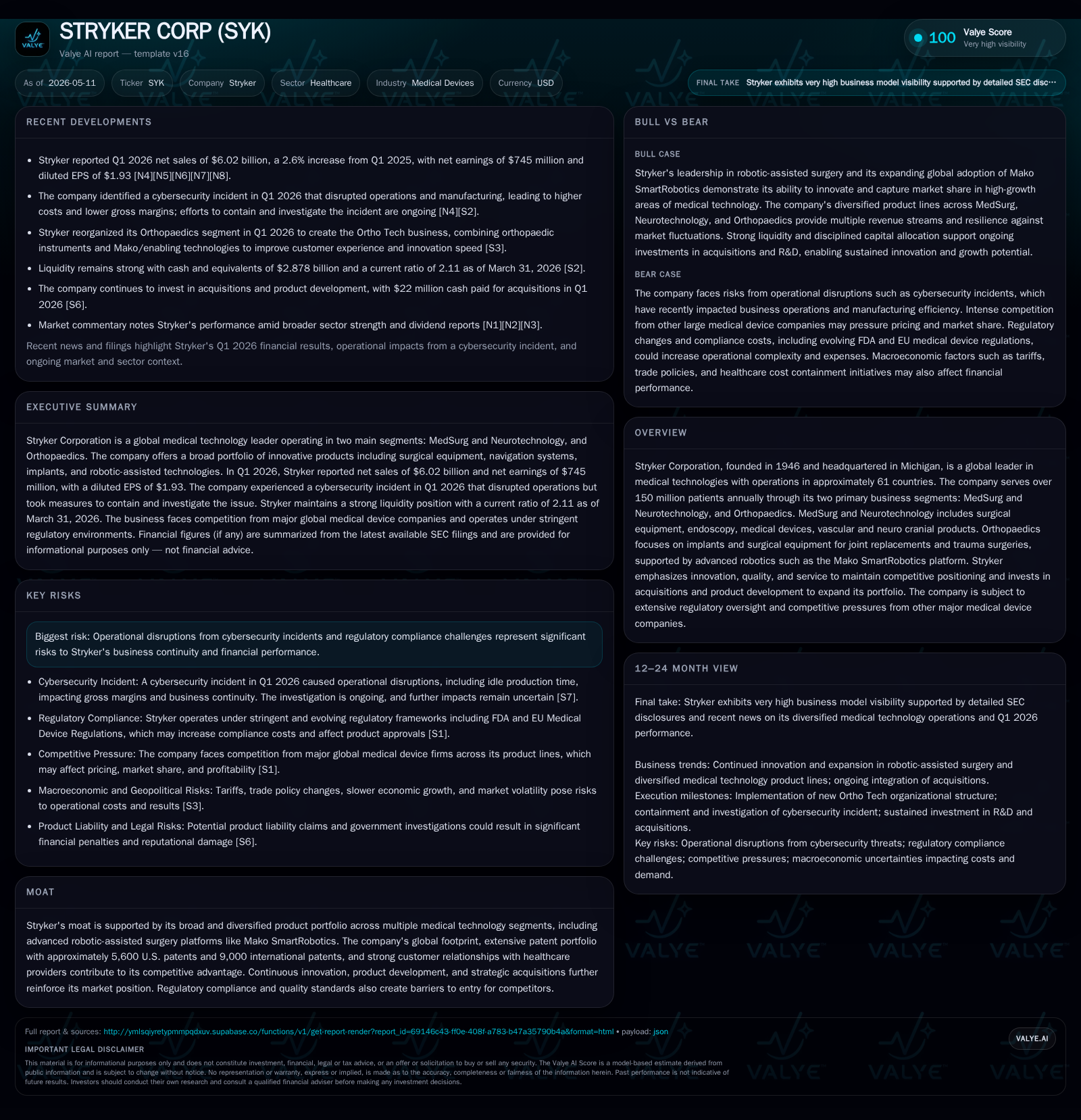
Stryker’s Q1 2026 results reveal the tangible impact of a cybersecurity incident that led to idle production time and higher supply chain costs, compressing operating margins in its MedSurg and Neurotechnology segment. Nonetheless, the company's diversified medical technology portfolio—anchored by robotic-assisted surgery platforms like Mako SmartRobotics—continues to drive volume and pricing gains. Stryker’s robust patent estate, global reach, and reinvestment in R&D support its competitive positioning amid ongoing regulatory scrutiny and evolving market dynamics. The balance sheet remains strong with abundant liquidity and minimal debt, providing financial flexibility as it navigates operational recovery and invests in growth initiatives.
Q1 2026 Operating Update: Cyber Incident’s Impact on Margins
In Stryker’s latest quarterly filing dated May 11, 2026 ([S2]), the company disclosed that its first quarter performance was materially affected by a cybersecurity incident causing idle production time primarily within its MedSurg and Neurotechnology segment. This disruption triggered elevated manufacturing and supply chain costs that compressed operating income margins significantly—from 24.8% to 21.8% as a percentage of net sales in this segment. Despite these headwinds, overall sales grew 2.6%, or 1.0% organically in constant currency terms after excluding acquisitions and divestitures.
Operating income margin for the consolidated entity improved slightly to 15.5% aided partly by price increases and volume gains; however, adjusted operating income margin fell by 180 basis points to 21.1%, reflecting the cost inflation pressures attributed to the cyber event alongside increased research and development spending ([S2], [S10]). Notably, derivative hedge reclassifications are expected to impact cost of sales and other income within the next twelve months due to inventory sold with previously hedged purchases.
In Orthopaedics—the other major reporting segment—operating margins dipped marginally from 30.4% to 30.1%, impacted by similar manufacturing inefficiencies but partially offset by reduced selling, general & administrative expenses ([S23]).
Stryker’s Business Model: Integrated MedTech Portfolio with Robotics Edge
Stryker derives revenue predominantly through two reportable segments: MedSurg and Neurotechnology, which produces surgical equipment including endoscopic systems, clinical communication platforms augmented by AI-assisted virtual care tools, vascular intervention devices (boosted recently by acquisitions such as Inari), and neuro cranial products; alongside Orthopaedics focusing on joint replacement implants, trauma-related devices, spinal implants (now divested), plus advanced surgical navigation technologies including the Mako SmartRobotics platform ([S1], [S9]).
The company sells primarily directly to hospitals, surgeons, and healthcare providers worldwide—spanning approximately 61 countries ([S1]). Its value proposition hinges on improving surgical outcomes and patient recovery times through innovative products such as robotic-arm assisted joint replacement systems which enable precision cuts reducing operative time and improving implant longevity—capabilities crucial for physician preference formation within a high-stakes purchasing environment.
Recurring revenue streams emerge from disposables and instrumentation required per procedure alongside longer lifecycle implant sales which garner stable demand tied to demographic trends favoring aging populations globally ([S1]). Investment in R&D remains robust; Q1 R&D expenses rose nominally but held flat as a percentage of sales (6.9%), underscoring commitment to innovation despite near-term cost pressures ([S7]).
Competitive Positioning within Surgical and Orthopaedic Markets
Operating amidst a concentrated landscape of global medical technology leaders such as Johnson & Johnson's DePuy Synthes unit, Zimmer Biomet, Medtronic (neurovascular devices), Stryker leverages an expansive patent moat encompassing roughly 5,600 U.S. patents plus approximately 9,000 international patents ([S1]). This intellectual property arsenal supports differentiated product designs notably in robotic-assisted surgery where high switching costs lock in hospitals due to training requirements and integration complexity.
Furthermore, regulatory hurdles across multiple jurisdictions impose stringent quality controls which act as barriers for new entrants or low-cost replicators attempting to penetrate these markets ([S1]). Stryker's global footprint coupled with direct sales force coverage facilitates deep relationships enabling tailored solutions addressing customer needs efficiently.
As hospitals increasingly adopt digitized workflow tools integrating surgical robotics with patient monitoring platforms via AI-powered analytics modules developed internally or via strategic partnerships/acquisitions (e.g., Amplitude Vascular Systems acquisition announced May 7th), Stryker continues to reinforce technological leadership while diversifying product breadth ([S20], [N5]).
Key Growth Drivers: Robotics Adoption, Product Innovation, and Geographic Expansion
Growth vectors for Stryker emanate primarily from accelerating adoption of its Mako robotic system in key orthopedic procedures like total knee arthroplasty—a category experiencing expanding clinical acceptance due to demonstrated reductions in revision surgeries ([S9]). The recent restructuring merging orthopaedic instruments with Mako-enabled technologies into an "Ortho Tech" business unit aims to streamline development pipelines for more rapid innovation cycles ([S9]).
Strategic acquisitions bolster new market penetration; for example, Amplitude Vascular Systems enhances peripheral arterial disease treatment options within the vascular business under MedSurg/Neurotechnology adding next-generation intravascular lithotripsy technology expected to expand procedural volumes globally ( [S20]). Moreover, growing investments in AI-based virtual care platforms promise augmentation of neurovascular diagnostics potentially increasing procedural throughput driven by remote monitoring capabilities.
Geographically expanding into emerging markets remains a priority given favorable demographic trends combined with rising healthcare investments particularly in Asia-Pacific regions where infrastructure improvements elevate demand for high-end surgical technologies ([S1]). While pricing power persists generally due to product differentiation in core markets, local reimbursement reforms necessitate adaptive commercial models especially pertinent as payers continue scrutinizing medical device costs.
Risks and Constraints: Cybersecurity, Cost Pressures, and Regulatory Environment
Operational risk exposure crystallized sharply with the recent cyberattack disrupting manufacturing output forcing costly idle time; management undertook swift remediation partnering with external experts although investigation is ongoing ([S2], [N3]). The persistent threat landscape renders cybersecurity an existential concern potentially affecting data integrity or operational continuity.
Supply chain volatility remains pronounced amid inflationary raw material costs besides potential tariff impacts stemming from shifting U.S.-trade policy post Supreme Court decisions on tariffs previously imposed—a dynamic Stryker actively monitors given component sourcing dependencies across multiple jurisdictions ([S4]).
Regulatory frameworks continue tightening around AI-enabled medical devices given fast-emerging legal uncertainty over intellectual property rights plus privacy/data protection rules complicating go-to-market strategies ([S1]). Additionally, payer reimbursement environments exhibit sustained downward pressure on pricing necessitating continued innovation cycles balanced against margin impact risks.
Key Near-Term Watchpoints: Recovery Trajectory, Product Launches, and Guidance Updates
Market participants should monitor upcoming earnings announcements assessing trajectory on operating margin recovery following ongoing remediation of cyber incident effects alongside normalization in supply chain costs ([N5], [S2]). Progression of next-generation surgical navigation system rollouts attributable to the Ortho Tech restructure will serve as a bellwether for innovation cadence acceleration.
Management commentary regarding supply chain resiliency improvements plus details on integration outcomes from latest acquisitions including AVS will illuminate execution potency amidst challenging macro backdrops ([N5], [S3]). Investor focus may also sharpen on maintaining R&D investment levels critical for sustaining competitive differentiation while managing short-term profitability tradeoffs.
Financial Snapshot: Strong Liquidity amid Margin Compression
Latest financial snapshot
| Metric | Value | Period |
|---|---|---|
| Cash & equivalents | $2.9bn | |
| 2026-03-31 | ||
| Current assets | $13.3bn | |
| 2026-03-31 | ||
| Current liabilities | $6.3bn | |
| 2026-03-31 | ||
| Current ratio | 2.11x | |
| 2026-03-31 |
Source: SEC companyfacts cache [F1].
A strong balance sheet buffers near-term operational challenges—with cash & equivalents totaling $2.88 billion at quarter-end March 31st against minimal debt outstanding (~$24 million by oldest available measure; no borrowings under revolving credit facilities) resulting in a robust current ratio of 2.11 supporting day-to-day liquidity needs ([F1], [S2], [S20]).
Net earnings rose year-over-year to $745 million or $1.93 per diluted share reflecting scale benefits; however adjusted net earnings per diluted share declined about 8.5% signaling margin pressures remain a near-term constraint requiring efficient cost management going forward ([S10], [F1]). Capital expenditure increased moderately ($166 million total), focused predominantly on capacity expansion supportive of long-term growth ambitions ([S18]).
Note: This analysis is based exclusively on publicly available SEC filings up to May 11th, 2026 and credible news sources cited herein without speculative extrapolation or investment advice.
Disclaimer: This is research-only, informational analysis and not investment advice. It may include AI-generated interpretation and general industry context. Always verify important details using primary sources.

Comments