
OraSure Technologies Bolsters Diagnostic Portfolio Amid Regulatory Challenges
OraSure's latest quarterly results emphasize innovation in diagnostics within a stringent regulatory environment, highlighting its growth prospects and operational risks.
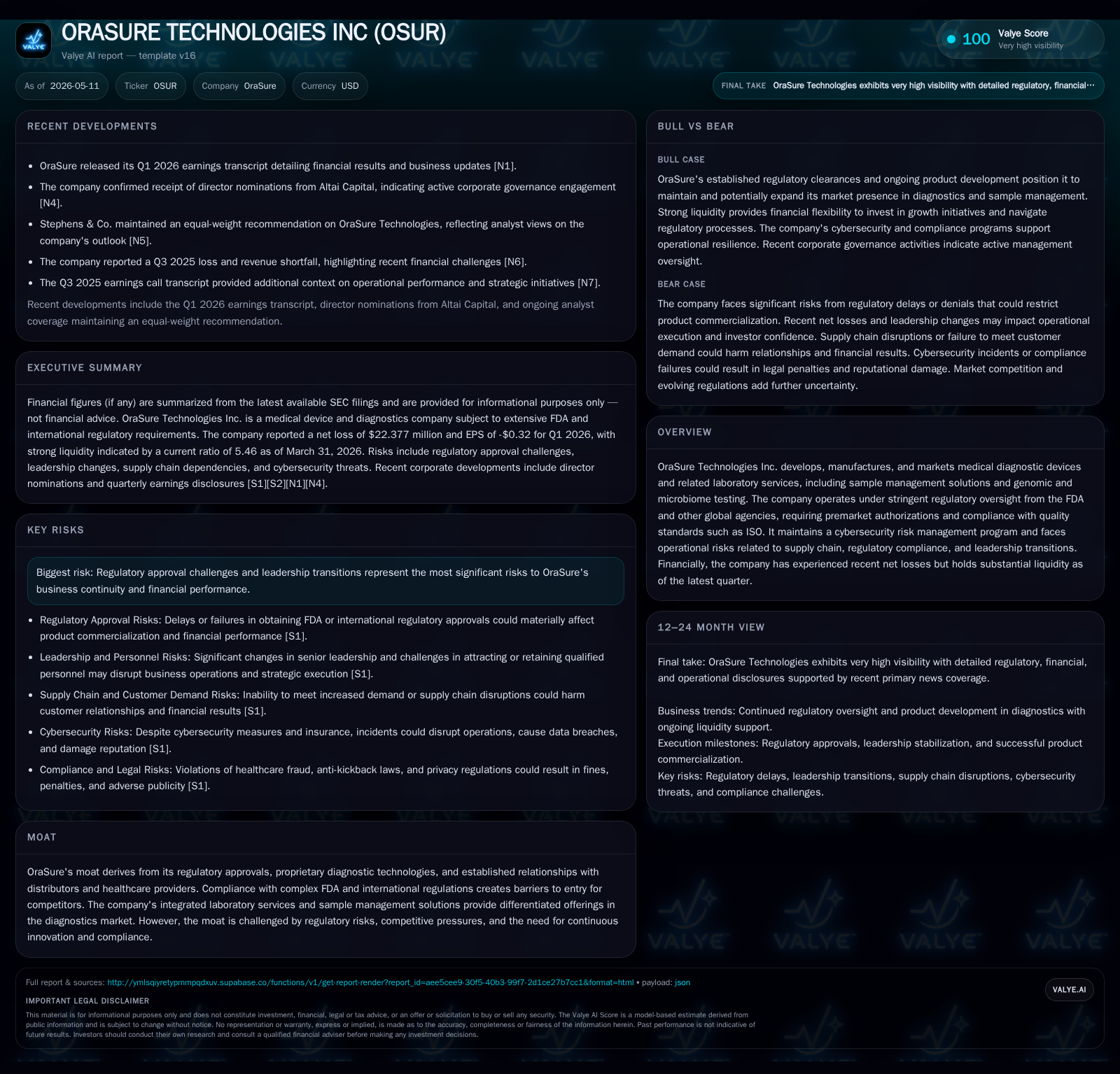
In Q1 2026, OraSure Technologies maintained strong liquidity while navigating ongoing net losses and regulatory complexities. The company’s business model encompasses proprietary diagnostic devices, integrated laboratory services including genomics, and comprehensive sample management solutions underpinned by FDA and international approvals. Its competitive moat is shaped by regulatory barriers, technological differentiation, and distributor networks, although regulatory delays and leadership transitions pose material risks. Looking ahead, product approvals and sales expansion will be critical milestones.
Latest Quarterly Operating Update: Key Developments and Implications
OraSure Technologies’ Q1 2026 10-Q filing [S2] illuminates a continuing pattern of operating losses alongside a robust liquidity position that anchors the company's near-term operational flexibility. As of March 31, 2026, OraSure held approximately $177 million in cash and equivalents supported by a strong current ratio of 5.46 [F1], evidencing ample short-term asset coverage over liabilities. This financial footing enables sustained investment in R&D activities aimed at diagnostic innovation despite net losses reported in the prior full fiscal year [F1]. The accompanying May 6 event filing (8-K) [S3] reinforced these points during the earnings webcast where management disclosed ongoing initiatives in product pipeline development and market expansion despite regulatory headwinds.
Revenues highlighted in the latest filings show continued recovery efforts post-pandemic disruptions; however, detailed top-line figures from the quarter were not explicitly updated in the source material. Operationally, the company remains committed to scaling laboratory testing capabilities for genomics and microbiome services alongside its core device portfolio – recognizing that the regulatory environment imposes substantial time and cost burdens on bringing new products to market [S2]. These constraints underline why liquidity strength matters deeply for endurance.
Business Model and Product Quality: Diagnostic Devices, Lab Services and Beyond
OraSure’s revenue model is undergirded by a diversified mix spanning three principal vectors: proprietary diagnostic devices; laboratory services incorporating advanced genomic and microbiome analyses; and comprehensive sample management solutions [S1]. The dominant revenue contributors remain rapid diagnostic devices deployed across clinical settings and the consumer self-testing market globally. These products require rigorous FDA clearances — often via 510(k) pathways or premarket authorizations — to reach patients legally [S1], which adds complexity but confers customer trust through validated performance claims.
Complementing devices are laboratory services facilitated through integrated genomic testing platforms leveraging company-owned labs equipped for cutting-edge clinical assessments [S1]. These offerings extend beyond diagnostics into personalized medicine arenas targeting precision health trends. The sample management division addresses logistical challenges faced by healthcare providers in specimen collection, transportation, and processing workflows enhancing customer stickiness via contractually anchored arrangements.
Importantly, OraSure maintains strict adherence to ISO quality certifications crucial for medical device manufacturing reliability alongside compliance with global regulatory regimes such as the European Union’s IVDR [S1]. This comprehensive compliance framework supports product quality assurance critical for maintaining supplier-customer trustworthiness amid evolving safety requirements.
Industry Structure and Competitive Positioning in Medical Diagnostics
The medical diagnostics industry is characterized by formidable regulatory gatekeeping primarily directed by bodies such as the FDA in the United States alongside international agencies enforcing standards like ISO certifications [S8]. These create significant entry barriers limiting competition mostly to established players possessing necessary regulatory expertise and clinical trial capabilities.
OraSure’s competitive moat is notably derived from this heavy regulatory overlay combined with proprietary technology systems protecting intellectual property embedded within their diagnostic devices [S1]. Established distribution partnerships with major healthcare providers further reinforce switching costs that disincentivize customer migration to rival platforms. However, this industry structure can also slow go-to-market velocity owing to prolonged approval cycles exacerbated recently by agency staffing shortages and funding uncertainties impacting review timelines [S6].
Pricing dynamics are pressured by commoditization trends among basic diagnostic tests but partially insulated at higher-tech genomics/lab service tiers where specialized offerings command premium margins. Supply chain stability remains a focal point given reliance on precision components susceptible to disruption or cost inflation [S13].
Growth Drivers: Innovation, Regulatory Approvals, and Market Expansion
Future top-line growth hinges on multiple measurable vectors: expediting FDA clearances or approvals for new product launches accelerates revenue realization post-investment cycles [S4]. The ongoing development pipeline targeting improved rapid diagnostics—especially self-administered tests—and expanded lab testing portfolios with next-gen genomic assays positions OraSure well within growing precision medicine trends.
Strategic acquisitions augmenting complementary technologies or adding geographic footprints are noted as avenues under exploration [N1]. Management commentary highlights plans to broaden direct sales channels internationally while deepening penetration in existing segments to capture increasing demand driven by public health initiatives for infectious disease monitoring.
Operational metrics such as backlog orders for newly cleared tests, renewal rates on lab service contracts, utilization rates at owned lab facilities, and distributor adherence to volume commitments serve as important KPIs around how scalable growth will be executed effectively [S3]. Enhanced manufacturing efficiencies aimed at reducing cost of goods sold will also contribute positively if realized at scale.
Risks and Constraints: Regulatory Hurdles, Leadership Changes, and Competitive Pressures
Regulatory approval delays represent a prominent constriction point due to costly clinical data requirements underpinning premarket authorization processes—risking postponed launches with attendant revenue impacts [S8]. Additionally, evolving US healthcare fraud-and-abuse laws impose compliance costs that could affect promotional practices or distributor arrangements adversely if violations occur inadvertently [S5].
Leadership transitions pose executional uncertainty given dependency on experienced senior executives adept at navigating complex regulatory landscapes; any loss could disrupt strategic momentum [N1]. Competitive pressures from both established diagnostics companies offering lower-cost alternatives or new entrants leveraging breakthrough technologies impose margin compression risk especially if differentiated value propositions erode over time.
Cybersecurity threats form an emerging risk vector impacting client data privacy obligations under HIPAA-like regulations; breaches could inflict reputational damage alongside financial penalties necessitating continuous investment in IT security governance overseen by dedicated committees reporting up to audit functions [S22].
Macro-level factors such as geopolitical tariff fluctuations or inflation may indirectly suppress demand or inflate operational expenses further pressuring profit margins absent effective cost pass-through mechanisms [S29].
Upcoming Milestones and What to Watch Next
Investors should focus intently on FDA review outcomes of key pipeline products slated for submission or ongoing clinical data gathering as disclosed post-Q1 filings. Monitoring quarterly revenue compounding against incremental gross margins will provide clarity on commercialization success rates [S3].
Management guidance updates around capital expenditure plans for lab capacity expansion or strategic collaborations announced in upcoming investor communications will inform near-term capital deployment rationales. Moreover, any shifts communicated regarding share repurchase programs or equity issuances could signal balancing acts between liquidity preservation versus shareholder returns [S7].
Data privacy regulation evolutions at state or federal levels remain watchpoints impacting compliance costs or customer engagement approaches particularly around genomic data handling frameworks required for expanding personalized testing markets.
Latest Financial Profile: Liquidity Strength Amid Ongoing Losses
Latest financial snapshot
| Metric | Value | Period |
|---|---|---|
| Cash & equivalents | $177mm | |
| 2026-03-31 | ||
| Current assets | $241mm | |
| 2026-03-31 | ||
| Current liabilities | $44mm | |
| 2026-03-31 | ||
| Current ratio | 5.46x | |
| 2026-03-31 |
Source: SEC companyfacts cache [F1].
As evidenced in the latest quarter ending March 31, 2026 [F1], OraSure holds cash & equivalents totaling approximately $176.96 million with current assets of $240.78 million against current liabilities of $44.08 million—yielding an exceptionally healthy current ratio of 5.46 indicative of sound short-term balance sheet health supporting operational investments. Despite persistent historical operating losses reflected most recently at approximately $72 million annually ending December 2025 [F1], this liquidity buffer allows OraSure to continue funding innovation pipelines without immediate refinancing pressure.
| Metric | Value (USD) |
|---|---|
| Cash & Equivalents | 176,964,000 |
| Current Assets | 240,781,000 |
| Current Liabilities | 44,084,000 |
| Current Ratio | 5.46 |
This analysis relies exclusively on recent quarterly disclosures supplemented with historical annual information strictly for contextualizing business operations per defined policy guidelines. All statements avoid investment advice.
Disclaimer: This is research-only, informational analysis and not investment advice. It may include AI-generated interpretation and general industry context. Always verify important details using primary sources.

Comments