
California BanCorp Strengthens Community Banking Model Amid Q1 2026 Profit Pressure
Q1 2026 results highlight earnings contraction tied to loan portfolio challenges and competitive market pressures.
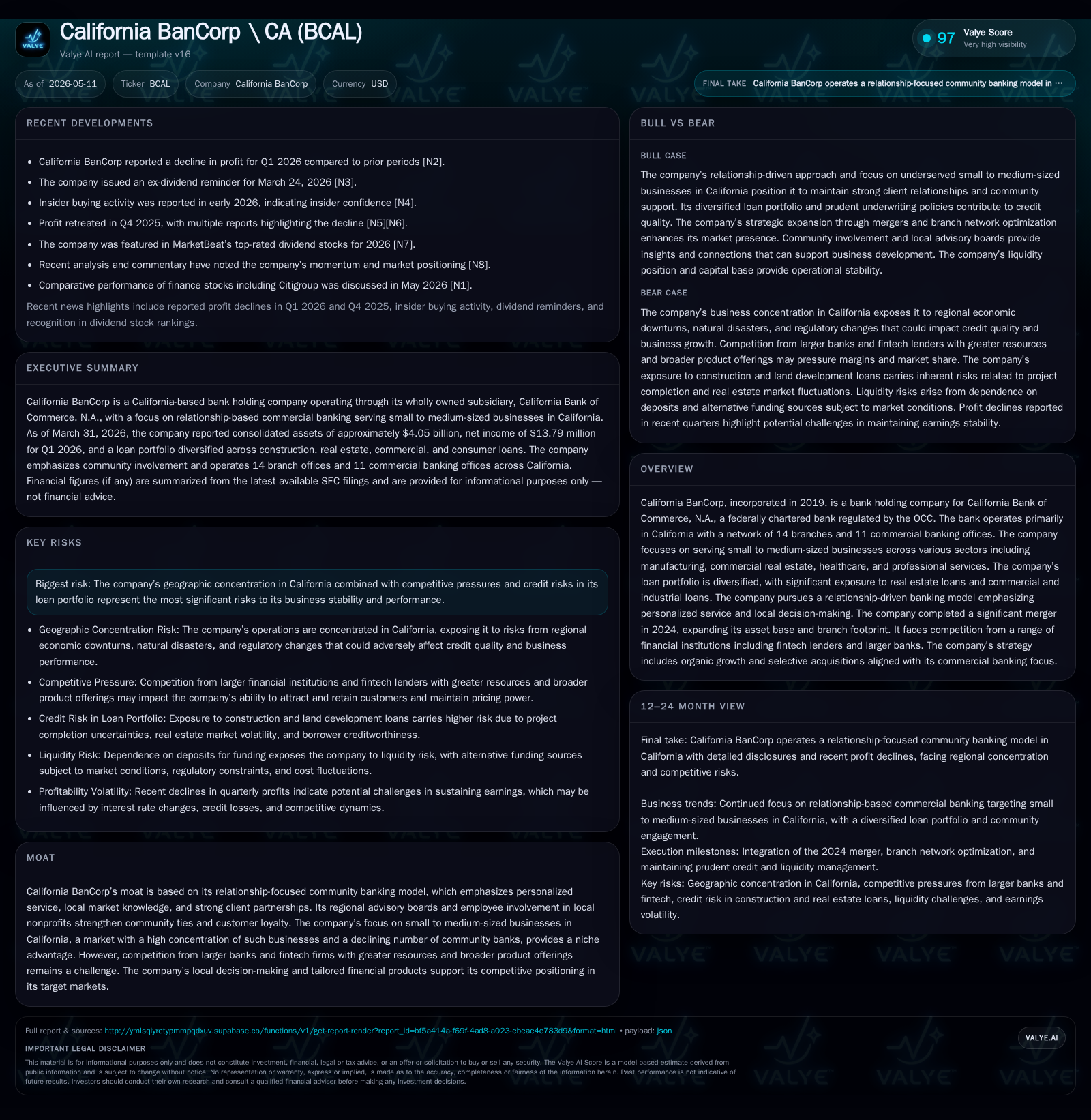
California BanCorp reported a decline in net income for Q1 2026 compared to the prior year period, reflecting increased credit costs linked to specific nonperforming loans and heightened competition in the California banking sector. The company continues to emphasize its relationship-driven community banking strategy focused on small and medium-sized businesses, leveraging its regional footprint and personalized decision-making. Despite near-term profitability headwinds and concentrated geographic risk, ongoing expansion of its branch network and diversified loan portfolio underpin its growth prospects. Key risks stem from California's economic sensitivity, loan quality volatility especially in commercial real estate, and competitive pressures from fintech and larger banks.
Recent Operating Update
California BanCorp’s Q1 2026 filing reveals a notable net income decline to $13.8 million from $16.9 million in the year-ago quarter [S2][F1]. This contraction primarily traces back to elevated credit costs from two nonaccrual loans secured by a large event venue property in Los Angeles, as detailed in an April 2026 earnings release [S3]. While overall asset size exhibited modest growth to over $4 billion, loan balances dipped slightly, notably reflecting a reduction in loans held for investment to about $2.97 billion [S2].
Cash and equivalents increased marginally to $411 million by quarter-end with total borrowings steady near $34 million—resulting in a net debt position that is negative by approximately $377 million—a conservative balance sheet strength signal for a regional bank [F1][S2]. The bank’s deposit base shows stability with total deposits around $3.39 billion.
The company’s common stock buyback program remained active with about 410 thousand shares repurchased during the quarter at an average price of $18.08 per share, signaling management’s confidence amidst earnings headwinds [S11].
Business Model
California BanCorp operates as a federally chartered bank holding company for California Bank of Commerce, N.A., focusing on servicing small-to-medium sized businesses (SMBs) across California via customized relationship banking models [S1]. Its revenue largely derives from net interest income generated by lending activities across multiple commercial sectors plus fee income from treasury services.
Its loan portfolio composition is heavily concentrated in commercial real estate (CRE) loans—comprising roughly 60% of total loans—targeting owner-occupied properties, multi-family residential housing, and other CRE assets with typical loan-to-value ratios capped at around 75% [S23]. Commercial & Industrial (C&I) loans form a substantial segment (~20%) financing operational capital needs of SMBs beyond real estate collateral while construction and land development loans add around 4.6% exposure involving higher risk profiles due to the nature of underlying projects [S23][S14]. SBA-guaranteed loans provide additional diversification but represent a smaller fraction.
The bank’s value proposition rests on localized decision-making authority embedded within its branch network which includes 14 full-service branches plus 11 commercial banking offices spread largely within Southern California markets after the merger integration completed mid-2024—expanding both its asset base and market reach substantially [S1][S29]. This structure enables enhanced responsiveness to client needs and underwriting tailored credit solutions fostering long-term deposit relationships.
Customer behavior reflects loyalty driven by personal service accessibility coupled with advisory input from regional business boards feeding local economic insights into credit decisions. Deposit offerings revolve around relationship-demand accounts including NOW accounts, money markets, savings products as well as time deposits designed for SMBs seeking flexibility balanced with yielding features backed by FDIC insurance up to regulatory limits enhancing depositor confidence [S5].
Industry Structure & Competitive Position
California BanCorp operates within the crowded Microsoft-shaped banking industry fabric surrounding California's diverse SMB segment but faces concentration risks tied to single-state exposure compounded by regional economic dependence on sectors like CRE development which cyclically fluctuate based on macroeconomic variables such as interest rates and local market demographics.
The competitive field consists of large national banks equipped with extensive product breadth including sophisticated digital platforms; fintech entrants presenting convenience-oriented lending alternatives often with less regulatory overhead; alongside midsize regional banks jockeying similarly for SMB wallet share via personalized yet scalable offerings [S1].
In this context California BanCorp leverages its community-bank moat rooted in:
- Strong client relationship focus prioritizing cross-selling deposit products alongside credit extensions tailored around borrower cash flows.
- Regional advisory boards amplifying local market intelligence gathering aiding risk management.
- Employee engagement with nonprofit organizations enhancing reputational goodwill that nurtures referral networks.
Further growth support stems from post-merger synergies realized through branch consolidations providing deeper penetration into Northern California markets previously less served by the bank's legacy footprint enabling access to newer customer cohorts.
Loan portfolio diversification efforts targeting SBA loans may help moderate cyclical CRE risks over time complemented by measured expansion into commercial & industrial lending segments emphasizing flexible structures aimed at improving client retention metrics.
The stable deposit franchise funded chiefly through noninterest-bearing demand deposits — accounting for over one-third of total deposits — provides a low-cost funding advantage underpinning net interest margins albeit sensitivity persists relative to broader interest rate movements impacting asset yields versus cost of funds dynamics.
Technological enhancements that facilitate remote deposit captures along with ACH capabilities improve operational efficiency aiding client satisfaction though competitive catch-up remains necessary vis-à-vis fintech innovation velocity.
Risks / Watchpoints / Growth Constraints
Key vulnerability resides in geographic concentration: any adverse economic shock or regulatory tightening within California disproportionately affects loan repayments creating credit loss volatility especially inside construction/land development credit where project completion risk and collateral illiquidity amplify loss severity potential post-defaults noted already during Q1 related to event venue property underperformers [S3][S14][N2].
Competitive intensity represents another constraint with fintech lenders circumventing some traditional regulatory costs allowing more aggressive loan pricing or rapid approval processes posing threats particularly toward younger SMB clients amenable to streamlined digital experiences absent same-person service.
Liquidity reliance on core deposits surpassing FDIC insurance thresholds introduces susceptibility during episodes of depositor anxiety which might trigger outflows forcing reliance on more expensive alternative funding sources affecting profitability adversely.[S8]
Regulatory compliance burden remains substantial given ongoing updates affecting capital rules, anti-money laundering protocols, cybersecurity safeguards among others requiring continual investment diverting resources away from growth initiatives.[S1]
Finally staff retention amid competitive talent markets especially for specialized lending officer roles is critical since executive leadership heavily influences portfolio risk management philosophies.[S1]
What To Watch Next
Key upcoming catalysts include monitoring quarterly credit loss trends beyond Q1 weakness focusing on resolution or further deterioration of recognized nonaccrual assets including foreclosed real estate owned balances carried through wholly owned subsidiaries [S2].[N2]
Branch network expansion efficacy should be tracked via new account openings along with deposit growth metrics indicative of wallet share gains within targeted Californian SMB sectors.[N2]
Assessments around technology platform enhancements adoption rates can offer insights into future customer acquisition/retention improvements.
Watch management commentary closely for capital allocation shifts including potential acceleration or pause of share repurchases linked directly to liquidity conditions or regulatory feedback.[S11]
Macro-economic indicators such as local CRE market values or unemployment rates will remain vital external benchmarks influencing underlying loan repayment capacity thus shaping future performance outlook.[N2]
Financial Profile - Latest Snapshot Summary
Latest financial snapshot
| Metric | Value | Period |
|---|---|---|
| Cash & equivalents | $411mm | |
| 2026-03-31 | ||
| Total debt | $34mm | |
| 2026-03-31 | ||
| Net debt | $-377mm | |
| 2026-03-31 |
Source: SEC companyfacts cache [F1].
This snapshot illustrates a solid liquidity cushion relative to debt load providing financial flexibility amid operating volatility.[F1]
Disclaimer: This analysis is provided solely for informational purposes based on publicly available SEC filings and related disclosures as of May 2026. It does not constitute investment advice or recommendations regarding securities of California BanCorp.
Disclaimer: This is research-only, informational analysis and not investment advice. It may include AI-generated interpretation and general industry context. Always verify important details using primary sources.

Comments