
Constellation Energy Expands Scale and Scope with Calpine Acquisition; Focus on Clean Energy Reliability
Constellation Energy's 2026 Q1 report highlights integration milestones post-Calpine acquisition, reinforcing its position as the largest private-sector U.S. power producer with diversified clean and natural gas assets.
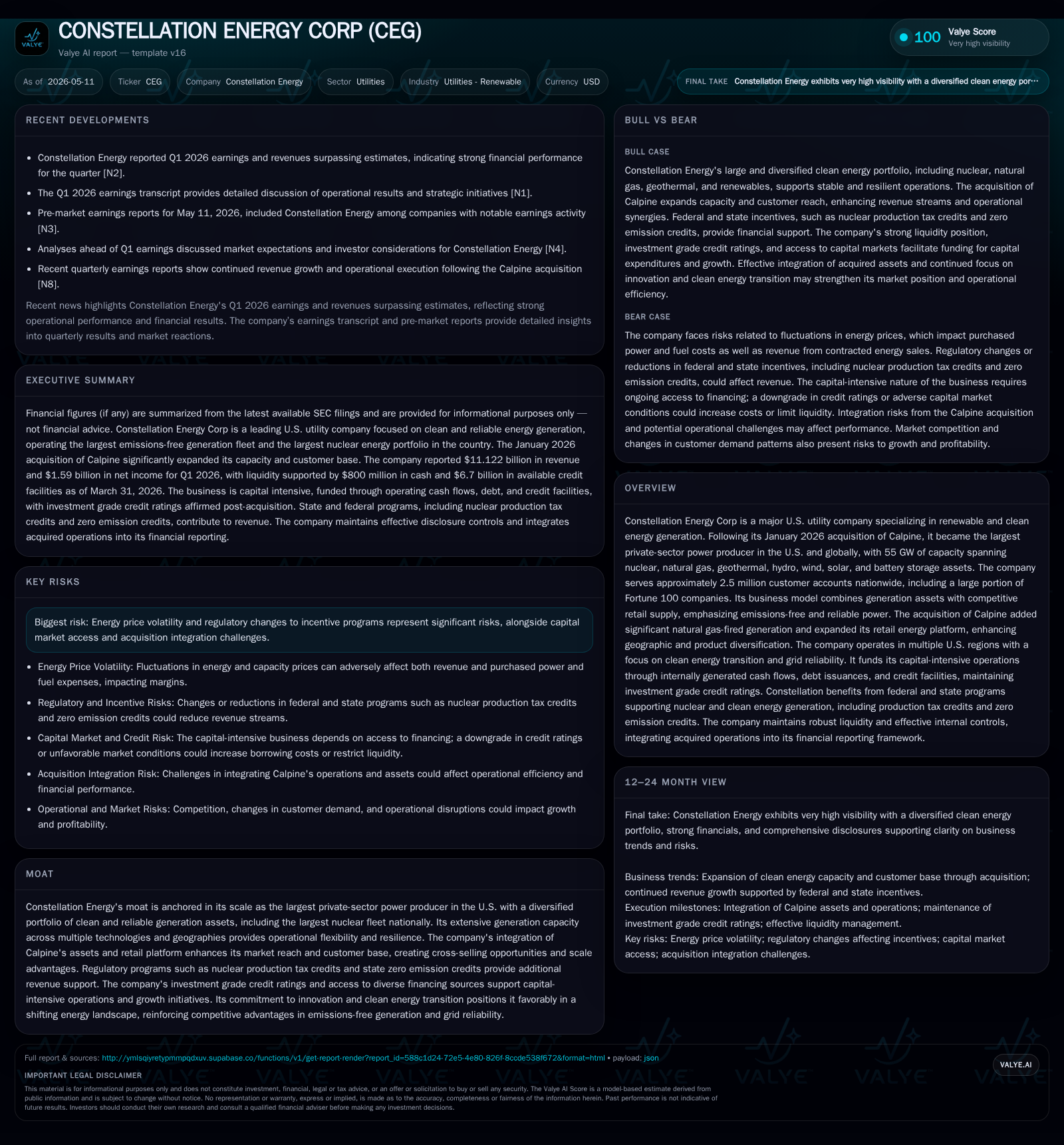
In its first quarter 2026 filing, Constellation Energy detailed the ongoing integration of Calpine, broadening its generation portfolio to 55 GW spanning nuclear, natural gas, geothermal, hydro, wind, solar, and battery storage. The acquisition substantiates Constellation's status as the leading private U.S. power producer by capacity and extends its competitive retail supply footprint. The company’s business model leverages a diversified asset base to provide reliable, emissions-free power to approximately 2.5 million customers, including much of the Fortune 100. Key growth drivers include regulatory incentives for nuclear and renewables, geographic diversification through Calpine’s footprint, and innovation investment. Risks include exposure to energy price volatility, regulatory changes to subsidy programs, and integration complexities. Liquidity remains robust with a current ratio of 1.36 and investment grade credit ratings sustaining access to capital markets.
Recent Operating Update: Q1 2026 Filing Anchors New Scale Post-Calpine Acquisition
Constellation Energy’s quarterly disclosure on May 11, 2026 ([S2]) centers heavily on the ongoing operational integration of Calpine following the closed acquisition in January 2026 ([S1]). This transaction elevated Constellation to the largest private-sector power producer in the U.S. and globally with a total combined capacity of around 55 GW spanning multiple generation technologies.
The filing emphasizes that management views this scale expansion as transformational, bolstering geographic diversification particularly in high-growth demand regions including Texas, California, and the Northeast through Calpine’s strong natural gas and geothermal holdings. The company reiterated progression toward full internal control integration but flagged ongoing efforts to harmonize financial reporting systems by year-end 2026 ([S2]).
Concurrently reported liquidity metrics reflect a healthy balance sheet position with cash and equivalents at $800 million against $13.215 billion in current liabilities yielding a current ratio of approximately 1.36 ([F1]), supporting planned capital expenditures for renewables and battery storage expansion.
Earnings releases attached to the event filing ([S3]) supplement discussion on solid Q1 operational performance contributing positively to consolidated revenues.
Business Model: Integrated Generation and Retail Supply Emphasizing Emissions-Free Power
Constellation Energy operates an integrated business combining large-scale power generation with competitive retail energy supply. Its revenue stems primarily from electricity sales — generated and retailed — supported by long-term contracts for nuclear power complemented by merchant market sales from natural gas turbines acquired via Calpine.
The company’s strategic strength lies in its diversified asset portfolio: nuclear units represent stable baseload generation complemented by flexible natural gas plants used for peaking needs or balancing intermittent solar and wind resources. This mix reduces reliance on any single fuel source or market segment.
Additionally, Constellation serves about 2.5 million customer accounts nationwide across commercial and industrial sectors including three-fourths of Fortune 100 companies ([S1]). This retail division generates recurring revenues through contracts indexed to customer demand profiles and pricing arrangements.
Critical to the business model are federal incentives such as nuclear Production Tax Credits (PTCs) extending through at least 2032 as well as various state zero-emission credit programs that augment revenue flows for emissions-free nuclear power ([S1]). However, some programs are subject to phase-out or refund provisions potentially compressing margins over time.
Industry Structure and Competitive Position
Constellation occupies a leading role in a highly regulated yet dynamically evolving electricity industry characterized by rising penetration of renewables paired with persistent demand for reliable baseload power.
Post-Calpine acquisition, it commands an unrivaled scale among private-sector generators—larger than NextEra Energy or Dominion Energy in pure generation GW terms—allowing operational scale benefits including bargaining power with fuel suppliers and financiers.
Its diverse portfolio offers resilience against regional regulatory shifts or commodity cycles; for example, Texas’ ERCOT market volatility is offset by regulated state environments in Illinois or Maryland where nuclear plants benefit from long-term contracts.
Competitive retail supply contends within deregulated states against utilities like NRG Energy or Direct Energy but benefits from integrated supply capabilities providing hedging advantage especially for large commercial clients seeking sustainability commitments.
Growth Drivers
Geographic Diversification & Asset Expansion
Calpine added roughly 23 GW across natural gas-fired and geothermal assets along with battery storage projects expanding Constellation’s footprint into key fast-growing demand corridors ([S1], [S2]). The inclusion improves load balancing capabilities critical as intermittent renewables rise nationally.
Regulatory Incentives for Nuclear & Renewables
Nuclear PTCs incentivize continued operation of aging nuclear units through at least early next decade while state zero emission credits provide additional revenue support though subject to renewal risk ([S1]). Federal climate policies likely underpin sustained support favoring cleaner energy sources.
Innovation & Technology Investment
The company highlights ongoing investments in advanced technologies including expanded battery storage deployment (as per Nova Power projects) aiming to enhance grid reliability packaged with clean energy offerings ([S1]).
Retail Customer Base Stability & Expansion
Serving ~2.5 million retail customers offers revenue visibility; increasing corporate sustainability mandates among Fortune 100 firms fosters demand for bundled clean energy contracts leveraged by Constellation’s integrated generation resources ([S1]).
Risks / Watchpoints / Growth Constraints
Commodity Price Volatility Impacting Merchant Gas Generation Margins
Natural gas price spikes or weakness can materially affect earnings from merchant plants acquired from Calpine which operate in competitive wholesale markets exposing Constellation to margin variability ([S1]).
Regulatory Policy Uncertainty on Incentive Programs
Federal nuclear PTC phase-outs beginning after early 2030s alongside expiration or contraction of state zero emission credits create medium-term uncertainty around revenue streams supporting legacy generation assets ([S1]).
Integration Execution Risk Post-Acquisition
Debt Levels & Capital Markets Access Sensitivity
Total debt stands near $17.48 billion with net debt approximately $16.68 billion ([F1]). Maintaining investment grade ratings is critical given capital-intensive nature of utility operations; downgrade risk could increase collateral requirements (£3B estimated collateral increment if downgraded below investment grade) impacting liquidity ([S1], [S2]).
What to Watch Next
- Full-year integration metrics for Calpine assets in subsequent quarterly filings examining synergy realization benchmarks,
- Updates on nuclear PTC legislative or regulatory changes given their material earnings impact,
- Retail customer book growth rates particularly among high-profile corporate accounts signaling demand traction for sustainability-focused products,
- Commodity price trends affecting merchant operations profitability,
- Debt refinancing activity or credit rating announcements maintaining funding flexibility,
- Expansion progress on battery storage projects such as Nova Power developments enhancing grid services capabilities.
Financial Profile Snapshot (As of March 31, 2026) [F1]
Latest financial snapshot
| Metric | Value | Period |
|---|---|---|
| Cash & equivalents | $800mm | |
| 2026-03-31 | ||
| Total debt | $17.5bn | |
| 2026-03-31 | ||
| Net debt | $16.7bn | |
| 2026-03-31 | ||
| Current assets | $18.0bn | |
| 2026-03-31 | ||
| Current liabilities | $13.2bn | |
| 2026-03-31 | ||
| Current ratio | 1.36x | |
| 2026-03-31 |
Source: SEC companyfacts cache [F1].
Liquidity remains sufficient to support capital expenditure plans while scale mitigates financing costs despite elevated absolute leverage levels consistent with capital-intensive utilities.
This analysis synthesizes information from Constellation Energy Corporation's latest quarterly report filed May 11, 2026 [S2],[S3], annual context from their February 24, 2026 Form 10-K [S1], supplemented by current financial snapshot data [F1]. It reflects operating developments post-Calpine acquisition central to the company’s expanded strategic positioning within U.S. utility markets emphasizing clean energy focus tempered by regulatory and commodity risks inherent to the power sector.
Disclaimer: This is research-only, informational analysis and not investment advice. It may include AI-generated interpretation and general industry context. Always verify important details using primary sources.

Comments