
Evolution Global Acquisition Corp Advances with Fresh Leadership Amid SPAC Market Flux
EVOX maintains trust account integrity and navigates leadership change while poised for critical business combination execution.
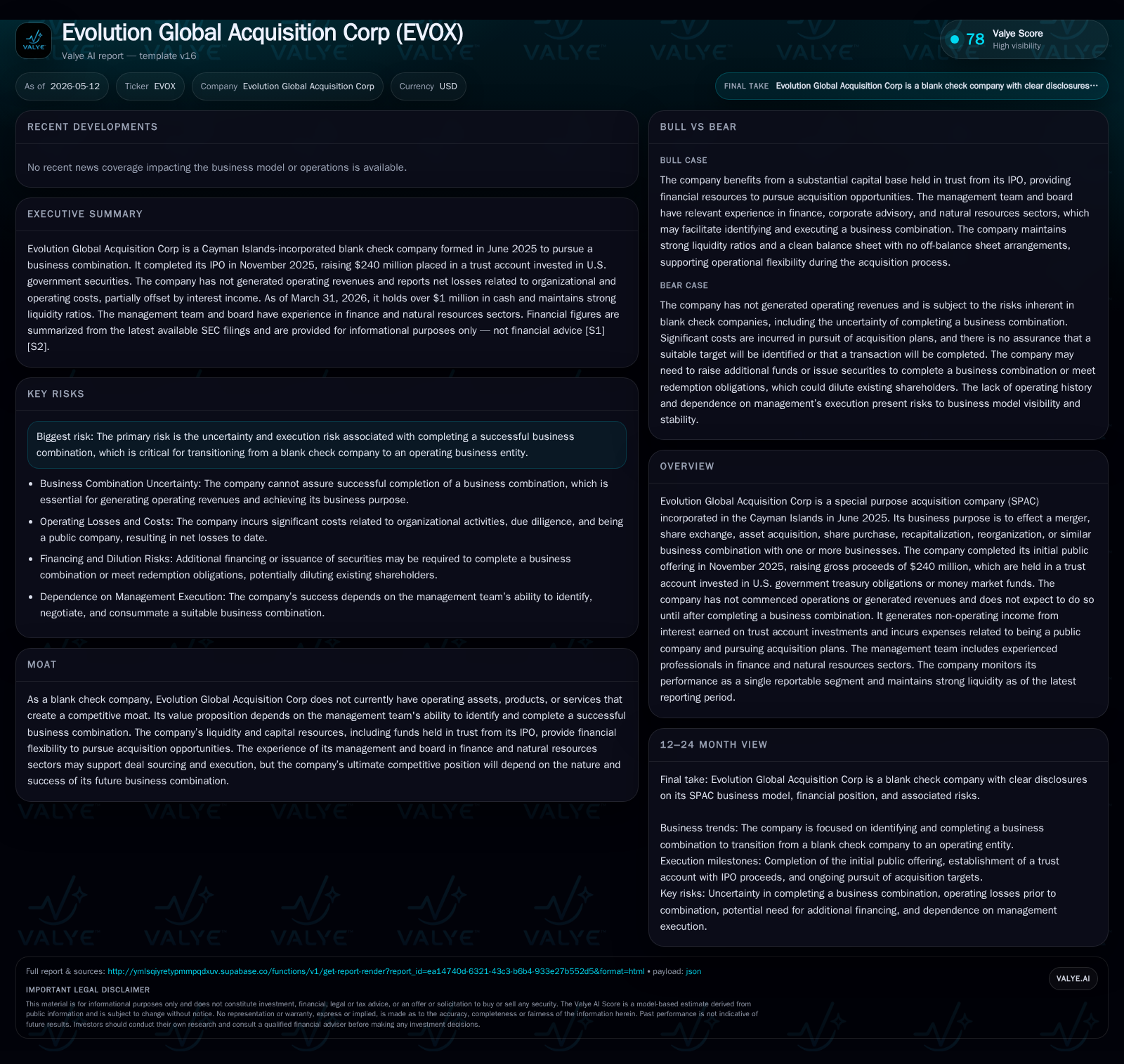
Evolution Global Acquisition Corp (EVOX), a Cayman Islands-incorporated SPAC, reported stable liquidity and operating status in its latest 10-Q filing dated May 12, 2026. The company holds approximately $240 million in trust from its November 2025 IPO, generating non-operating interest income but no operating revenue to date. A significant recent development includes the resignation of COO Ashley Zumwalt-Forbes, highlighting organizational shifts ahead of its business combination. EVOX’s growth hinges on successful deal execution led by a management team with SPAC and operational expertise, though market skepticism and regulatory scrutiny pose execution risks.
Latest Quarterly Operating Update: Stability and Key Changes
In its latest quarterly report filed on May 12, 2026 (Form 10-Q), Evolution Global Acquisition Corp (EVOX) reiterates its status as a blank check company holding approximately $240 million of initial public offering proceeds within a trust account dedicated to U.S. government treasury securities or compliant money market funds. This trust fund underpins the potential capital for EVOX’s planned business combination but remains restricted until consummation or liquidation events. At quarter-end March 31, 2026, EVOX held $1.01 million in unrestricted cash and equivalents to cover administrative expenses associated with its public company operations [S2][F1].
Operating revenues remain nonexistent given EVOX has not launched commercial activities. Non-operating income is exclusively derived from interest earned on the trust investments. Correspondingly, the company incurs predictable costs reflecting standard public company expenses such as legal compliance, financial reporting fees, due diligence costs related to merger efforts, and general administrative overhead [S2][S1].
A noteworthy development disclosed in an 8-K dated May 6, 2026 involves the resignation of Ashley Zumwalt-Forbes as Chief Operating Officer and Director effective May 5, 2026. The departure was explicitly noted as amicable without disagreements concerning corporate policies or operations. Strategically this could reflect either normal executive turnover or realignment preceding or following critical merger negotiations [S3].
Additionally, Michael Bloom joined the leadership ranks bringing extensive experience in strategic finance at both private investment firms focused on operating businesses and previous roles within public-market investment firms with SPAC exposure. His expertise strengthens EVOX’s capacity for source evaluation and transactional execution [S3].
SPAC Business Model and Capital Structure Fundamentals
Evolution Global Acquisition Corp operates as a Special Purpose Acquisition Company formed June 26, 2025 in the Cayman Islands specifically to identify suitable acquisition targets through merger or other forms of business combinations. The IPO completed November 12, 2025 raised gross proceeds of $240 million with all funds earmarked primarily for investment-grade U.S. Treasury instruments held in trust until deployment at transaction close.
Despite being publicly listed (Nasdaq ticker EVOX), the company has no operating products or services at this stage; shareholder returns rely on management’s ability to identify attractive acquisition candidates that can grow post-combination equity value.
The capital structure includes Public Warrants exercisable at $11.50 per share alongside an equal number of Private Placement Warrants sold to sponsors and underwriters generating incremental gross proceeds at IPO time. These warrants introduce dilution risk immediately upon exercise following or during post-merger periods.
Management compensation predominantly reflects efforts to source deals rather than revenue performance; costs are mainly driven by public company compliance rather than operational throughput. This capitalization approach typifies SPACs dependent on sponsor deal expertise coupled with substantial capital funding parked safely awaiting deployment [S1][F1].
Industry Context and Competitive Environment in SPAC Space
The SPAC sector has witnessed an uptick in launches alongside escalating regulatory scrutiny amid fluctuating investor sentiment since late 2024 through mid-2026 cycles. Competition has intensified significantly among blank check vehicles competing for quality target companies across various industries.
EVOX competes not only against similar vehicles backed by high-profile sponsors but also against traditional private equity players leveraging longer investment horizons without capital redemption constraints typical in SPACs. Regulatory considerations related to disclosure requirements and accounting standards have led to heightened due diligence rigor potentially elongating deal timelines.
Importantly, market participants increasingly underwrite SPACs based on sponsor track records in deal execution and post-merger success rather than mere capital availability; thus, recruiting executives like Michael Bloom with proven strategic financial navigation capabilities aligns EVOX towards capturing greater investor confidence.
Warrant dilution presents an ongoing structural challenge since exercised warrants increase share count diluting common equity holders unless monetized value exceeds thresholds set by strike prices plus transaction costs [S1][S6].
Growth Catalysts: Executing on Business Combination Strategy
EVOX’s pathway beyond its blank check phase depends critically on consummating an initial business combination that leverages capital resources efficiently while aligning with management’s domain expertise drawn notably from natural resources investment sectors and established U.S.-based operating businesses.
The addition of Mr. Bloom enhances analytical depth to vet candidate companies rigorously while applying operational experience gleaned from leading strategic finance functions within growth-oriented platforms.
Significant catalysts thus center on formal announcements regarding definitive agreements with acquisition targets within prescribed timelines (generally two years post-IPO). Such deal closures reframe EVOX as an operating public entity unlocking prospects for top-line generation and margin expansion versus sole reliance on passive interest income from trust holdings [S1][S3].
Risks and Constraints: Execution and Market Factors to Monitor
Intrinsic risk arises chiefly from execution uncertainty around completing a qualifying merger within regulatory deadlines—failure compels liquidation of trust assets returning nominal amounts net of expenses to shareholders.
Leadership shifts identified by COO Zumwalt-Forbes's departure may signal internal adjustment needs although officially characterized as amicable. Continuity of deal sourcing momentum during such transitions warrants monitoring.
Broader market volatility impacting SPAC investor appetite remains an overarching constraint compounded by potential further regulatory changes imposing additional procedural burden or timing delays across transactions.
Dilution risk tied to warrant exercises can pressure per-share economics post-business combination especially if share price performance lags relative to strike levels.
In sum, successful navigation through these risk vectors will determine EVOX's ultimate ability to transition from capital holder to value-generating acquirer [S2][S3][S6].
Looking Ahead: Milestones, Guidance, and Market Signals
Key forthcoming events comprise the formal naming of acquisition targets subject to shareholders’ votes required under Nasdaq and SEC guidelines. Transparent updates around negotiation progress will be crucial in shaping market perceptions.
Monitoring warrant holder activity provides clues into investor conviction levels; significant exercises may indicate confidence while avoidance could reflect caution regarding future equity valuation prospects.
Regulatory filings including amendments or extensions related to merger deadlines also offer actionable insights into EVOX’s timeline certainty.
Given no explicit guidance was provided beyond prior reports per the latest filings, market attention pivots toward these qualitative indicators over numerical forecasts at present [S2][S3].
Financial Snapshot: Liquidity Profile and Operating Expenses
Latest financial snapshot
| Metric | Value | Period |
|---|---|---|
| Cash & equivalents | $1010726 | |
| 2026-03-31 | ||
| Current assets | $1151320 | |
| 2026-03-31 | ||
| Current liabilities | $263518 | |
| 2026-03-31 | ||
| Current ratio | 4.37x | |
| 2026-03-31 |
Source: SEC companyfacts cache [F1].
| Metric | Value | Period Ending |
|---|---|---|
| Cash & Equivalents | $1,010,726 | |
| 2026-03-31 | ||
| Current Assets | $1,151,320 | |
| 2026-03-31 | ||
| Current Liabilities | $263,518 | |
| 2026-03-31 | ||
| Current Ratio | 4.37 | |
| 2026-03-31 |
EVOX maintains a robust current ratio reflecting sufficient short-term liquidity principally supported by trust account residuals augmenting reported cash balances covering minimal operating costs typical of early-stage blank check entities[S2][F1]. No investment advice is offered herein; readers should consider primary source documents directly for decision-making purposes.
Disclaimer: This is research-only, informational analysis and not investment advice. It may include AI-generated interpretation and general industry context. Always verify important details using primary sources.

Comments