
ClearPoint Neuro Advances Integrated Neurosurgery Systems in Q1 Results
ClearPoint Neuro's Q1 2026 report shows mixed top-line performance with ongoing strategic focus on disposable-heavy product sales and neurocritical care expansion.
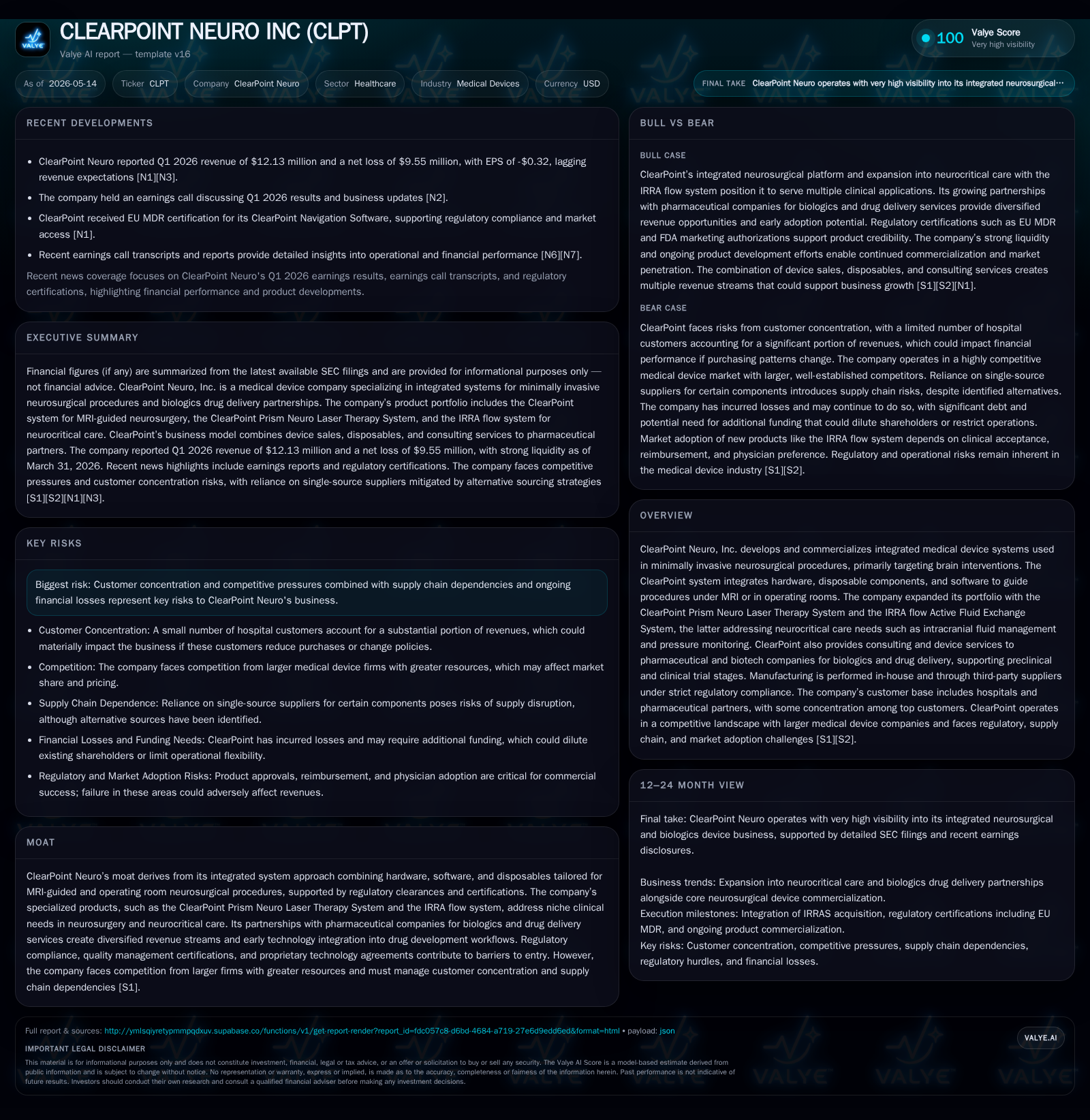
In its latest quarterly filing, ClearPoint Neuro reported revenue growth challenges amid sustained operating losses, emphasizing continued penetration of its integrated neurosurgical systems. The company’s business model hinges on a high-margin disposables-driven revenue mix, complemented by hardware and software offerings for MRI-guided interventions. Its competitive moat is reinforced by regulatory clearances and innovative product additions including the IRRA flow system for neurocritical care. Growth prospects center on expanding installed bases, deepening pharma partnerships, and scaling newer clinical modalities, while customer concentration and supply chain risks remain key headwinds. Financially, ClearPoint maintains ample liquidity offset by significant debt and ongoing cash burn.
Q1 2026 Operating Update Highlights
ClearPoint Neuro’s first quarter of fiscal 2026 revealed a challenging environment marked by revenue performance shortfalls and ongoing operating deficits as reported in their recent 10-Q filing dated May 13, 2026 [S2]. Although total revenue figures were not explicitly refreshed in the release beyond the annual $36.9 million figure as of end-2025 [F1], management commentary in the concurrent Form 8-K and earnings transcripts acknowledged a lag in sales versus expectations, particularly in consumables sales which are pivotal for margin expansion [S3][N3]. The firm continues to deploy its disposable component strategy to lock-in hospitals through initial reusable system placements — either sold at lower margins or retained under rental/placement agreements — anticipating downstream purchases of disposables that comprise higher-margin recurring revenue streams [S1].
Operationally, ClearPoint confirmed progress integrating its commercial operations following last year’s acquisition of IRRAS Holdings, expanding into neurocritical care with the addition of the IRRA flow Active Fluid Exchange System [S3]. Although this product line showed initial commercial traction, scale remains nascent relative to the firm’s broader ambitions. Manufacturing updates highlighted ongoing reliance on single-source arrangements for critical components despite efforts to identify alternative suppliers to mitigate risk [S22]. Overall, Q1 results reflect a transitional phase where ClearPoint seeks to accelerate unit placement growth and disposables stocking orders while managing operational costs under constrained revenues [N1][N3].
ClearPoint’s Integrated Medical Device Business Model
At its core, ClearPoint Neuro monetizes via an integrated ecosystem comprising hardware platforms, proprietary software facilitating MRI or operating room procedure navigation, and predominantly disposable navigation tools used during minimally invasive neurosurgeries [S1][S18]. The ClearPoint system includes durable capital equipment — such as head fixation frames and digital workstations — typically installed at hospital sites under various title-retention agreements that may include rentals or placements tied to future purchase commitments for disposables.
Revenue generation heavily depends on sales of the proprietary disposable components required per procedure; these account for a larger portion of gross margins due to their single-use nature and recurring reorder necessity [S1]. This model is consistent with medical device sector trends that emphasize consumables to create annuity-like revenue profiles and foster switching costs once installed bases expand. Complementing this is sales of advanced procedural software updates with versioned releases enhancing clinical workflow efficiency.
Product innovation extends beyond traditional stereotactic systems: acquisitions like IRRAS introduce new devices such as the IRRA flow system which integrates continuous irrigation, drainage, and real-time intracranial pressure monitoring — addressing acute management needs in neurocritical care settings alongside routine surgical procedures [S18][S22]. Service-oriented revenues stem from consulting engagements supporting pharmaceutical companies’ biologics delivery pipelines through preclinical protocols and clinical trial device provision, diversifying income streams outside direct hospital sales [S1][S22].
Competitive Positioning in MRI-Guided Neurosurgeries
ClearPoint operates within a specialized niche targeting image-guided neurosurgical interventions predominantly conducted under MRI guidance — a setting that demands precision hardware-software integration and compliance with stringent regulatory frameworks across global markets including the U.S., EU, UK, Brazil, Canada, Turkey, and Taiwan [S1][S14]. Their cleared products possess FDA 510(k) clearances for general neurosurgical uses as well as a De Novo classification specifically for intraputaminal administration of gene therapies using their SmartFlow Neuro Cannula disposable device [S14].
This regulatory foothold coupled with patented technology offers differentiation against competitors like Brainlab or Renishaw plc who operate adjacent navigation systems but generally lack similarly combined MRI-OR workflows or disposables-focused consumable models. However, these larger peers wield superior marketing budgets and manufacturing scale that impose competitive pressure on ClearPoint’s modest commercial reach.
Integration of acquired platforms adds breadth by serving neurocritical care clinicians requiring automated intracranial fluid management solutions unmet by legacy vendors. Moreover, ClearPoint leverages longstanding pharma partnerships embedding their devices early into biologics development workflows — a niche segment that can soften competitive intensity but demands ongoing innovation and regulatory compliance vigilance given complex trial protocols [S22][N2].
Manufacturing dependencies manifest as a risk factor given reliance on select suppliers without extensive long-term contracts; supply chain disruptions could hamper ability to fulfill orders especially for high-demand disposable components critical to enabling procedure volumes steady at customer sites [S21]. Customer concentration further compounds vulnerability given few large hospital systems represent sizable revenue portions limiting diversification means [S21].
Growth Drivers: Innovation and Market Penetration
ClearPoint's growth trajectory rests predominantly on scaling adoption of its integrated platforms—both traditional neurosurgery systems and new entrant IRRA flow device—while capitalizing on expanding biologics delivery collaborations.
Technological innovations such as the ClearPoint Prism Neuro Laser Therapy System provide avenues into minimally invasive tumor ablation under MRI guidance offering differentiated value versus conventional open surgeries or non-image guided lasers. CLS-exclusive manufacturing rights bolster positioning though clinical adoption curves remain early-stage since commercialization began in late 2022/early 2023 periods [S18][N2].
The IRRA flow system’s potential lies in addressing emergent neurocritical care challenges via advanced continuous fluid exchange coupled with intracranial pressure monitoring embedded into one platform — an intersection gaining attention amid rising acute stroke and hemorrhage interventions globally. Increasing clinical evidence base and clinician familiarity could fuel incremental placements accelerating consumable usage over time [S21][N2][S3].
Pharma partner programs targeting brain biologics delivery require bespoke procedural devices that ClearPoint supplies alongside consulting expertise throughout drug development phases—from protocol design through preclinical studies to human trials. This dual-device-and-service model generates diversified contract revenue less correlated with hospital purchasing cycles thus smoothing income volatility while entrenching technology usage earlier in therapeutic lifecycle pathways [S22][N2].
Overall growth measurements hinge on installation bookings ramping — driven through managed rental/placement strategies coupled with disposable stocking orders per active client site — along with extension of clinical indications supported by ongoing regulatory submissions intended to expand approved use cases aiding broader market penetration [N2][S3].
Risks and Operational Constraints to Monitor
Key headwinds tempering ClearPoint’s outlook include entrenched customer concentration risks where few health systems contribute disproportionately to revenue; shifts in hospital purchasing behavior or macro healthcare budget pressures could materialize as rapid volume fluctuations adversely impacting topline stability [S21]. Supply chain frailties originating from single-source supplier dependency create vulnerability around production lead times particularly for tightly regulated custom components essential to system integrity and safety compliance standards enforced by FDA Quality Management System Regulations (QMSR) [S21][S17].
Competitive pressures loom large from deep-pocketed medtech incumbents capable of accelerating innovation cycles or outspending in market development restricting ClearPoint’s relative commercial traction amidst crowded neurosurgery navigation spaces encompassing both image-guided platforms and emerging robotic assistance solutions (analysis).
Financially, persistent net losses driven by R&D investments into new product introductions combined with commercial scaling expenses constrain spare runway available without additional capital infusions; balanced liquidity presently sufficient but subject to potential dilution risk if unfavorable market conditions extend cash consumption horizons unexpectedly [F1][S2][S10].
Regulatory scrutiny presents a continual watchpoint given complex multi-jurisdictional approvals needed for new claims or device enhancements; even minor recalls or adverse event reports could impair reputation or delay market rollouts creating temporary demand shocks (known industry precedent) [S10][S17].
Looking Ahead: Key Milestones and Market Developments
Investors should monitor forthcoming quarterly releases for indications around disposables sales momentum gains reflecting deeper installed base utilization—a critical hinge for margin improvement given disproportionate contribution of consumable components to profitability margins [N3][S3]. Clarity on integration outcomes from acquired IRRAS franchises including cross-selling efficiencies within neurocritical care segments will serve as important execution barometers.
Regulatory developments remain front-line catalysts; approvals extending existing device indications (e.g., expanded gene therapy delivery applications via SmartFlow cannulas) or novel claims substantiating clinical benefits will determine speed at which hospitals can onboard more comprehensive system configurations under evolving procedural standards [N2][S3].
Pipeline clinching collaborations or service expansions within pharmaceutical customers advancing CNS biologics trials will also bear watching as predictable recurring contractual revenues accrue from these partnerships underpinning revenue diversification efforts away from pure-device dependency.
Financial Snapshot: Liquidity, Leverage, and Profitability
Latest financial snapshot
| Metric | Value | Period |
|---|---|---|
| Cash & equivalents | $36mm | |
| 2026-03-31 | ||
| Total debt | $51mm | |
| 2026-03-31 | ||
| Net debt | $16mm | |
| 2026-03-31 | ||
| Current assets | $55mm | |
| 2026-03-31 | ||
| Current liabilities | $9mm | |
| 2026-03-31 | ||
| Current ratio | 5.79x | |
| 2026-03-31 |
Source: SEC companyfacts cache [F1].
| Metric | Value (USD) |
|---|---|
| Cash & equivalents | 35,593,000 |
| Total debt | 51,433,000 |
| Net debt | 15,840,000 |
| Current assets | 54,877,000 |
| Current liabilities | 9,480,000 |
| Current ratio | 5.79 |
| The company retains $35.6 million in cash equivalents against total indebtedness approximating $51.4 million as of March 31, 2026 resulting in net debt near $15.8 million; robust current asset coverage enables a current ratio above 5x indicative of strong short-term liquidity cushioning operational needs despite ongoing quarterly operating losses highlighted in recent filings (-$24 million operating income annualized) [[F1],[S2]]. This balance sheet positioning provides moderate runway while sustaining investments required for product commercialization execution but underscores dependence on either improved earnings performance or refinancing initiatives over the medium term. |
Disclaimer: This analysis is provided solely for informational purposes based on disclosed SEC filings and related public disclosures; it does not constitute investment advice or recommendations.
Disclaimer: This is research-only, informational analysis and not investment advice. It may include AI-generated interpretation and general industry context. Always verify important details using primary sources.

Comments