
Peoples Financial Corp Advances Credit Risk Management Amid Loan Portfolio Complexity
Latest quarterly disclosures reveal stable credit quality and ongoing risk vigilance in a diversified loan portfolio amid economic challenges.
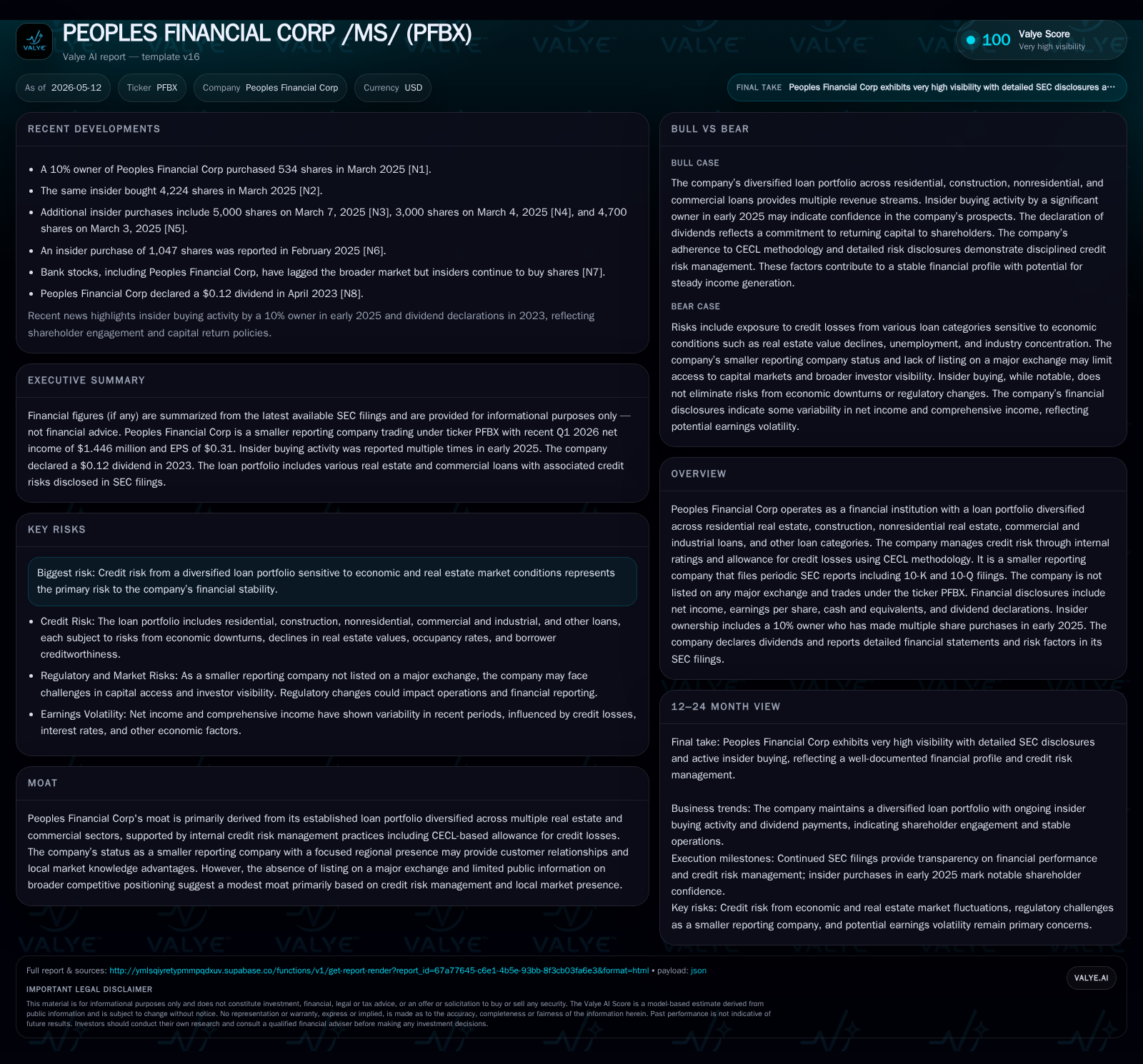
Peoples Financial Corp's 2026 Q1 10-Q filing highlights balanced loan portfolio segmentation across residential, construction, nonresidential real estate, and commercial loans, with continued emphasis on CECL-driven credit loss allowances. Despite economic uncertainties impacting key real estate segments, the firm maintains disciplined credit monitoring and allowance buffers. The company’s business model leverages local market knowledge and relationship banking, supporting a modest moat centered on credit risk management. Growth is driven by measured loan demand and dividend sustainability, while risks remain concentrated in economic sensitivity of collateral values and regulatory compliance. Upcoming quarterly results and credit metrics will be critical to assessing operational resilience.
Latest Operating Update: Quarterly Loan Portfolio Dynamics and Risk Assessment
Peoples Financial Corp’s latest quarterly report for the three months ended March 31, 2026 ([S2]) lays out a detailed snapshot of its loan portfolio composition and associated credit risk controls. The company continues to maintain a multi-segment loan book comprising residential mortgage loans, commercial construction loans (including both commercial and residential projects), nonresidential real estate loans, commercial and industrial loans, and other loan categories.
The filings emphasize the susceptibility of residential mortgages to macroeconomic pressures such as heightened unemployment rates and declining real estate prices—typical structural risks impacting borrower capacity and collateral values. Construction loans carry risks related to cost overruns, shifts in property market demand, financing adequacy, and fluctuating valuations. Nonresidential real estate exposures face challenges including industry concentration risk, difficulties monitoring collateral condition remotely, occupancy fluctuations, business performance issues, and general economic downturns.
Despite these inherent sector sensitivities, Peoples Financial demonstrates disciplined credit surveillance particularly via quarterly monitoring of credit ratings for held-to-maturity securities. The allowance for credit losses remains governed under CECL methodology—a forward-looking impairment model—showing no material adjustments triggered by new accounting pronouncements issued through early 2026 ([S2], [S17]). Notably, the company reports an unchanged allowance of $31,000 on held-to-maturity securities as of year-end 2025 with no additional impairments recognized by Q1-2026.[S2] This suggests stable asset quality without emergent stress signs in the fixed income investment segment.
There are no indications of significant upticks in nonaccrual loans or charge-offs within the quarter. This maintenance of portfolio health alongside ongoing provisioning presents a cautiously conservative stance appropriate for a financial institution exposed to cyclical real estate markets.
Business Model Overview: Diversified Lending and Revenue Streams
As detailed in the March 18 annual report ([S1]), Peoples Financial operates as a regional financial institution focused primarily on generating net interest income from a geographically localized yet sector-diversified lending business. Its primary revenue driver stems from interest on outstanding loans across multiple real estate verticals—residential mortgages provide a baseline consumer lending volume while construction lending captures both short-term project financing needs and longer-term residential development.
Commercial and industrial loans add diversification beyond real estate reliance but share some vulnerabilities to local economic swings affecting small to medium businesses. The company also realizes fee income related to deposit accounts and trust department services albeit at smaller scale compared to core lending interest income ([S1]).
The firm’s strategic strength lies in its embeddedness within regional markets of Mississippi where topographical customer relationships foster superior informational advantages relative to larger competitors potentially less attuned to localized credit profiles. However, it trades as a smaller reporting entity without listing on any major exchange ([S3]), which limits access to broad capital markets but simultaneously anchors the bank firmly within its community niche.
Dividend payments declared during recent periods signal sufficient distributable earnings supported by stable cash flows from loan interest collections ([S2]). This payout policy underscores confidence in maintaining recurring profitability despite cyclical headwinds.
Product and Service Quality: Credit Risk Controls and CECL Methodology
Peoples Financial’s moat revolves significantly around its internal credit risk management capabilities highlighted in its filings ([S1], [S2]). The adoption of CECL has instilled a rigorous approach whereby current expected credit losses are estimated using comprehensive data encompassing historical performance, current conditions, and reasonable future forecasts relevant to recoverability.
Credit risk grading is segmented broadly along Call Report portfolio categories with optional refinement into sub-segments when analytically beneficial. This granularity supports differentiated provisioning reflective of distinct risk profiles inherent to residential mortgages versus commercial construction or industrial equipment loans.
Quarterly monitoring cycles ensure that any deterioration in borrower or collateral quality triggers timely adjustments in allowance for credit losses or proactive remedial action. The absence of increased impairments on securities or adverse effects from recent FASB Accounting Standards Updates (such as ASU 2025-11 clarifying interim reporting disclosures) corroborates steady asset quality maintenance ([S17]). Such disciplined oversight forms a tangible competitive barrier limiting downside volatility often faced by regional banks dependent on cyclical real estate sectors.
Industry Context: Competitive Landscape and Regional Market Presence
Within the competitive field of regional financial institutions providing tailored real estate financing solutions ([S1]), Peoples Financial faces typical tradeoffs balancing specialized local expertise against constraints imposed by scale and capital access. Its lack of exchange listing reflects this smaller institution status but reinforces close client relationships critical for underwriting complex regional construction and commercial deals.
Pricing power tends to be limited given competition from both larger banks offering economies of scale financing packages plus emerging fintech lenders targeting niche segments. Regulatory burdens continue introducing operating cost pressures salient for smaller players.
Nonetheless, the firm’s entrenched local knowledge combined with a relatively diversified loan mix spanning mortgage segments through commercial industrial exposures provides some insulation against single-sector downturns affecting profitability.[S1]
Growth Drivers: Loan Demand, Portfolio Expansion, and Dividend Strategy
Growth catalysts for Peoples Financial hinge primarily on measured expansions within its diversified loan book sanctioned under tight credit metrics. Economic recovery patterns influencing housing starts stimulate construction lending opportunities particularly in residential development segments where margins may be more attractive despite intrinsic risks.[S2]
Likewise, improving occupancy trends or revitalization efforts within local nonresidential real estate can underpin increases in commercial mortgage originations or refinancings.[S3]
The company continues tracking key performance indicators such as overall loan balances alongside stable or improving allowance coverage ratios supporting distributable earnings retention needed to sustain dividends.[S1],[S2] Dividend continuity remains an important factor reinforcing shareholder confidence even amid challenging macro environments.
Risks and Constraints: Credit Exposure, Economic Sensitivity, and Regulatory Factors
Principal risk exposure centers on credit quality vulnerability stemming from economic cyclicality impacting property values across multiple real estate segments—the largest share of the portfolio.[S8] Rising unemployment or softening local economies could elevate delinquency frequencies on residential mortgages or depress cash flows servicing commercial obligations.
Construction loans entail heightened uncertainty due to project complexity including cost overruns or shifts in market absorption rates for newly developed properties.[S2]
Nonresidential properties carry additional risks related to tenant turnover affecting occupancy levels that directly influence debt service capacity.[S8]
Monitoring limitations particularly for collateral consisting of inventory or accounts receivable underpin commercial & industrial loan risk profiles requiring intensified surveillance mechanisms.[S8]
Regulatory compliance imposes ongoing cost burdens which tend to weigh more heavily on smaller institutions lacking scale efficiencies.[S8]
These combined risk vectors necessitate vigilant management focus ensuring allowance adequacy aligned with evolving economic conditions amidst episodic stress scenarios.
What to Watch Next: Upcoming Milestones and Performance Indicators
Key forward-looking areas include upcoming quarterly financial reports that will illuminate trajectory changes in portfolio health indicators—nonaccrual trends, charge-offs relative to allowance buffers—and potential shifts in loan origination volumes reflecting regional economic shifts.[S2],[S3]
Insider ownership activity or share transactions could hint at management sentiment toward near-term prospects observed during annual shareholder meetings held April 22, 2026 ([S3]).
Heightened scrutiny will fall on incremental impacts associated with newly effective accounting standards implemented after year-end periods given their potential subtle influence on reported results.[S17]
Tracking dividends declared versus free cash generation trends will also offer insight into evolving capital allocation priorities critical for sustaining investor support.[S3],[S2]
Financial Profile Snapshot: Liquidity, Leverage, and Earnings
Peoples Financial’s financial condition remains broadly sound with reported net income around $3.9 million as per latest filings ([F1]). The company sustains a net cash position indicated by available cash equivalents approximating $35.9 million against total debt near $30 million per available metrics ([F1]), implying liquidity buffers adequate for portfolio demands.
Earnings per share remain stable at levels commensurate with weighted average shares outstanding (~4.6 million), with no dilution sources present ([S18]). Interest expense trends show moderate payments consistent with historical patterns indicating stable funding costs amid an evolving interest rate environment.
These factors collectively underline operational stability providing a foundation that supports ongoing credit vigilant strategies coupled with measured growth ambitions reflective of external economic conditions.
This analysis is based exclusively on information derived from publicly filed SEC documents up to May 12, 2026. It does not constitute investment advice but aims to provide an informed perspective on Peoples Financial Corp’s recent operating developments, business dynamics, industry positioning, growth outlooks, risks, and financial condition.
Disclaimer: This is research-only, informational analysis and not investment advice. It may include AI-generated interpretation and general industry context. Always verify important details using primary sources.

Comments