
Maywood Acquisition Corp. 2 Starts Trading Separately as SPAC Search Gains Momentum
Following its April IPO, Maywood Acquisition Corp. 2 has begun separate trading of its units’ components, positioning itself for active pursuit of a business combination.
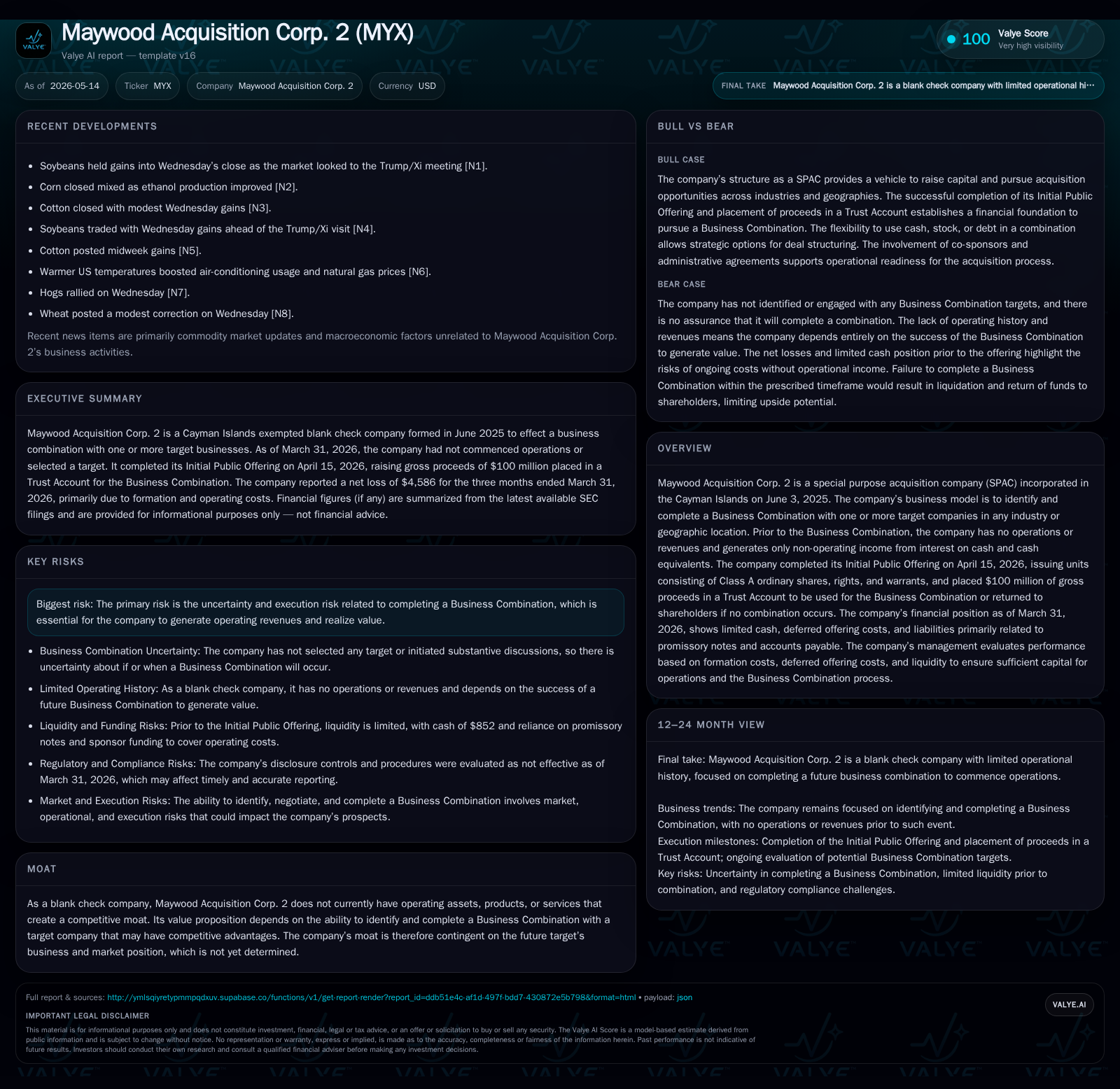
Maywood Acquisition Corp. 2, a Cayman Islands-based SPAC formed in mid-2025, completed its IPO on April 15, 2026, raising $100 million placed in a Trust Account to fund a future business combination. On May 15, 2026, the company commenced separate trading of its Class A ordinary shares, rights, and warrants on Nasdaq under distinct tickers. The company has no operating revenues yet and relies on sponsor loans and careful capital structure management to sustain operations while searching for acquisition targets globally across industries. Key near-term milestones include securing a deal within the stipulated timeline or else returning funds to shareholders. Risk centers on execution challenges and sponsor support dependency.
Recent Developments from Latest SEC Filings
Maywood Acquisition Corp. 2's most recent quarterly filing dated May 13, 2026 [S2] alongside a contemporaneous Form 8-K [S3] revealed critical operational updates following the company's April IPO close. On April 15, the company raised gross proceeds of $100 million through an Initial Public Offering consisting of 10 million units priced at $10 each. Concurrently with closing, these funds were deposited into a Trust Account designed to preserve capital for eventual use in a business combination or shareholder return if no deal materializes.
Two months later, effective around May 15, the components that constituted those IPO units — specifically Class A ordinary shares (ticker MYX), rights (MYXXR), and redeemable warrants (MYXXW) — began trading separately on Nasdaq [S3]. This transition provides granular investor choice unavailable while units traded bundled as MYXXU. Notably, no fractional rights will be issued upon separation; only whole rights trade.
No operating revenues have been recorded since incorporation; all financial outflows pertain to formation costs such as legal and accounting fees [S2]. Sponsor Stone Bay LLC advanced financing for founder shares ($25k payment) and extended unsecured promissory note loans totaling $139k at quarter-end to facilitate operational necessities before IPO funding cleared [S2][S8]. As per filings [S2], warrant agreements include provisions allowing amendments with holder consent exceeding 50% outstanding warrants—a flexibility mechanism relevant post-exercise—but there were no warrants outstanding as of March 31.
This initial quarter also saw administrative service agreements set up for essential infrastructure support costing $1,667 monthly payable to a sponsor affiliate commencing at IPO listing [S10]. The company meets going-concern criteria with sufficient liquidity assured through either completion of the business combination or one year from reporting date [S14][S28].
SPAC Business Model and Capital Structure
Maywood Acquisition Corp. 2 is structured as a Cayman Islands exempted company formed June 3, 2025 [S7], operating as a special purpose acquisition company with no commercial operations or revenues until closing a qualifying business combination. The IPO units comprise one Class A ordinary share, one Right entitling the holder to receive one-quarter interest in an additional Class A share after business combination completion, plus one redeemable warrant exercisable at $11.50 per share subject to standard adjustments [S16][S24].
Upon IPO close April 15, gross proceeds ($100 million) were deposited into the Trust Account managed by Continental Stock Transfer & Trust Company as trustee—invested conservatively in government securities or cash equivalents pending deal consummation [S29]. Funds outside this account are earmarked to cover expenses associated with target identification and transaction due diligence including travel and legal review.
Sponsors hold founder shares acquired via private placement at nominal cost subsidized by unsecured promissory notes repayable without interest upon combination completion or convertible into private placement units if lenders opt [S8][S25]. Transaction costs from underwriting totaled around $4.3 million allocated between cash fees and representative share issuance deducted accordingly from paid-in capital [S29].
No competitive moat or ongoing product asset presence exists until the initial Business Combination consummates; thus value creation depends fully on identifying an appealing target capable of lasting competitive advantage post-merger.
Industry Context and Competitive Dynamics in SPAC Space
Within the expanding global SPAC market ecosystem where competition among sponsors intensifies for quality targets across sectors/geographies, timing is critical: Maywood Acquisition’s relatively recent IPO places it alongside peers racing to deploy capital within regulatory-mandated windows (12 months or extended up to 15 months if announced) [S25]. Investor appetite increasingly favors structures allowing component-wise trading facilitating price discovery on public shares versus warrants or rights separately.
Sponsors’ reputations and access to exclusive deal flow channels serve as key differentiators in source quality acquisitions—the extent to which Maywood leverages its Stone Bay backing will influence future competitive positioning. Regulatory scrutiny pertaining to transparency around redemption rights and warrant terms also shapes market reception of SPAC offerings.
Growth Drivers: Path Toward Identifying a Target
As a blank-check vehicle void of direct product-market exposure before combining with an operating entity, growth metrics hinge on non-traditional KPIs: capital deployment efficiency from Trust Account funds plus speed and quality of target identification across any industry/location globally given no stated sector restrictions [S7][S3]. The planned use of proceeds includes due diligence activities covering financial/legal vetting plus operational site visits enabling thorough target evaluation prior to signing definitive agreements.
Separate trading of equity components beginning mid-May could enhance liquidity relative to unit-only trading; this may draw more investor attention during the search phase helping preserve market cap ahead of deal announcement. Ultimately, successful conversion of capital raises into an operating concern generating revenue will mark true growth transformation.
Key Risks and Execution Challenges Ahead
Fundamental uncertainty centers around completing an initial Business Combination within mandated timeframes or risk obligatory liquidation distributing Trust Account funds back pro rata [S25]. Failure here results in termination of trading status disposing shareholder value contained solely in financial instruments rather than ongoing enterprise value.
Regulatory compliance demands can increase operational complexity especially regarding shareholder notifications linked to redemption decisions under uncertain event clauses outlined for Class A shares subject to redemption rights [S2].
Investors lack visibility over management’s target pipeline since no substantive discussions had commenced through end-March quarter per disclosure [S7], so execution depends heavily on management's M&A acumen against competitive pursuit by other SPACs with overlapping mandates.
Near-Term Milestones and Market Moving Catalysts
Primary upcoming trigger points include announcements signaling progress toward identifying or securing preliminary merger agreements which would materially impact valuations given conversion potential unlocking real enterprise value beyond cash balances held now.
Warrant holders face watchpoints around possible amendments requiring majority consent potentially altering exercise features or timing that may influence price behavior shortly after commencement of separate trading phases May onward [S2].
Monitoring external M&A activity trends in relevant sectors may offer early indicators regarding pipelines where Maywood might position offers amid increased corporate consolidation demand exhibited generally across tech, healthcare or alternative energy industries leveraged by many contemporary SPACs [N14].
Latest Financial Snapshot
Latest financial snapshot
| Metric | Value | Period |
|---|---|---|
| Current assets | $168,993 | |
| 2026-03-31 | ||
| Current liabilities | $165,572 | |
| 2026-03-31 | ||
| Current ratio | 1.02x | |
| 2026-03-31 |
Source: SEC companyfacts cache [F1].
At quarter-end March 31, prior to IPO close but post-formation activities initiation, Maywood reported modest cash balances totaling $852k with working capital standing at approximately $3.4 million balanced against related party liabilities primarily promissory note advances totaling $139k [F1][S2][S8]. Operating losses are concentrated in formation-related expenses approximating $4.8 million annually scaled down proportionally for Q1 alone without any offsetting revenue streams given pre-combination status [F1][S2].
This analysis reflects publicly available information as of May 13–14, 2026 and does not constitute investment advice nor recommendations regarding securities issued by Maywood Acquisition Corp. 2. The company's value realization depends critically on successfully completing a business combination within regulatory timelines under evolving market conditions.
Disclaimer: This is research-only, informational analysis and not investment advice. It may include AI-generated interpretation and general industry context. Always verify important details using primary sources.

Comments