
Meridian Corp Reveals Mixed Q1 Results Amid Commercial Loan Pressures
Q1 2026 highlights operational resilience tempered by rising commercial real estate loan risk within a diversified regional banking franchise.
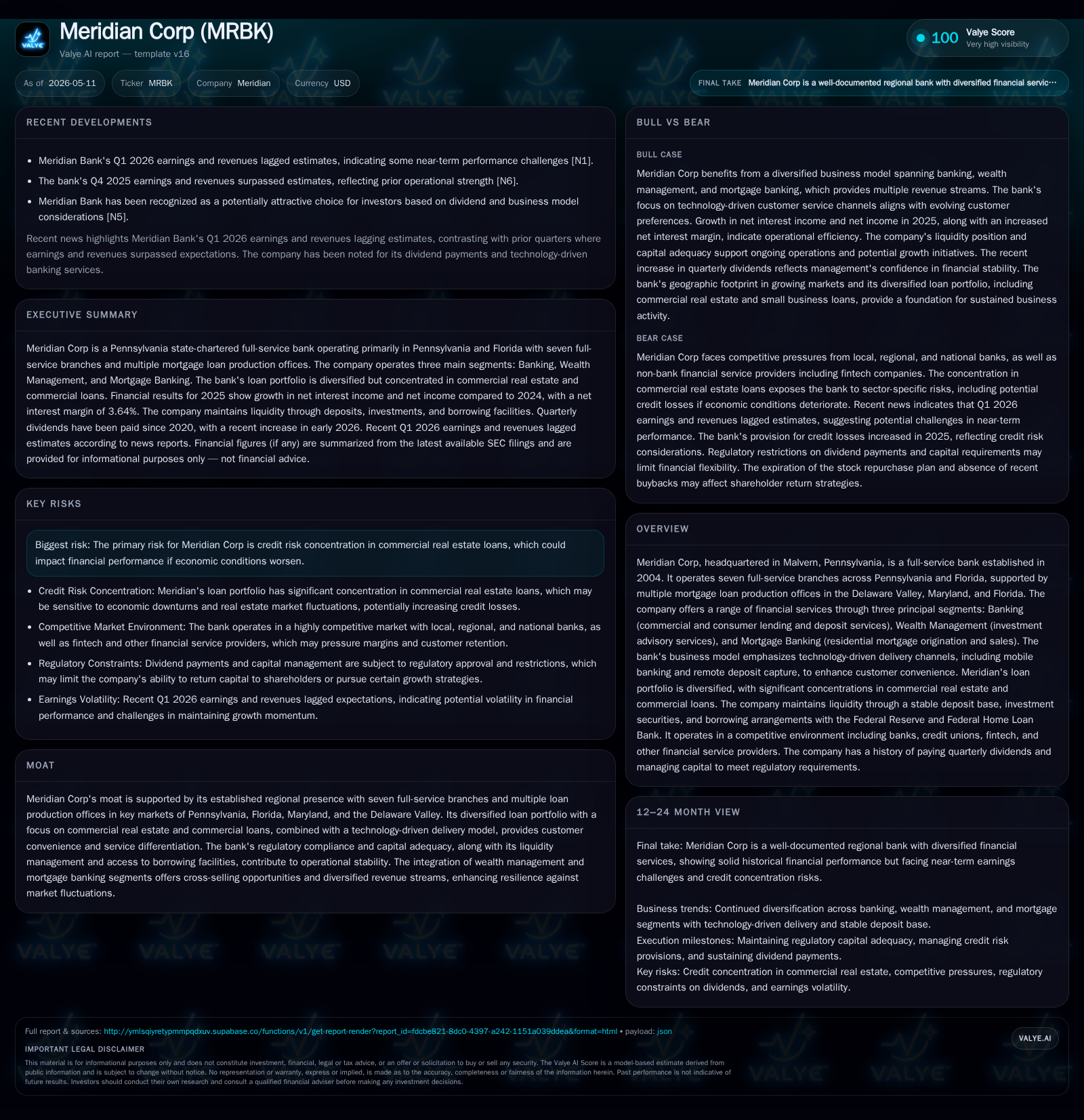
Meridian Corp’s latest 10-Q for Q1 2026 disclosed earnings and revenue results that trailed market estimates, primarily influenced by emerging credit pressures in its commercial real estate loan portfolio. The company’s business model centers on a regional footprint spanning Pennsylvania, Florida, Maryland, and the Delaware Valley, blending traditional banking with wealth management and mortgage banking services underpinned by digital delivery channels. While the bank benefits from a stable deposit base and regulatory capital adequacy, concentrated exposure to commercial real estate loans marks a key risk factor moving forward. Future growth depends on digital adoption and cross-segment sales, even as near-term credit quality remains a watchpoint.
Latest Quarterly Operating Update: Mixed Performance and Emerging Credit Trends
Meridian Corp’s first quarter 2026 results reported in the May 11, 2026 10-Q highlighted a mixed performance profile marked by earnings and revenue figures below analyst estimates [S2][N1]. While no new material risk factors were introduced in this filing, the ongoing credit quality trajectory bears careful watching. Notably, the bank faced emerging pressure stemming from its commercial real estate loan portfolio where modest upticks in net charge-offs and provisions affected profitability metrics. The company confirmed stable operating segments but flagged cautious optimism around early signs of stress primarily tied to small business loan delinquencies within the broader commercial book.
The absence of fresh risk disclosures in the recent quarterly filing indicates management’s confidence in underwriting standards; however, elevated provisioning compared with prior periods signals awareness of evolving economic headwinds affecting borrower repayment capacity. Complementary event filings from April 27 provide no indication of abrupt deterioration but underscore governance updates intended to sustain oversight during these challenges [S3].
Meridian Corp’s Business Model: Regional Banking with Multi-Segment Diversification
Founded in 2004 and headquartered in Malvern, PA, Meridian Corp operates a hybrid financial services model combining traditional full-service commercial and consumer banking with wealth management advisory and residential mortgage origination operations [S1]. The company’s physical footprint consists of seven full-service branches situated across pivotal regional markets including Pennsylvania’s suburban counties (Main Line, Chester, Delaware), Center City Philadelphia, several Maryland locations, Delaware Valley areas, and a strategic presence in Southwest Florida via its Bonita Springs branch. Supplementing these are multiple geographically dispersed mortgage loan production offices facilitating targeted residential mortgage lending.
Revenue generation unfolds across three core segments: Banking (commercial loans and deposits), Wealth Management (investment advisory fees), and Mortgage Banking (loan origination gains). The banking segment leverages a diversified loan portfolio prominently weighted towards commercial real estate loans (approx. 41% of total loans), complemented by commercial & industrial loans (about 19.5%) and consumer loans making up roughly 15–16% [S21][S26][S27]. This mix reflects an intentional tilt towards higher-yielding commercial exposures balanced against retail lending for portfolio diversification.
Crucially, Meridian couples its traditional brick-and-mortar presence with advanced technology deployments such as mobile banking apps offering remote deposit capture capabilities, aiming to boost customer engagement while controlling operating expenses. This technology-first approach supports retention among both retail customers—who value digital convenience—and commercial clients needing streamlined transaction experiences.
Industry Context: Competition, Regulatory Environment, and Market Positioning
Positioned within the competitive regional U.S. banking landscape, Meridian contends with larger national banks possessing scale advantages alongside nimble fintech entrants innovating digital financial services. Its mid-sized footprint confines it to local markets where personalized relationships furnish competitive moats but limit rapid scale expansion.
Regulatory oversight mandates capital sufficiency levels wherein Meridian is classified as "well capitalized" by FDIC standards with strong Tier 1 leverage (~9.5%) and common equity ratios exceeding minimum guidelines [S4][S5][S27]. Liquidity management relies on a stable customer deposit base supplemented by wholesale funding lines including Federal Home Loan Bank borrowing capacity near $750 million and brokered certificates of deposit programs totaling over $300 million [S4][S5][S11]. While these resources underpin short- to medium-term funding adequacy, the bank’s credit concentration notably restricts aggressive lending expansion given heightened sensitivity to real estate valuation volatility.
Commercial loan pricing reflects subdued power due to competitive pressures both within established banking peers and alternative financing sources increasingly available to small-to-medium enterprises. Consequently, margin improvement potential is constrained absent meaningful diversification or scale gains.
Growth Drivers: Technology Platforms and Cross-Selling Across Segments
Meridian’s growth strategy exploits synergies across its three principal segments through cross-selling opportunities leveraging client relationships developed inside banking units towards wealth management advisory products and residential mortgage offerings. Wealth management income increased over 10% year-over-year supported by expanding assets under advisement—indicating attractive demand for integrated financial planning services beyond core deposit accounts [S23]. Similarly, SBA-related loan sale income surged nearly 58%, reflecting success tapping government-backed credit channels attractive to smaller enterprises [S23].
Digital adoption serves as another lever for organic expansion. Increased penetration rates for mobile app usage reduce branch transaction burdens while enhancing data collection enabling refined customer targeting strategies. The remote deposit capture facility facilitates faster check clearing for business clients optimizing working capital cycles—a service valued especially among mid-market borrowers.
Mortgage banking continued showing modest compression due to market interest rate fluctuations but remains a vital fee revenue contributor through origination volume generated at multiple production offices strategically placed across suburban metros where housing demand remains resilient relative to other geographies.
Risks and Constraints: Commercial Loan Concentration and Economic Sensitivities
The bank’s primary vulnerability resides in its concentrated exposure to commercial real estate lending comprising approximately two-fifths of its total loan portfolio—a figure that both enhances interest income potential yet concurrently heightens credit risk during economic downturns or sector-specific disruptions [S21][S26][S28]. This risk is accentuated by an observed increase in non-performing assets predominantly clustered within small business loans which represent tighter underwriting margins relative to larger corporate credits.
Reserve adequacy has been adjusted upward reflecting these trends with provision expenses rising incrementally to buffer against expected losses arising from delinquency escalations noted in recent quarters [S23]. Given the localized nature of its branch markets—in Pennsylvania suburbs, Florida coastal communities, Maryland counties—regional economic shocks like slowed construction activity or office space revaluation could disproportionately affect repayment rates compared with more geographically diversified institutions.
Additionally, tightening regulatory scrutiny on community banks’ capital buffers places constraints on leverage use for accelerated asset growth or dividend payouts requiring calibrated balance sheet management moving forward.
Future Catalysts: Key Milestones and Monitoring Points Ahead
Monitoring upcoming quarterly filings for incremental movements in loan loss provisions will be critical gauge points for credit trajectory assessment at Meridian 9E28094 looking specifically at shifts within commercial vs consumer real estate buckets. Further attention should be paid to client adoption metrics pertaining to new digital initiatives which directly influence operating costs offset potential revenue deceleration periods.
Branch efficiency initiatives or potential network expansions particularly into adjacent Florida or Mid-Atlantic markets could emerge as a medium-term growth vector provided credit metrics stabilize. Additionally, integration progress related to new board appointments—such as Ken Warriner announced April 27—may signal governance enhancements aligning strategic priorities with evolving industry conditions [S3].
Wealth management inflows constitute a leading indicator for fee income sustainability calling for scrutiny of client retention trends within this segment through periodic disclosures.
Financial Positioning: Liquidity, Capital Adequacy, and Credit Metrics
As of June 30, 2023, Meridian reported total debt and net debt of approximately $12.37 billion [F1]. Credit loss reserves have been incrementally increased commensurate with modest rises in non-performing loans particularly concentrated among small businesses within the commercial sector; management appears engaged actively monitoring these asset quality developments without triggering heightened alarm at present [S2][S23].
This analysis is based solely on publicly available SEC filings dated through May 11, 2026 without inference or recommendation regarding investment decisions.
Disclaimer: This is research-only, informational analysis and not investment advice. It may include AI-generated interpretation and general industry context. Always verify important details using primary sources.

Comments