
Broadwind Advances Diversification and Operational Efficiency in Q1 2026
Broadwind's Q1 2026 results highlight progress in reducing wind energy dependence and optimizing manufacturing amid evolving power generation demands.
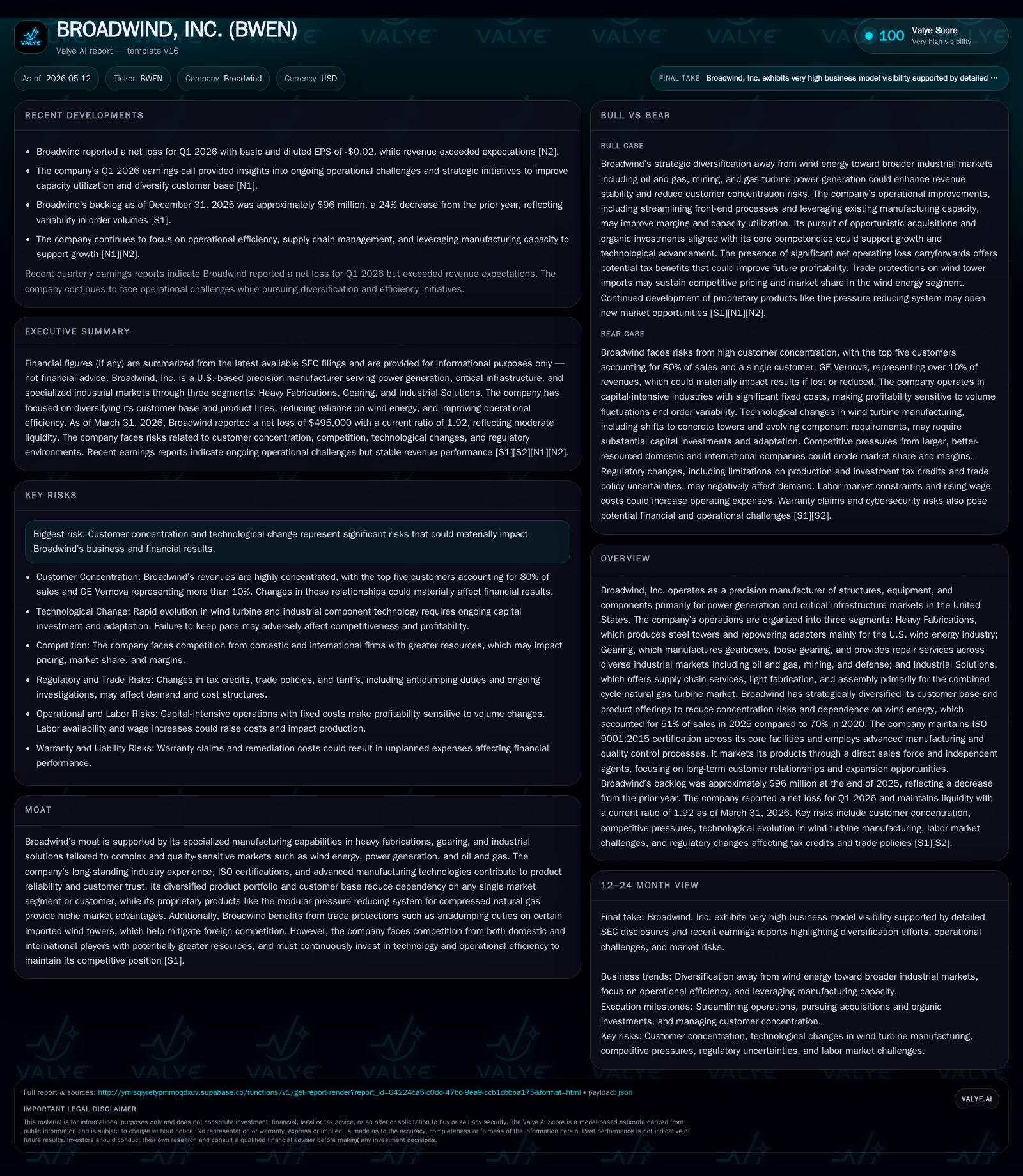
In its latest 10-Q filing for Q1 2026, Broadwind, Inc. reported operational progress driven by consolidation of its heavy fabrications segment and sustained backlog around $96 million. The company's strategic reduction in reliance on U.S. wind energy, now representing 51% of sales versus 70% in 2020, underpins diversification efforts. Broadwind's manufacturing capabilities span heavy fabrications, gearing, and industrial solutions, supported by specialized processes and trade protections that grant a modest moat despite customer concentration risks. Key growth drivers include capacity optimization post-facility consolidation and expanding product mix outside wind towers. Notable risks persist around concentrated customer exposure and the challenge of adapting to rapid technological shifts in wind turbine components.
Q1 2026 Operating Update: Key Changes and Significance
Broadwind’s latest quarterly filing (10-Q as of May 12, 2026) documents meaningful strides in refining its business structure. The company has continued the strategic consolidation of its Heavy Fabrications segment operations into a single facility located in Abilene, Texas—a move aimed at boosting efficiency and leveraging scale in tower production [S2]. This plant can produce up to approximately 220 steel wind towers annually (equivalent to roughly 660 tower sections), capable of supporting turbines generating over 800 MW assuming a standard 3 MW turbine size. The streamlining effort follows the divestiture of the Manitowoc industrial fabrication operation in late 2025 [S24].
Backlog remains healthy at about $96 million based on unfilled purchase orders and supply agreements as of December 31, 2025—a figure reiterated through early statements accompanying the first quarter results [S1], [S3]. Despite ongoing market headwinds reflected in recent order timing variability, Broadwind maintains confidence through its steady backlog build.
Notably, Broadwind’s revenue mix continues shifting away from a concentrated exposure to the U.S. wind energy sector. In full-year 2025, sales into wind accounted for approximately 51% compared to nearly 70% just five years prior, underscoring its diversification strategy targeting oil & gas gearing markets and natural gas turbine supply chains alongside compressed natural gas infrastructure solutions such as the Modular Pressure Reducing System (PRS) units [S1], [N1]. This realignment reduces cyclical volatility tied to renewables while tapping complementary infrastructure demand.
Business Model and Product Quality Dynamics
Broadwind monetizes through three core reporting segments that capture a range of precision manufacturing capabilities:
Heavy Fabrications: Produces large-scale steel towers primarily serving U.S.-based wind turbine manufacturers along with specialized repowering adapters used in upgrading existing wind farms. Post-consolidation, all heavy fabrication outputs funnel through the Abilene facility supporting an annual capacity near 220 towers [S1], which includes proprietary mobile modular PRS units critical for expanding compressed natural gas distribution without pipelines.
Gearing: Manufactures industrial gearboxes, loose gearing products, and provides gearbox repair services across diversified sectors including power generation, oil & gas exploration/production equipment (fracking/mud pumps), mining machinery, and defense technology components. Segment sales depend mostly on individual purchase orders reflecting variable but technically demanding production runs requiring close tolerances and reliability standards.
Industrial Solutions: Focuses on supply chain services coupled with light fabrication and assembly chiefly serving combined cycle natural gas turbine manufacturers supplying after-market upgrades and replacement parts. This segment benefits from long-standing relationships established via engineering support and integrated logistics solutions.
Each segment commands strict quality controls backed by ISO certifications enabling Broadwind to meet rigorous customer specifications integral to critical infrastructure projects where failure risk is material. Revenue flows are dictated by a blend of supply agreements and individual purchase orders; for example, tower sales under supply agreements entail commitments forecasted ahead but executed via serial POs sensitive to customer production schedules. This mix contributes to working capital dynamics where temporary spikes or troughs occur due to timing deviations between order anticipation and actual fulfillment [S1], [S5].
Competitive Positioning within Heavy Fabrications, Gearing, and Industrial Solutions
Broadwind competes against both domestic peers—like Arcosa Inc.—and global entrants including C.S. Wind (South Korea), Marmen Industries (Canada), GRI Renewable Industries (Spain), among others operating U.S. facilities or exporting into the country. Import competition is somewhat curbed by antidumping duties extending on steel wind towers originating notably from China, Vietnam, Canada, Indonesia enforced through recent multi-year extensions by the U.S. Department of Commerce—providing a protective trade framework that supports domestic fabricators like Broadwind by discouraging below-cost imports [S17].
The gearing market exhibits notable consolidation trends internationally with strategic buyer acquisitions reshaping competitive dynamics; meanwhile supply chain uncertainties have propelled buyers towards domestically sourced gears boosting pricing stability among producers like Broadwind within North America but also leaving them exposed should key suppliers disrupt delivery schedules or cost inputs shift markedly.
While these segments benefit from specialized expertise—welding precision fabrications or machining complex gears—their exposure to concentrated customers entails operational risk given top five clients constitute roughly four-fifths of total revenue with GE Vernova alone comprising more than one-tenth [S4], [S17]. Such concentration amplifies vulnerability to single-customer budget shifts or renegotiations.
Broadwind’s moat stems from decades of deep-rooted industry knowledge evidenced by advanced production techniques (metal rolling/coatings/heat treatment/assembly engineering) alongside robust customer trust cultivated through reliability under mission critical contracts across highly regulated markets like renewable energy generation or oilfield equipment manufacturing. Proprietary technology developments—including the PRS unit targeting compressed natural gas distribution—create niche differentiators that complement the broader offering yet remain reliant on continued innovation investment amidst accelerating technological shifts especially in offshore offshore turbine design transitioning toward alternative materials like concrete towers rather than traditional steel structures ([S14]).
Drivers of Growth: Diversification, Capacity Utilization, and Market Trends
Growth vectors revolve principally around three themes:
Diversification reducing reliance on pure-play U.S. land-based wind energy: Having curtailed dependence from ~70% share in early decade to roughly half now allows Broadwind to smooth cyclicality thanks to stronger positioning in gearing products servicing oil & gas sectors undergoing renewed investment cycles as well as Industrial Solutions supplying combined cycle natural gas turbine aftermarket upgrades—markets driven by broader energy mix transition pragmatism rather than pure renewables push alone [N1], [S1].
Production capacity utilization improvements post-facility rationalization: Concentrating heavy fabrications into Abilene leverages economies of scale facilitating better throughput management enabling up-to-date lean manufacturing methodologies applied alongside continuous improvement initiatives referenced since prior annual disclosures—these aim at lowering unit costs while maintaining quality consistency critical for regulatory compliance across infrastructure sectors ([S8]).
Emerging demand opportunity via compressed natural gas virtual pipeline deployments leveraging Modular Pressure Reducing Systems (PRS): PRSs cater uniquely to regions lacking established gas infrastructures offering broad geographic expansion potential complementing existing industrial client bases plus favorable regulatory environments incentivizing natural gas adoption relative to other fossil fuels ([S8]).
Technology adoption also figures into future growth outlook: Broadwind acknowledges generative AI / machine learning integration opportunities aimed at augmenting engineering design accuracy/inventory optimization/supply chain predictability which may materially enhance operational agility if successfully implemented ([S14]).
Risks and Constraints: Customer Concentration and Technological Challenges
Foremost among risks is significant customer concentration: one dominant customer (GE Vernova) accounts for more than ten percent of revenues while five customers collectively represent about eighty percent total sales volume creating notable sensitivity to shifts within any major account’s strategic purchasing priorities or financial health ([S4]). Periodic ordering variability exacerbates fixed manufacturing overhead absorption leading historically to volatile operating profits impeding reliable quarterly earnings comparisons ([S1]).
Technological trajectory poses another constraint: advancing offshore wind turbines increasingly favor concrete towers over traditional steel fabrication which could require substantial capital reinvestment should Broadwind elect or need to compete meaningfully within this variant product space ([S14]). Concurrently evolving legal/regulatory frameworks surrounding AI pose uncertain implementation risks potentially affecting product liability or security concerns if not perfectly managed during technology adoption phases ([S14]).
Additionally, exposure exists around supplier financing programs impacting working capital requirements unpredictably as well as potential liquidated damages penalties stemming from delivery schedule failures noted within complex supply agreements constraining margin preservation ability ([S11]). These operational risks compound amid an industry backdrop marked by cyclical capital expenditure rhythms largely tied to macroeconomic conditions influencing both renewable energy project pipelines as well as oil & gas equipment refurbishment cycles.
Upcoming Milestones and Monitoring Points
Stakeholders should observe several near-term indicators:
- Q2 order momentum especially signals from primary wind turbine OEMs concerning repowering adapters or new tower initiatives will reveal pace of recovery or stability post-realignment away from legacy concentration vulnerabilities ([N1], [S2]).
- Developments around adoption rates for PRSs within new geographic compressed natural gas markets could indicate success scaling niche product variants leveraging emerging infrastructure spending ([N1]).
- Updates on supply chain costs impacting Industrial Solutions pricing power following recent global disruptions remain key variables affecting gross margin sustainability ([S2]).
- Management commentary during upcoming earnings calls focusing on progress integrating AI technologies within operations will offer insight into future efficiency gains potential ([N1]).
- Monitoring any alterations in contractual terms or payment patterns involving significant customers remains crucial given past history of renegotiations affecting cash flow timing ([S11]).
Current Financial Snapshot
Latest financial snapshot
| Metric | Value | Period |
|---|---|---|
| Cash & equivalents | $943000 | |
| 2026-03-31 | ||
| Total debt | $11mm | |
| 2026-03-31 | ||
| Net debt | $10mm | |
| 2026-03-31 | ||
| Current assets | $65mm | |
| 2026-03-31 | ||
| Current liabilities | $34mm | |
| 2026-03-31 | ||
| Current ratio | 1.92x | |
| 2026-03-31 |
Source: SEC companyfacts cache [F1].
| Metric | Value |
|---|---|
| Cash & Equivalents | $943K |
| Total Debt | $10.75M |
| Net Debt | $9.81M |
| Current Assets | $64.59M |
| Current Liabilities | $33.62M |
| Current Ratio | 1.92 |
As of March 31, 2026, Broadwind held cash balances near $943 thousand against total debt approximating $10.75 million yielding net debt around $9.8 million indicative of modest leverage levels relative to asset base liquidity ($64.59 million current assets) supporting near-term operational funding needs without undue financial strain ([F1]). The current ratio at about 1.92 suggests sufficient short-term asset coverage over liabilities providing some cushion amid working capital fluctuations common within project-driven manufacturing environments [F1], [S2].
This analysis synthesizes factual information available through recent SEC filings including the Q1 2026 Form 10-Q release along with historical context found within the latest annual report filed March 11, 2026 plus corroborating news transcripts dated May 12, 2026 without offering investment advice or forward-looking price expectations.
Disclaimer: This is research-only, informational analysis and not investment advice. It may include AI-generated interpretation and general industry context. Always verify important details using primary sources.

Comments