
Qnity Electronics Advances AI and Semiconductor Capabilities with Robust Q1 Growth
Qnity delivers strong volume-driven revenue gains in Q1 2026 across semiconductor and interconnect segments, driven by AI hardware demand and advanced packaging innovations.
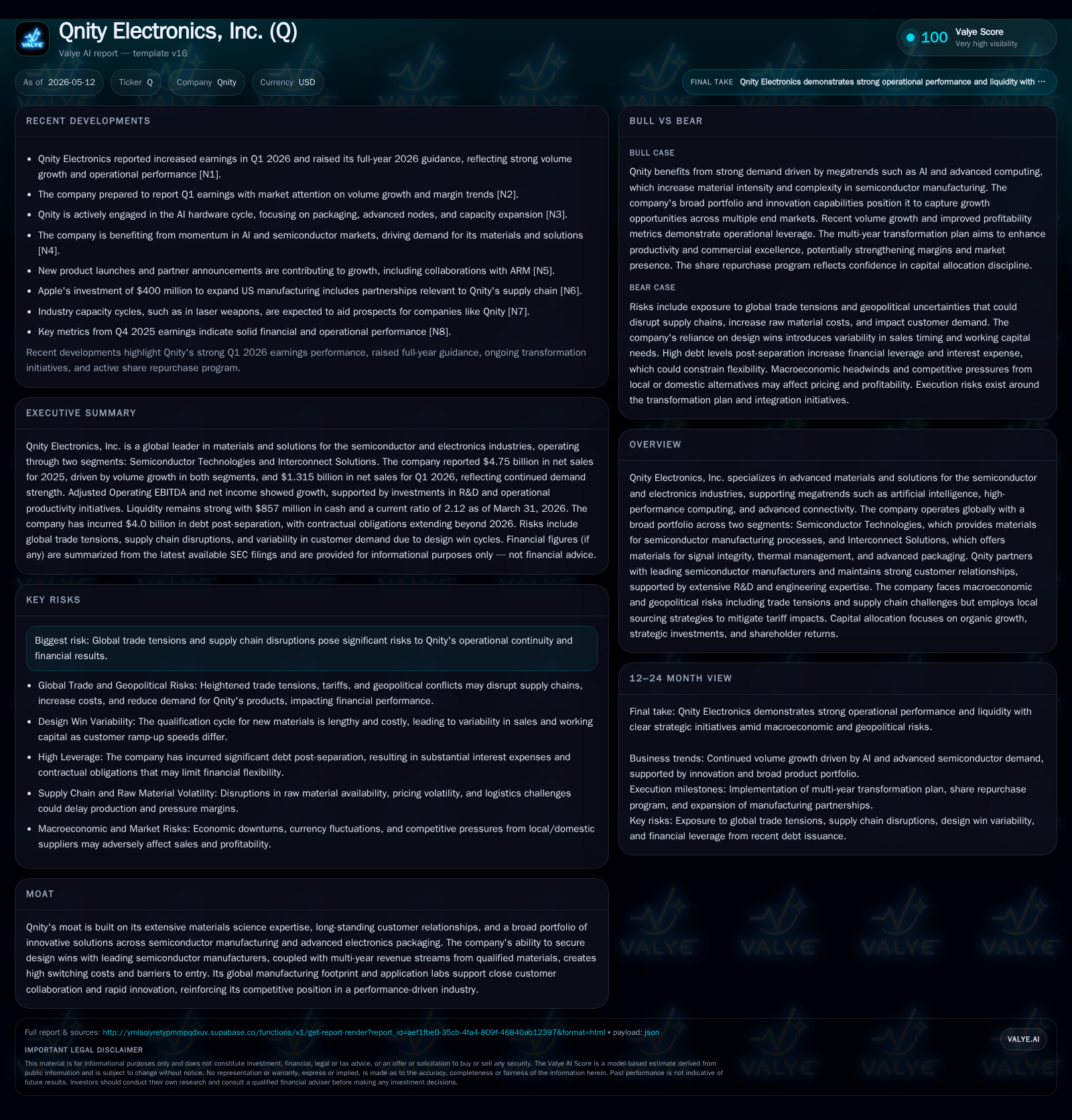
In Q1 2026, Qnity Electronics demonstrated significant operational momentum with an 18% rise in net sales, primarily fueled by volume expansions in both its Semiconductor Technologies and Interconnect Solutions segments. The company’s integrated materials portfolio underpins key technology roadmaps for AI and high-performance computing applications, bolstering its competitive moat through multi-year customer partnerships and rigorous qualification cycles. While geopolitical tensions and supply chain challenges remain headwinds, Qnity’s local-for-local sourcing strategies and broad innovation pipeline position it well to capture accelerating demand associated with AI-driven semiconductor advancements. Going forward, watch for design wins, material qualifications, and supply chain resilience as critical execution metrics.
Q1 2026 Operating Highlights: Sales and Profit Momentum
Qnity Electronics reported strong first-quarter results ending March 31, 2026, with consolidated net sales reaching approximately $1.3 billion — an 18% increase from $1.1 billion in the prior year period [S2]. This uplift was volume-driven, with Interconnect Solutions demonstrating a remarkable 23% volume increase contributing to a total segment sales rise of 25%, despite minor negative price/mix impacts (-1%) offset by currency tailwinds (+3%). Semiconductor Technologies grew net sales by 12%, powered solely by volume gains without price/mix changes [S2]. Adjusted Operating EBITDA expanded substantially in absolute terms reflecting beneficial operating leverage amid rising demand.
Geographically, the Americas led growth with a robust 20% volume increase despite a slight negative price/mix impact; EMEA and Asia Pacific also contributed positively with double-digit volume gains across segments accompanied by beneficial currency effects mainly in EMEA (+6%) [S2]. Cost of sales rose proportionally with volume increases but maintained consistent margins relative to net sales at about 53% [S2], indicating disciplined cost control despite inflationary pressures.
Integrated Materials Solutions Fueling Customer Technology Roadmaps
Qnity’s business model revolves around two tightly integrated segments: Semiconductor Technologies and Interconnect Solutions. The Semiconductor Technologies segment provides critical materials qualified into customers’ complex node transition roadmaps encompassing chemicals like CMP pads/slurries, photoresists, post-CMP cleaners, functional sub-layers, etc., tailored to improve chip performance metrics such as yield and defectivity at advanced technology nodes [S1][S2].
The Interconnect Solutions segment addresses escalating packaging complexity with best-in-class materials serving signal integrity enhancements (e.g., copper pillar plating), thermal management (specialty thermal interface materials), power distribution layers (redistribution layers), and dielectrics supporting multi-die stacking/higher layer counts. This segment is integral to enabling new packaging architectures crucial for AI hardware acceleration and high-performance computing platforms [S1][S2].
Customers rely on Qnity not only for product quality but also engineering collaboration through application labs worldwide that enable rapid prototyping and material qualification aligned with demanding multi-year design cycles. These close partnerships foster recurring revenue streams via renewals embedded within customers’ evolving device roadmaps.
Competitive Moat in Semiconductor Materials and Interconnect Solutions
Qnity maintains durable competitive advantages rooted in its deep expertise in materials science developed over five decades alongside the semiconductor industry’s evolution. The company’s moat is fortified by stringent multi-stage qualification processes that create significant switching costs for OEMs once their roadmaps integrate Qnity’s solutions. These barriers dissuade entrants given the high technical hurdles to match or exceed qualified product performance within stringent reliability specs.
Its global footprint spans manufacturing sites strategically placed near major customer hubs along with R&D application labs facilitating close co-development engagements. Sustained R&D investments approximating 7% of net sales underpin continuous innovation critical to keeping pace with fast-moving demands for smaller nodes and more complex packaging schemes [S1].[S2]
Additional strength stems from long-term customer relationships often spanning decades combined with scalable production capabilities that can rapidly ramp alongside customer capacity expansions without compromising quality or delivery reliability.
Industry Dynamics: Supply Chains, Trade Tensions, and Innovation Cycles
The semiconductor ecosystem faces layered challenges ranging from geopolitical trade tensions—particularly U.S.-China tariff disputes—to raw material availability constraints exacerbated by energy market volatility impacting manufacturing cost structures [S1][S2]. Although Qnity employs local-for-local sourcing to mitigate tariff impacts partially, prolonged or escalated geopolitical frictions could still restrict market access or raise component costs.
Supply chain tightness occasionally induces lead-time extensions; however, the company’s diversified supplier base and inventory strategies aim to balance throughput continuity against inflationary pressures on materials and logistics. Economic uncertainties stemming from conflict zones or fluctuating fuel prices further complicate input cost predictability.
Moreover, the industry innovation cycle driven by node shrinkage pushes material intensity upward — smaller transistors require advanced process chemicals alongside increasingly complex interconnect schemes. Such secular shifts elevate demand for Qnity’s specialized inputs but require continuous investment in process improvements partnered closely with OEM roadmap evolutions.
Growth Drivers: AI Hardware Adoption and Advanced Packaging Evolution
A core growth vector for Qnity flows directly from accelerating artificial intelligence compute demands necessitating more powerful silicon chips fabricated using cutting-edge nodes coupled increasingly with sophisticated heterogeneous integration via multi-die packaging. AI workloads drive higher layer counts in packages to enhance bandwidth and reduce latency, directly increasing material content per device – benefitting both Semiconductor Technologies (process-related consumables) and Interconnect Solutions (packaging dielectrics, thermal interface materials) segments [N4][N5][S2].
Volume gains reported in Q1 reflect these trends quantitatively: Interconnect Solutions surged +23% by volume while Semiconductor Technologies posted +12%, underscoring broad-based structural expansion fueled by evolving end-market requirements rather than cyclical inventory moves alone.
Further technological tailwinds stem from accelerated node transitions requiring novel chemical formulations compatible with extreme ultraviolet lithography (EUV) processes or atomic layer deposition methods enhancing device yields. Combined with growing adoption of system-in-package designs incorporating photonics or sensors beyond traditional logic chips, the product mix tilt towards higher-margin innovative chemistries supports sustained margin improvement potential.
Risks and Constraints: Global Geopolitics and Supply Chain Volatility
Risks remain concentrated around geopolitical uncertainty including tariffs impacting competitiveness especially against local or regional players potentially leveraging domestic incentives or preferences [S1]. While local sourcing mitigates some direct tariff effects on raw materials, indirect consequences via logistics costs or regulatory unpredictability persist.
Supply chain disruptions due to logistic bottlenecks or raw material shortages can delay deliveries causing downstream yield degradation risks at customer fabs—critical given tight semiconductor fab capacities globally. Currency fluctuations introduce variability into reported results but have been historically manageable under company hedging frameworks.
Operational risks include ongoing transformation plan-related charges that encompass consulting fees, severance costs, asset impairments linked to restructuring-related initiatives aimed at productivity gains [S2][S23]. Although currently not material relative to earnings power, these charges warrant monitoring as execution unfolds.
Key Upcoming Catalysts and Execution Watchpoints
Looking ahead through late-2026 into early-2027 horizons, several milestones will shape reappraisal opportunities:
- Progression of new material qualifications aligned with advanced logic nodes (sub-3nm) where securing design wins significantly boosts future revenues.
- Expansion of customer base within emerging sectors such as automotive electronics requiring robust interconnect solutions calibrated for harsh environments.
- Execution success of the multi-year transformation plan targeting operational efficiency enhancement while maintaining innovation pace.
- Monitoring backlog levels as early indicators of sustained demand versus transient order flow spikes.
- Geopolitical developments influencing trade policies especially regarding China relations which could either ease cost pressures or exacerbate sourcing complexities.
- Commodity raw material price trends affecting input cost pass-through capabilities.
Earnings call commentary aligns with raised full year guidance predicated on strong Q1 momentum plus positive early engagement feedback on new product launches indicating robust pipeline health [N1][N2][S3].
Qnity Electronics demonstrates solid execution anchoring its growth trajectory firmly around structural secular tailwinds powering semiconductor advances. The company’s integrated solutions offering coupled with extensive R&D investment forms a formidable competitive edge characterized by sticky long-term OEM partnerships essential in an innovation-intensive market. Navigating macro risks through local sourcing strategies while capturing ever-growing content per chip will define its medium-term path.
Disclaimer: This analysis is provided solely for informational purposes based on SEC filings dated through May 12, 2026. It does not constitute investment advice nor an offer or solicitation to buy/sell securities.
Disclaimer: This is research-only, informational analysis and not investment advice. It may include AI-generated interpretation and general industry context. Always verify important details using primary sources.

Comments