
Canterbury Park Shows Resilience with Strategic Redevelopment and Stable Liquidity
The latest quarterly update reveals Canterbury Park’s deliberate redevelopment financing coupled with a nuanced loyalty-driven revenue recognition approach.
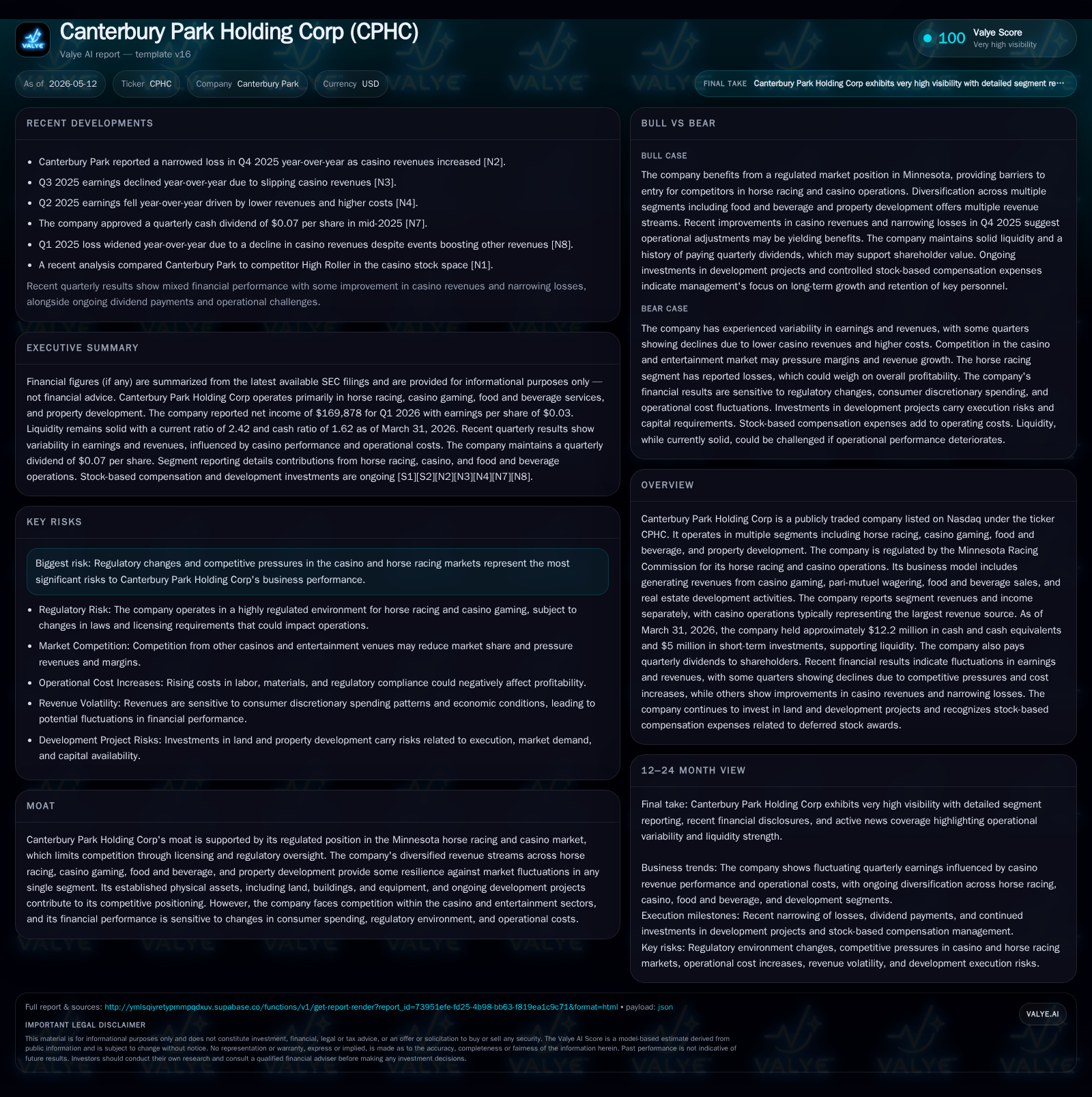
In its Q1 2026 filing, Canterbury Park Holding Corp detailed how it manages casino and pari-mutuel wagering revenue through distinct performance obligations linked to its loyalty program, illustrating steady customer engagement. The company plans to fund its strategic redevelopment project primarily via current operations and available credit lines, signaling confidence in its liquidity position. Supported by regulatory barriers that limit competition, Canterbury Park’s diversified segments—including gaming, food and beverage, and property development—foster resilience amid industry headwinds. Risks emanate chiefly from regulatory shifts and regional competitive pressures. Upcoming milestones to monitor include redevelopment progress and financial performance against established bonus matrices.
Latest Operating Update Highlights Redevelopment Strategy
Canterbury Park's most recent quarterly filing dated May 12, 2026 [S2] introduces critical nuances in how it recognizes revenue from casino operations and pari-mutuel wagering. Specifically, contracts for customers enrolled in its loyalty program carry two distinct performance obligations: one relating to the wagers placed and another linked to the points earned under the program. Non-loyalty participants are accounted for under a single obligation model. This bifurcation allows clearer matching of revenues with earned benefits, reflecting stable engagement dynamics within the casino patron base. The company pragmatically applies a portfolio accounting expedient due to the homogenous nature of wagering contracts.
It also left open the possibility of securing third-party capital infusion if necessary, demonstrating prudent capital management rooted in available financing options [S2].
A March 26, 2026 event filing [S3] further contextualizes management incentives aligned with financial milestones. The Compensation Committee set thresholds for Adjusted Income From Operations (AIFO) and consolidated revenue that will determine payouts under the 2026 Annual Bonus Plan. These metrics carry a weighting of 70% to AIFO and 30% to revenue, with payouts capped at 150% of target yet restricted below minimum results.
Business Model Overview and Revenue Diversification
According to the latest annual report filed on March 10, 2026 [S1], Canterbury Park Holding Corp operates across several interlinked segments: horse racing regulated by the Minnesota Racing Commission, casino gaming (primarily card games), food and beverage services at its facilities, and property development on owned land parcels.
The company generates revenues predominantly through casino operations—which include card gaming handled internally—and pari-mutuel horse race wagering. Pari-mutuel betting revenues represent pools collected minus payouts to bettors and horsemen; while casino earnings derive from house take on gaming activities.
Food and beverage offerings add a complementary revenue stream capturing ancillary entertainment spending. Meanwhile, property development involves proactive land use planning that captures tax increment financing (TIF) benefits alongside real estate appreciation potential.
This multi-segment business model provides natural diversification against cyclicality inherent in gambling markets: while visitation fluxes impact gaming revenue directly, stable property returns and recurring food & beverage sales offer buffers.
Competitive Positioning in Regulated Gambling Markets
Canterbury Park’s moat is underpinned largely by Minnesota’s stringent regulatory environment. Licensing restrictions effectively cap new entrants in both horse racing venues and casinos within the state’s jurisdiction overseen by the Minnesota Racing Commission [S1]. This regulatory barrier constrains direct competition while allowing Canterbury Park to maintain meaningful pricing power on wagering margins and gaming yield.
Nonetheless, as consumer entertainment preferences evolve, regional competition from nearby casinos or alternative leisure options does exert market pressure. Retention strategies such as loyalty programs become critical in sustaining repeat patronage.
Capacity constraints exist physically—in terms of gaming floor space—and regulatory caps limit expansion possibilities absent renegotiated licenses or approvals. Supply chain factors appear limited for core operations but sensitivity remains toward labor costs impacting service quality in food & beverage segments.
Growth Drivers: Redevelopment and Loyalty Program Dynamics
Canterbury Park's ongoing Redevelopment Agreement serves as a central strategic growth lever [S2]. Expansion or renovation of facilities can increase capacity utilization or elevate guest experience quality—both critical for incremental margin uplift. Funding this with operational cash complemented by a flexible $10 million revolving credit line provides financial tailwinds without aggressive leverage buildup.
The firm’s loyalty program is structurally notable: it is accounted for via two-tier performance obligations tied directly to customer behavior metrics [S2]. This setup incentivizes increased spend frequency or volume from loyal patrons who receive points redemption options enhancing stickiness. Measurable KPIs include points issued versus redeemed alongside related wagering activity influencing recognized revenue.
The Annual Bonus Plan matrices reflect management’s commitment to hitting key profitability (AIFO) and top-line (revenue) milestones [S3]. Meeting or exceeding these targets likely correlates with operational efficiencies unlocked via redevelopment projects plus optimized customer engagement leveraging loyalty programs.
Market expansion avenues remain modest given regulatory containment but innovation in promotional offerings or selective partnerships could cultivate incremental audience segments.
Risks and Constraints: Regulatory and Competitive Pressures
Regulatory changes represent the principal risk vector [S1]. Alterations in state licensing laws or taxation frameworks could materially affect Canterbury Park’s operating license viability or cost structure.
Competitive pressures from both licensed casinos in adjacent states or unregulated online gambling platforms could erode market share over time if not proactively countered by experiential differentiation or enhanced customer value propositions.
Economic sensitivities linked to discretionary consumer spending patterns can create cyclical variability in wagering volume particularly during downturns. Additionally, rising operational costs—labor, utilities, compliance—could compress margins absent price/mix improvements.
The company’s diversification partly mitigates these risks but dependencies remain.
Key Upcoming Milestones and What to Watch
Critical near-term milestones center on redevelopment project execution—the timing of capital expenditures relative to planned enhancements—and their measurable impacts on guest traffic or incremental revenue gains [S2].
Financially, tracking achievement against the 2026 AIFO and consolidated revenue targets set by the Compensation Committee will signal operational momentum or emerging issues [S3]. Incentive Award payouts are contingent upon these metrics meeting established floors implying they are meaningful internal performance indicators.
Monitoring potential third-party financing arrangements would reveal insights into capital strategy adjustments should operating cash flows prove insufficient for redevelopment needs.
Regulatory developments impacting horse racing statutes or gambling legislation remain ongoing watchpoints given their bearing on market access dynamics.
Financial Snapshot and Liquidity Analysis
Latest financial snapshot
| Metric | Value | Period |
|---|---|---|
| Cash & equivalents | $12mm | |
| 2026-03-31 | ||
| Current assets | $26mm | |
| 2026-03-31 | ||
| Current liabilities | $11mm | |
| 2026-03-31 | ||
| Current ratio | 2.42x | |
| 2026-03-31 |
Source: SEC companyfacts cache [F1].
As of March 31, 2026, Canterbury Park reported cash and cash equivalents totaling $12.2 million alongside an absence of reported long-term debt resulting in a net cash position approximately equal to cash levels [F1][S2].
The company maintains a revolving credit facility authorized up to $10 million securing borrowing flexibility for redevelopment among other uses [S2]. Interest terms are tied to Prime Rate floors ensuring manageable cost when drawn upon.
Recent earnings have shown fluctuations but basic net income per share rebounded positively in Q1 2026 compared to prior periods [S2][F1], consistent with enhanced operational execution aligned with strategic initiatives.
| Metric | Value (USD) |
|---|---|
| Cash & Equivalents | 12,193,651 |
| Current Assets | 25,738,890 |
| Current Liabilities | 10,614,732 |
| Current Ratio | 2.42 |
Disclaimer: This analysis is intended solely as an informational overview summarizing recent SEC filings and company disclosures pertaining to Canterbury Park Holding Corp as of May 12, 2026. It does not constitute investment advice or recommendations.
Disclaimer: This is research-only, informational analysis and not investment advice. It may include AI-generated interpretation and general industry context. Always verify important details using primary sources.

Comments