
Vishay Precision Group Accelerates Growth through Innovation and Strategic Expansion
VPG's Q1 2026 results underscore progress in operational excellence, bolstered by proprietary foil sensor technologies and strategic acquisitions.
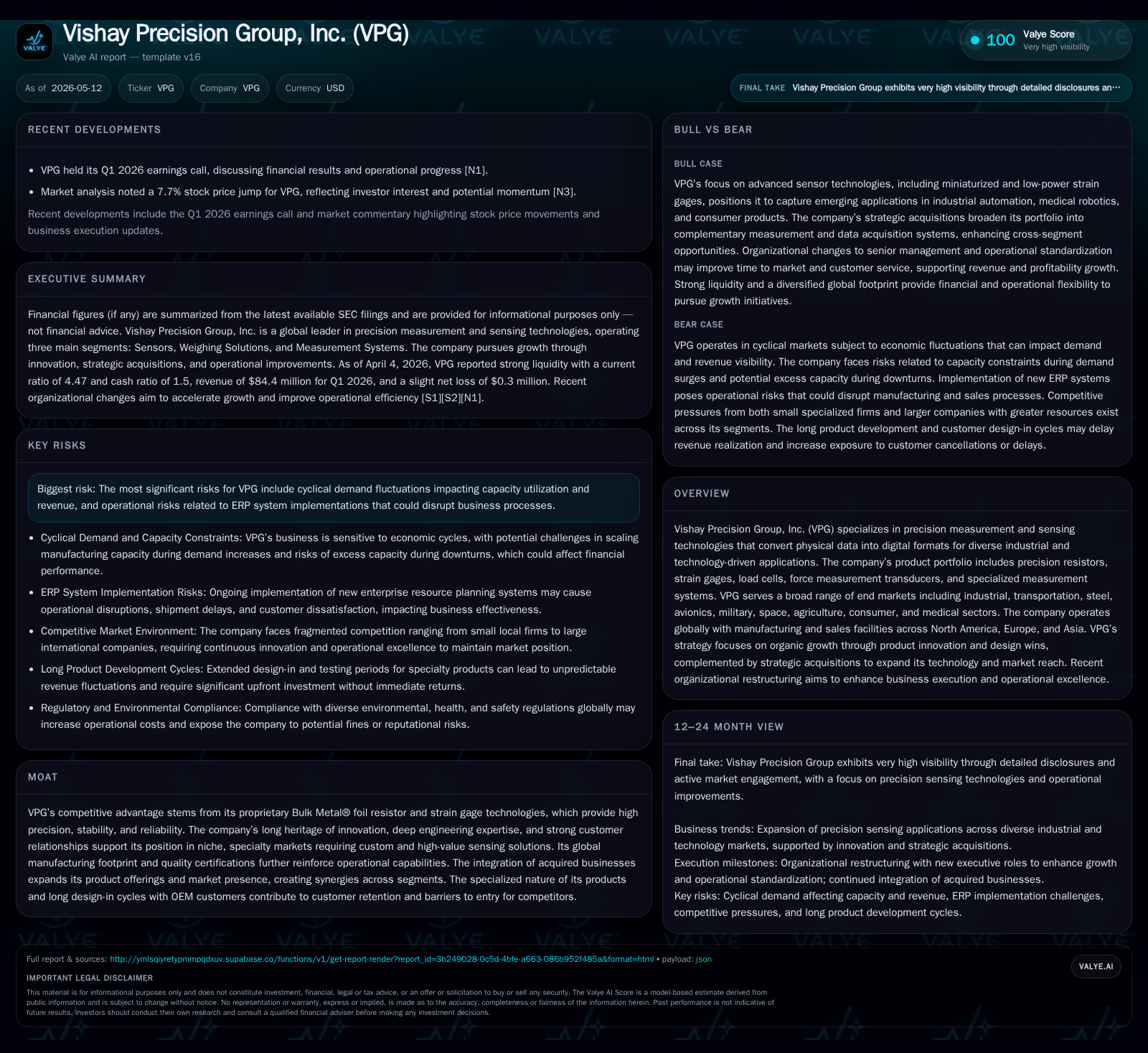
In its latest quarterly report, Vishay Precision Group (VPG) highlights strong execution momentum driven by organizational restructuring and product innovation. The company’s core strengths lie in its Bulk Metal® foil technology portfolio, long design-in cycles, and a diversified customer base spanning critical industrial and technology sectors. VPG’s disciplined acquisition strategy and global manufacturing footprint reinforce its competitive moat amidst a fragmented industry landscape. Key risks include cyclicality and ERP implementation challenges, but sustained R&D investment and growing market applications signal promising growth opportunities.
Q1 2026 Operating Update: Momentum in Execution and Growth
Vishay Precision Group’s first quarter fiscal 2026 results, disclosed on May 12, 2026, reflect a company advancing on its strategic growth trajectory. The filing reports no material changes to risk factors but highlights organizational enhancements underpinning growth acceleration [S2][S3]. Notably, newly created senior executive roles—the Chief Business & Product Officer and Chief Operating Officer—have been filled to sharpen focus on leveraging sales synergies across business units and improving operational standards [S5]. This restructuring aims to reduce cycle times for new product introductions and enhance customer service levels.
Recent earnings call commentary confirms positive demand trends across multiple end markets, with specific appreciation for design wins gaining traction as customers scale deployment. The company stressed operational excellence as key to extracting value from investments in advanced manufacturing automation and standardization efforts launched in prior years.
VPG’s Precision Measurement Portfolio: Business Model and Product Differentiation
VPG operates through a suite of specialized precision measurement technologies converting physical phenomena into digital signals utilized in critical industrial processes. Underpinned by its proprietary Bulk Metal® foil resistors and strain gages originally developed under Vishay Intertechnology's legacy, the company designs high-precision sensors that serve testing laboratories, industrial manufacturing lines, transportation systems, military hardware, aerospace applications, medical devices, and consumer products [S1].
Revenue generation flows primarily from OEM customers engaging VPG in extensive design-in cycles that can range between 12 to 24 months; these create switching costs that bolster retention once integrations are complete [S8]. Products such as load cells—force measurement transducers—and specialized thermal-mechanical test systems provide higher-margin opportunities due to customization demands.
Unit economics benefit from premium pricing justified by product reliability, multi-year customer engagements, and the company's consistent R&D-driven innovation pipeline targeting miniaturization (e.g., MEMS-enabled vehicle weighing solutions), power efficiency enhancements for sensors, and expanded data acquisition capabilities [S10][S17]. Geographic diversification across North America, Europe, and Asia buffers demand variability.
Competitive Moat and Industry Position in Precision Sensing
The precision sensing industry is notably fragmented with small local players alongside larger established firms. VPG’s moat derives markedly from its technological lead in Bulk Metal® foil tech providing unmatched stability compared to alternative resistor or strain gage technologies [S13]. Its trusted brand reputation supports technical credibility especially in stringent fields like aerospace certified to AS9100 standards and military-grade sensors.
Global manufacturing footprint accompanied by quality certifications including ISO/IEC 17025 for testing systems enhances operational resilience. Competitive threats include Chinese producers offering cost-competitive foil sensors albeit not yet matching performance specs; likewise semiconductor strain gages pose a technological challenge though so far lack reliability equivalence [S1]. In load cell measurements—a highly competitive segment—the company's niche positioning relies on technical customization aligned with close customer collaboration.
Strategic acquisitions add integrated sensor system capabilities allowing cross-selling within existing customer bases while expanding technological breadth. This synergistic growth fortifies barriers versus standalone component competitors [S6].
Key Growth Drivers: Innovation, Acquisitions, and Market Expansion
VPG’s forward path is fueled by continuous R&D investment sustaining a robust product pipeline aimed at higher-value sensor applications requiring greater accuracy with reduced form factors [S17]. Development efforts have yielded advanced sensors with lower power consumption—important for mobility applications—and automated manufacturing lines raising throughput without compromising quality.
Acquisitions since spin-off have targeted complementary specialists: Stress-Tek expanded rugged load cells for transportation sectors; Dynamic Systems Inc. added thermal-mechanical testing for metals industries; Diversified Technical Systems (DTS) brought embedded data acquisition targeting automotive safety testing with broad aerospace/military crossover potential [S6]. Furthermore, recent acquisition of Nokra broadened laser-based metal gauge measurement enhancing offerings in steel fabrication verticals.
End-market expansion includes aerospace & defense safety applications increasingly reliant on precision data acquisition; automotive onboard weighing systems integrate MEMS tech for real-time vehicle monitoring; heavy industries benefit from inline measurement upgrades promoting process control efficiencies.
Risks and Challenges: Cyclicality, ERP Integration, and Competition
Demand cyclicality remains relevant as many industrial customers adjust capital expenditure plans responding to macroeconomic conditions affecting production volumes. Such fluctuations impact capacity utilization rates directly influencing profitability metrics [S1].
ERP system rollouts pose operational risks; successful integration is pivotal to maintaining supply chain synchronization while avoiding disruptions that could degrade customer service or extend delivery schedules. Given the company's global footprint spanning multiple continents, such transitions require precise execution coordination [S2].
Competition from evolving sensor technologies—especially semiconductor strain gages—requires vigilance lest these alternatives erode market share by offering cost or performance advantages. Cost competition is noted particularly from Chinese suppliers who may leverage lower labor inputs but do not yet match VPG's high-quality standards [S1]. Maintaining technical differentiation via R&D remains critical.
Additionally, workforce shortages and labor cost inflation constitute ongoing headwinds given the specialized skills required for high-precision manufacturing roles worldwide.
Looking Ahead: Catalysts and Milestones for Sustained Momentum
Key near-term indicators include monitoring sequential quarterly revenue trajectories reflecting increasing volume orders tied to recent design wins maturing into production runs. Progress updates on ERP system implementation will be essential to validate operational improvements promised during restructuring announcements [N1][S3].
Potential additional acquisitions continue to be part of the stated corporate strategy focusing on synergistic technology platforms expanding force/weight/pressure measurement domains. Success here would support broader system integration capabilities offering cross-market solutions.
R&D outcomes delivering new sensor variants with improved characteristics will also serve as growth catalysts alongside deepened penetration into aerospace safety systems and automotive product-testing segments.
Latest Financial Snapshot
| Metric | Value | Period |
|---|---|---|
| Cash & equivalents | $82mm | |
| 2026-04-04 | ||
| Total debt | $21mm | |
| 2026-04-04 | ||
| Net debt | $-61mm | |
| 2026-04-04 | ||
| Current assets | $246mm | |
| 2026-04-04 | ||
| Current liabilities | $55mm | |
| 2026-04-04 | ||
| Current ratio | 4.47x | |
| 2026-04-04 |
Source: SEC companyfacts cache [F1].
| Metric | Value |
|---|---|
| Revenue (TTM) | $307.2M |
| Operating Income | $13.8M |
| Net Income | $5.3M |
| Cash & Equivalents | $82.5M |
| Total Debt | $21.0M |
| Current Ratio | 4.47 |
As of April 4, 2026 balance sheet metrics show a robust liquidity profile with about $82 million in cash against $21 million total debt yielding a net cash position exceeding $61 million [F1]. This financial flexibility supports ongoing R&D funding alongside selective acquisition activity without imposing refinancing risks.
This analysis synthesizes information available as of May 12th, 2026 including filings up to fiscal Q1 results without providing investment guidance or recommendations.
Disclaimer: This is research-only, informational analysis and not investment advice. It may include AI-generated interpretation and general industry context. Always verify important details using primary sources.

Comments