
Kodiak AI Scales Driver-as-a-Service Amid Rising R&D Investment and Cash Burn
Kodiak AI’s Q1 2026 reflects scaling commercial deployments alongside increased investment in technology development, balancing growth ambitions with liquidity challenges.
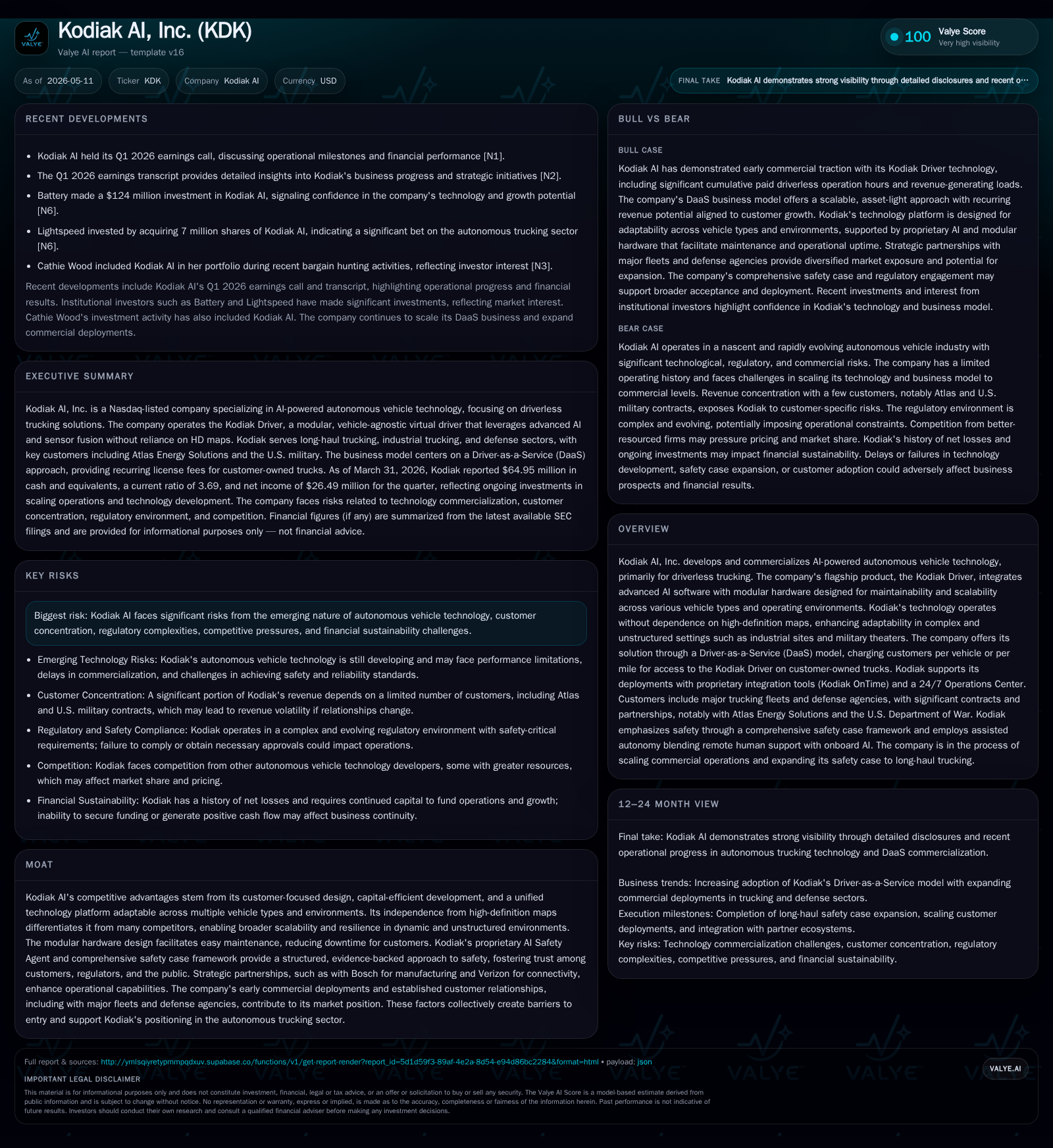
In Q1 2026, Kodiak AI advanced its autonomous trucking business by expanding its Driver-as-a-Service (DaaS) model through new commercial and defense partnerships. Revenues rose 24% year-over-year driven by DaaS, but losses widened due to accelerated R&D spending aimed at enhancing its Kodiak Driver platform. The company benefits from a differentiated autonomous solution that eschews high-definition maps and integrates modular hardware, supporting adaptability across vehicle types and environments. Growth hinges on broadening customer adoption beyond key partners while managing regulatory and technological execution risks and sustaining liquidity through capital markets access. Kodiak's balance sheet shows a solid current ratio but ongoing cash burn demands continued capital raises to fund expansion.
Recent Operating Update
Kodiak AI’s Q1 2026 results [S2] reveal meaningful progress in commercializing its AI-powered autonomous trucking solution known as the Kodiak Driver. Total revenues climbed to $1.8 million for the quarter ended March 31, marking a 24% increase from the prior year period primarily fueled by a $1.3 million jump in Driver-as-a-Service (DaaS) license fees. This growth partially offset a $1 million decline stemming from the winding down of contracts with the U.S. Army.
While revenue increased modestly, operating losses deepened substantially to $37.9 million GAAP from $18.6 million year-over-year. Non-GAAP operating losses excluding stock-based compensation nearly doubled to $31.8 million [S20]. The principal driver of this widening loss was aggressive investment in research and development which surged 73% to $17.6 million as Kodiak ramps up technology enhancements centered on enabling robust over-the-road deployments across diverse industry verticals including long-haul trucking, industrial trucking, and defense [S2].
Cash flows reflect sustained burn consistent with growth-phase development: net cash used in operating activities stood at approximately $29.5 million for the quarter while investing activities provided net inflows of $39.5 million primarily from maturities of marketable securities [S19]. As of March 31, the company held roughly $65 million in cash and equivalents against total debt nearing $42.8 million [F1][S2], leaving it with a healthy current ratio of about 3.69 reflecting substantial near-term liquidity.
On May 7-8, Kodiak closed a $100 million private placement (PIPE) transaction involving new institutional investors and existing partners including Ares Management affiliates [S3][S13], extending the company’s funding runway into Q2 2027 under current projections [S16].
Business Model
Kodiak AI generates revenue chiefly via its DaaS model launched in December 2024 [S1]. Customers pay license fees either per truck or per mile traveled using the Kodiak Driver software installed on their own vehicles rather than relying on Kodiak-owned trucks. This approach enables an asset-light scale-up that aligns revenue growth directly with operators' usage while reducing upfront capital expenditures for both Kodiak and customers.
At the core is the Kodiak Driver virtual driver system that synergizes advanced AI-enabled software with modular vehicle-agnostic hardware designed for maintainability and rapid integration across various platforms—from conventional semi-trucks used in long-haul routes to specialized vehicles serving industrial sites or military applications [S1]. Uniquely, Kodiak's system does not rely on high-definition mapping tech pervasive elsewhere in the AV market but instead leverages sophisticated real-time perception algorithms allowing penetration into complex and unstructured environments.
Revenue mechanics hinge on increasing vehicle deployments under active licenses combined with scaling miles powered autonomously; these metrics feed into recurring license income streams underpinned by multi-year commercial agreements with major fleet operators like Atlas Energy Solutions [S1]. Complementing licensing are operational support offerings including Kodiak OnTime integration tools facilitating efficient fleet onboarding and a centralized Operations Center providing continuous remote assistance enhancing safety and uptime.
Industry Structure & Competitive Position
The autonomous vehicle landscape is crowded with competitors differentiated by technology strategies, customer bases, and vertical focuses. Kodiak stands out through its customer-centric engineering emphasizing maintainability coupled with independence from HD maps—a costly dependency slowing scalability for many peers.
Its unified physical AI platform supports flexibility across vehicle types which broadens addressable markets beyond pure highway freight hauling into areas like industrial logistic operations where terrain unpredictability challenges map-dependent systems [S1]. Partnerships with Bosch for manufacturing hardware components and Verizon for connectivity infrastructure further bolster operational robustness.
Early mover advantages include multiple paid deployment hours exceeding 23,500 as of Q1 2026 collectively delivered over more than 15,600 loads signaling tangible traction despite the nascent market environment [S2]. Relationship depth with defense agencies introduces strategic optionality to diversify revenue streams complementary to commercial trucking segments.
Growth Drivers
Customer Expansion: Scaling DaaS bookings by onboarding additional large fleet customers is pivotal; leveraging existing partnerships anchors referenceability necessary for broader adoption.
Technology Maturation: Continued R&D focusing on improving autonomous driving capabilities—especially adapting algorithms to varied geographies and weather scenarios—reduces technical risk barriers.
Geographic Penetration: Extending service beyond initial southern U.S. corridors into new regional markets enhances utilization dynamics.
Operational Excellence: Optimizing maintenance cycles through modular hardware reduces truck downtime aiding fleet economics which drives renewals and upsells.
Defense Sector Engagements: Growing contracts supporting government initiatives reinforce revenue diversity while accelerating tech validation in demanding environments.
Recurring Revenue Model: Flexible pricing aligned to mileage or per vehicle underpins predictable revenue growth tightly coupled with customer operational scale.
Risks & Watchpoints
Key risks are rooted largely in industry infancy combined with execution demands:
- Technology Execution: Autonomous driving remains complex; failures or delays impair credibility affecting sales cycles and margin trajectories.
- Customer Concentration: Dependence on limited major customers including Atlas Energy Solutions poses revenue volatility if contracts lapse or scale below expectations.
- Regulatory Complexity: Dynamic autonomous vehicle regulations could constrain rollout pace or necessitate costly compliance efforts.
- Competitive Intensity: Larger well-funded rivals may accelerate feature development or pricing pressures disrupting market share gains.
- Financial Sustainability: Ongoing negative operating cash flow necessitates continued capital raises that may dilute shareholders or limit financial flexibility.
- Supply Chain Dependencies: Reliance on third-party suppliers for critical components imposes potential disruptions impacting delivery schedules.
- Safety Liability: Given inherent risks of AV tech causing accidents or fatalities can materially affect reputational risk and regulatory scrutiny.
What To Watch Next
- Announcements related to additional commercial fleet partnerships signaling breadth expansion of the DaaS customer base.
- Uptick in cumulative paid driverless hours evidencing growing operational maturity and reliability improvements.
- Defense contract awards or milestone achievements increasing government-related revenues.
- Progress updates on technology enhancements especially tied to environmental adaptability outlined during R&D acceleration phase.
- Liquidity management developments including follow-on fundraises or debt facilities beyond mid-2027 horizon.
- Regulatory developments potentially influencing deployment feasibility across states or federal jurisdiction impacting go-to-market timing.
Financial Snapshot (as of Q1 Ending March 31, 2026) [F1][S2]
Latest financial snapshot
| Metric | Value | Period |
|---|---|---|
| Cash & equivalents | $65mm | |
| 2026-03-31 | ||
| Total debt | $43mm | |
| 2026-03-31 | ||
| Net debt | $-22mm | |
| 2026-03-31 | ||
| Current assets | $95mm | |
| 2026-03-31 | ||
| Current liabilities | $26mm | |
| 2026-03-31 | ||
| Current ratio | 3.69x | |
| 2026-03-31 |
Source: SEC companyfacts cache [F1].
Kodiak maintains a strong liquidity position relative to short-term obligations but continues generating significant operational losses driven primarily by R&D investments essential for product maturation and scaling efforts [S2][F1]. The recent PIPE financing provides near-term capital stability but further raises are probable given ongoing cash burn rates [S13][S16].
Disclaimer: This analysis synthesizes public SEC filings and verified news sources related to Kodiak AI Inc.'s business operations as of May 2026 solely for informational purposes without offering investment advice or recommendations.
Disclaimer: This is research-only, informational analysis and not investment advice. It may include AI-generated interpretation and general industry context. Always verify important details using primary sources.

Comments