
Hawaiian Electric Industries Advances Recovery and Grid Resilience with Litigation Settlement Payments and Federal Grants
First quarter 2026 results show progress in litigation settlement financing, operational stability, and infrastructure modernization amid ongoing wildfire-related challenges.
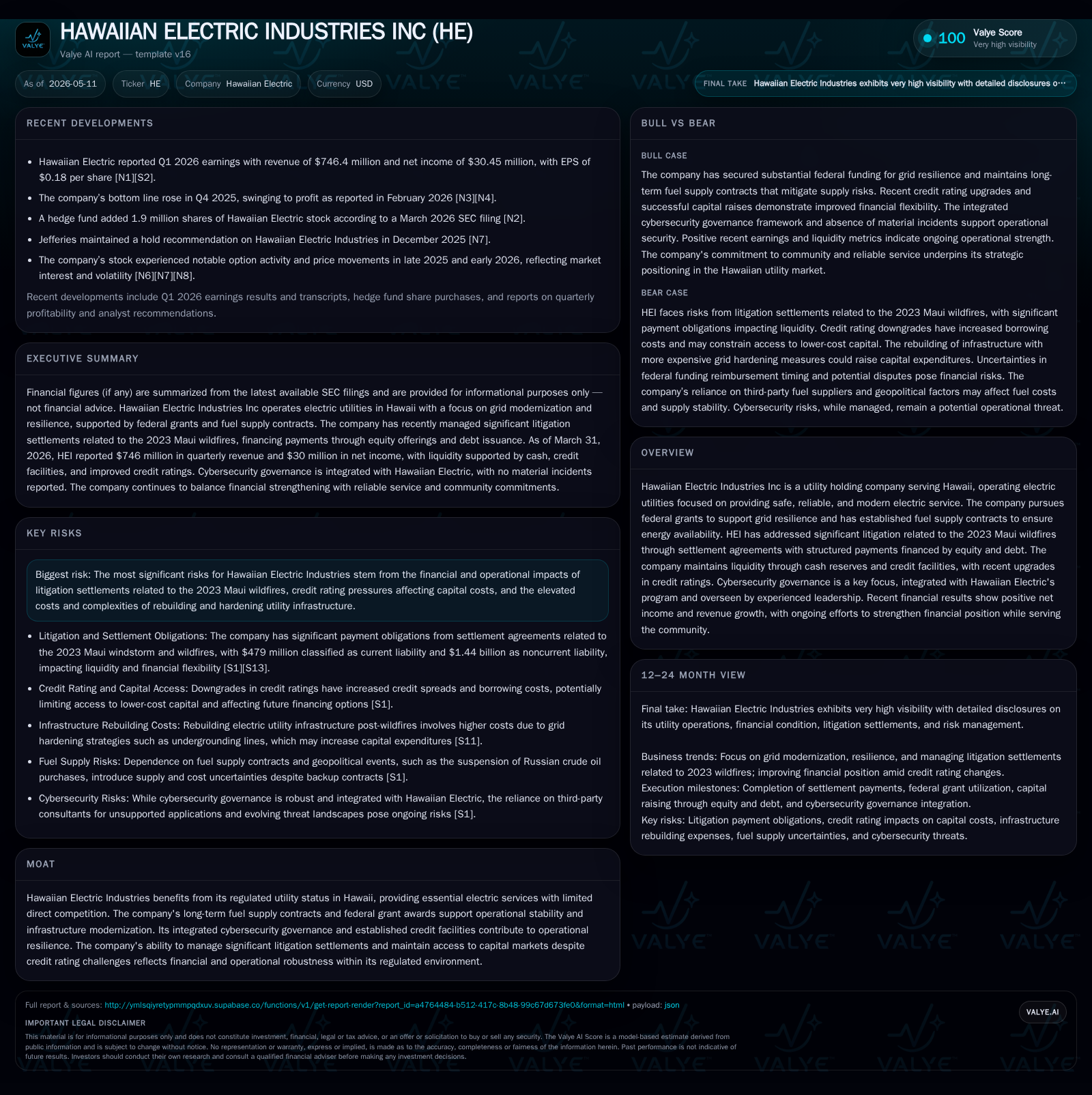
Hawaiian Electric Industries (HEI) has taken significant steps in early 2026 to address prior wildfire-related liabilities by authorizing the first installment of a multi-year $1.92 billion settlement, funded partly through a large equity raise in late 2024. Concurrently, the company continues to pursue federal grant funding for grid resilience improvements and maintain stable fuel contracts despite supply uncertainties. HEI operates as a regulated utility monopoly in Hawaii with durable contractual supports but faces cost inflation and credit rating risks related to its extensive capital rebuilding efforts and legal aftermath of the 2023 Maui wildfires. The utility’s integrated cybersecurity governance and strategic liquidity initiatives help manage operational risks, while tariff-regulated revenue and federal support form the backbone of its path toward infrastructure modernization and long-term community service.
Recent Operating Update
Hawaiian Electric Industries (HEI) disclosed critical operating developments in its first quarter 2026 Form 10-Q filed May 8, 2026 [S2] with supplementary disclosures in an event filing the same day [S3]. The most consequential update was authorization to pay the initial $479 million installment on a four-year structured settlement totaling approximately $1.92 billion for tort claims related to the devastating 2023 Maui wildfires [S3]. This payment was funded by proceeds from a $557.7 million equity offering completed in September 2024; those funds had been held in a restricted special purpose subsidiary pending final resolution of conditions triggering payout [S1], [S9], [S19]. The final legal conditions were met on April 10, 2026 [S19].
Parallel to settlement progress, HEI reported continued pursuit of federal grants aimed at electric grid resilience: notably, a confirmed $95 million award from the U.S. Department of Energy's Climate Adaptation Transmission and Distribution Resilience Program received notification on August 7, 2024 [S1]. This funding addresses needs to modernize and harden Hawaiian grids against climate-related threats.
Fuel supply contracts underpin operational stability amid turbulent geopolitical conditions. HEI maintains a fuel contract commencing January 1, 2023 with PAR Hawaii Refining LLC [S1], extended through an amendment effective June 18, 2025 that also created cost savings. Backup contracts with Vitol Inc., extended through mid-2026, mitigate risk from crude supply disruptions linked to sanctions on Russian oil purchases [S1]. Recovery of these fuel costs is facilitated by approvals from the Hawaii Public Utilities Commission (PUC) via Energy Cost Recovery Clauses (ECRCs) ensuring regulated tariff pass-through.
Liquidity remains sufficient in the near term with cash and equivalents totaling approximately $453 million at quarter-end March 31, 2026, alongside current assets exceeding current liabilities by a factor of ~1.34x [F1]. Total debt approximates $2.28 billion [F1], reflecting financing for capital expenditures including wildfire recovery projects and ongoing operations.
Business Model Overview
HEI operates primarily as a regulated utility holding company serving all of Hawaii through subsidiaries that provide electric utility services on multiple islands. As a geographically isolated monopoly under state regulation by the PUC, Hawaiian Electric’s revenue derives mainly from electric service tariffs which are set based on defined return-on-equity targets approved within rate cases.
This regulatory framework affords relative pricing power and ensures recovery of prudently incurred costs including fuel expense through mechanisms like ECRCs. It also creates significant barriers to entry for competitors due to infrastructure scale and regulatory complexities.
HEI’s fuel procurement strategy leverages long-term contracts negotiated competitively (e.g., RFPs initiated June 30, 2021 for fuel supplies beginning January 2023) to stabilize input costs while maintaining backup arrangements to hedge against supply interruptions [S1]. These contracts are scrutinized by regulators for prudency before tariffs incorporate their costs.
The utility business necessitates substantial capital expenditures for infrastructure maintenance, modernization, and disaster recovery—particularly pertinent given the impact of major wildfires in Maui and other climate-induced risks requiring grid hardening investments such as underground cable placement.
The company supplements tariff-based revenues through federal grant programs for resilience projects applying federal support such as the DOE’s Climate Adaptation Transmission & Distribution Resilience Program (CAPTDRP), designed explicitly to upgrade transmission systems vulnerable to extreme weather.
Cybersecurity forms an integral element of operational risk management within HEI's licensed utilities. HEI itself outsources majority IT/CRM functions to Hawaiian Electric under an advanced Service Level Agreement (SLA), complemented by access to third-party cybersecurity consultants where necessary for specialized risk assessments or breach resolution [S1]. Governance oversight occurs via quarterly board updates involving an experienced Chief Information Security Officer (CISO).
Industry Structure and Competitive Position
HEI enjoys an entrenched regulated monopoly as Hawaii's electric utility provider — essentially without direct competition due to geographic isolation combined with state regulatory protections. This confers a stable customer base composed mostly of residential households, commercial businesses, and institutional customers reliant on safe and reliable electricity.
Its competitive moat is anchored by:
- Exclusive service territories authorized by state PUC jurisdiction;
- Long-term contractual rights over key fuel sources ensuring supply stability;
- Regulatory-approved rate mechanisms recovering operating costs inclusive of contingency allowances;
- Institutional relationships facilitating access to capital markets despite ongoing reputational challenges related to historic wildfire litigation.
However, this structure also enforces regulatory scrutiny over pricing proposals, incentivizes efficiency improvements albeit within allowed returns frameworks, and exposes HEI to political/regulatory risks related to environmental policy shifts or customer affordability concerns.
Growth Drivers
Litigation Settlement Progress Unlocking Financial Certainty
HEI’s structured payment plan related to wildfire settlements disperses financial burdens over multiple years enabling more predictable cash flow planning and reducing operational uncertainty [S19]. Completion of payment conditions allows management focus on core business execution rather than protracted legal contingencies.
Federal Grants Supporting Capital Modernization
Federal awards such as the DOE’s CAPTDRP provide non-dilutive funding supporting investment in transmission/distribution grid robustness—critical given Hawaii's unique vulnerability to climate impacts and natural disasters [S1]. This external funding accelerates planned capital projects beyond what tariff collections alone could finance.
Strategic Fuel Procurement Mitigating Supply Volatility
Securing multi-year fuel contracts with cost-savings amendments plus backup suppliers limits risk of volatile spot-market exposure amid global energy market disruptions exacerbated by geopolitical tensions [S1]. Effective cost recovery mechanisms allow pricing transfer without eroding margins.
Regulatory Rate Case Wins Ensuring Revenue Stability
Consistent approval cycles by Hawaii PUC enable incremental rate adjustments aligning revenues with inflationary pressures on input costs (labor/materials/fuel) ensuring ongoing financial viability amidst rising operational expenses.
Operational Efficiencies via Integrated Cybersecurity & IT Support
Leveraging Hawaiian Electric’s IT infrastructure under SLA arrangement minimizes duplicated overheads at HEI corporate level while maintaining high security standards via experienced CISO oversight reduces risks that could otherwise disrupt service or incur financial penalties.
Risks / Watchpoints / Growth Constraints
- Wildfire Settlement & Rebuilding Costs: While initial payments are underway, overall capital outlay required for rebuilding physically hardened grids—including undergrounding lines—is materially higher than conventional reconstruction [S8]. Persistent cost overruns or delays could strain liquidity.
- Credit Rating Sensitivities: Despite mid-2025 upgrades from Fitch/Moody's/S&P improving credit spread outlooks [S8], lingering leverage levels near $2.28 billion plus contingent liabilities impose refinancing risk especially if market conditions tighten or regulatory delays occur.
- Regulatory & Political Risk: Rate case outcomes depend on evolving PUC policies balancing affordability concerns against infrastructure need; adverse rulings may compress allowed returns undermining reinvestment capacity.
- Fuel Price Inflation: Global commodity price spikes beyond hedged contract scope may elevate fuel expenses passed through tariffs only imperfectly or lagged impacting profitability temporarily.
- Cybersecurity Threats: Though no material breaches have occurred recently [S1], increasing cyber threat landscape globally mandates continuous vigilance; failure here could disrupt operations or damage reputation severely.
- Customer Demand & Economic Trends: Utility consumption growth is structurally slow; demand fluctuations driven by economic cycles or demographic shifts affect volumetric revenues though partially offset by fixed-cost recovery design.
What To Watch Next
- Execution pace & cost management details on wildfire-related infrastructure rebuilding including undergrounding initiatives announced under resilience programs.
- Updates on federal grant disbursement schedules tied to DOE resilience funding impacting capital project timelines.
- Confirmation of subsequent annual $479 million settlement payments scheduled through estimated full payout year per agreements.
- Regulatory decisions or filings linked to tariff changes reflecting updated cost recoveries post-settlement impact.
- Further refinements or additions to fuel sourcing strategies mitigating longer-term energy security risks for island operations.
- Any updates around IT/cybersecurity governance protocols or incidents affecting operational continuity.
- Quarterly earnings releases for trends on operating income margins post litigation payment phase transition.
Financial Profile Overview
Latest financial snapshot
| Metric | Value | Period |
|---|---|---|
| Cash & equivalents | $453mm | |
| 2026-03-31 | ||
| Total debt | $2.3bn | |
| 2026-03-31 | ||
| Net debt | $1828mm | |
| 2026-03-31 | ||
| Current assets | $1830mm | |
| 2026-03-31 | ||
| Current liabilities | $1368mm | |
| 2026-03-31 | ||
| Current ratio | 1.34x | |
| 2026-03-31 |
Source: SEC companyfacts cache [F1].
As of March 31, 2026:
- Cash & Equivalents: ~$453 million
- Total Debt: ~$2.28 billion
- Current Ratio: ~1.34
- Net Debt Approximation: ~$1.83 billion after cash offset [F1]
Though substantial leverage exists reflecting large-scale capital investment obligations including settlement obligations financed partially via equity injections ($557.7 million raised Sep 2024) [S9], liquidity remains adequate supported by undrawn revolving credit facilities historically totaling over $600 million along with solid cash reserves [S4], [F1]. Interest rates on senior notes hover around elevated levels given credit spreads but unchanged recent ratings upgrades provide optimism for debt servicing capacity improvement going forward.[S8]
Net income for latest full year reported stood at about $126 million on revenues near $3.09 billion showing operational resilience despite extraordinary charges previously incurred associated with wildfire impacts [F1].
Disclaimer: This analysis is based solely on publicly available SEC filings as well as verified news sources up through May 11, 2026; it does not constitute investment advice or endorsement but aims to provide nuanced industry-focused insight into Hawaiian Electric Industries’ current positioning and prospects.
Disclaimer: This is research-only, informational analysis and not investment advice. It may include AI-generated interpretation and general industry context. Always verify important details using primary sources.

Comments