
Saga Communications Faces Financial Covenant Challenges While Expanding Digital Ad Services
Saga Communications confronts a breach of its fixed charge coverage covenant even as it accelerates digital advertising efforts to reposition its revenue base.
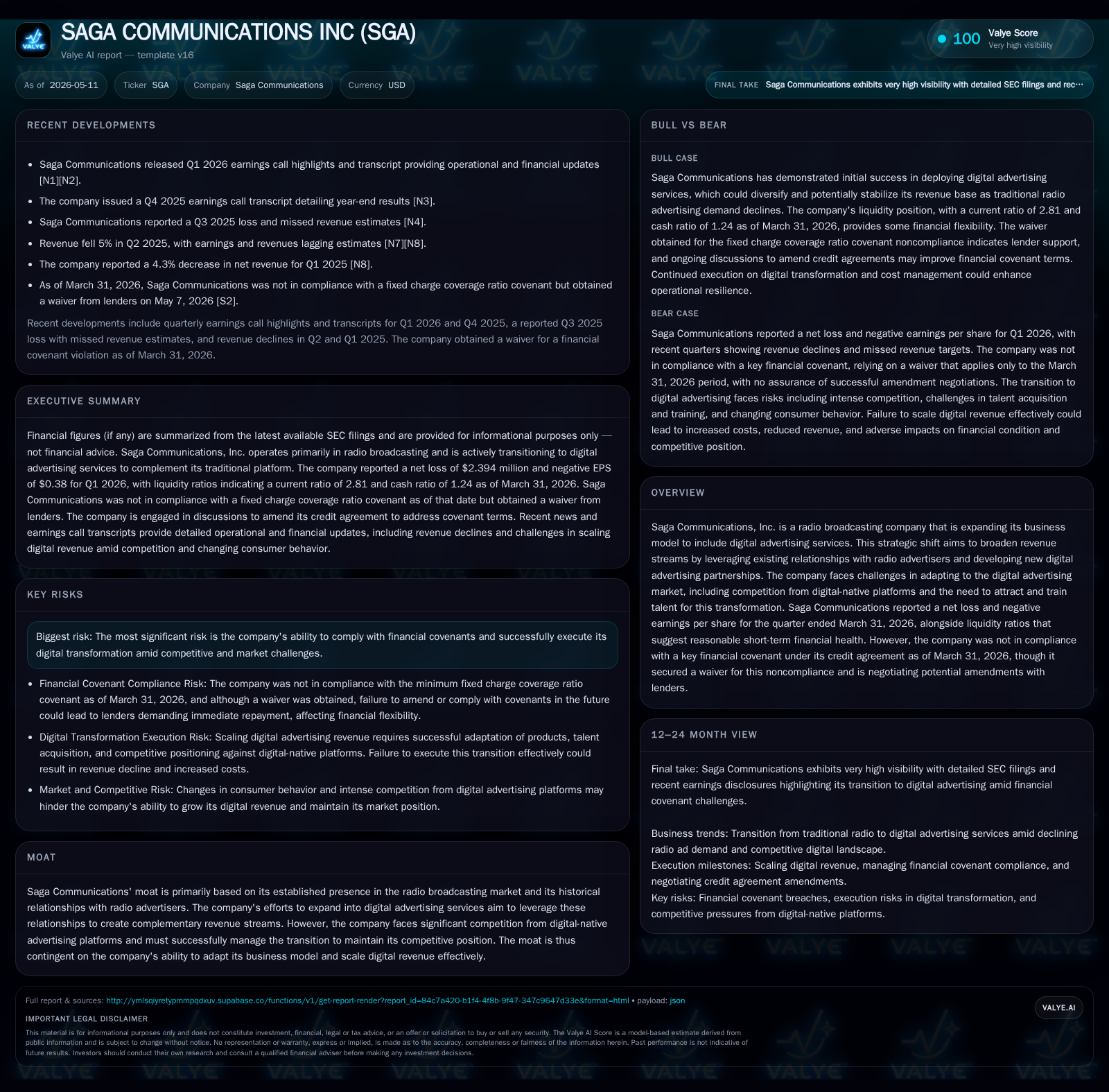
In Q1 2026, Saga Communications reported noncompliance with a key financial covenant related to fixed charge coverage, prompting a lender waiver and ongoing amendment negotiations. The company is shifting its traditional radio broadcasting business model to emphasize integrated digital advertising services, aiming to offset declining radio ad revenues. While it benefits from long-standing advertiser relationships, Saga faces competitive pressure from digital-native rivals and must overcome operational execution risks tied to talent acquisition and market acceptance. Near-term milestones center on covenant resolution and measurable growth in digital advertising revenue streams.
Latest Quarterly Operating Developments Highlight Covenant Noncompliance and Waiver
Saga Communications disclosed in its May 8, 2026 Form 10-Q that as of March 31, 2026, it failed to meet the minimum fixed charge coverage ratio required under its Credit Agreement [S2]. However, on May 7, 2026, Saga secured a waiver from its lenders covering this specific violation [S3]. The waiver applies only for Q1 2026 compliance failure; all future compliance remains subject to existing or modified terms.
Currently negotiating potential amendments with lenders, Saga seeks changes particularly regarding how the fixed charge coverage ratio is calculated going forward [S2]. There is no assurance these negotiations will succeed. Lender enforcement actions could severely limit the company's access to capital for acquisitions or other investments.
Revenue – mostly from commercial spot sales – depends on local advertiser budgets which have seen secular pressure due to broad shifts toward digital media consumption.
Saga's existing broadcast infrastructure and regional footprint provide a base for audience reach but also impose geographic concentration risks. Cost structure involves content production/curation and transmitter/network maintenance plus sales team expenses.
To diversify income streams amid declining traditional radio ad volumes, Saga has embarked on expanding its offerings into digital advertising services [S2]. This strategic shift leverages existing advertiser contacts by cross-selling complementary digital solutions such as targeted online ads or programmatic buys designed for local/regional campaigns.
Digital transformation encompasses leadership repositioning alongside recruiting technical experts capable of launching and maintaining new product lines in an inherently more technology-driven environment [S2]. However, adapting legacy organizational culture and sales capabilities presents material execution hurdles compounded by competition from established digital-native platforms commanding larger ad budgets.
The growth imperative relies on quickly scaling digital revenues to offset legacy radio decline. Initial deployments reportedly have achieved some success but require further expansion to meaningfully alter overall revenue composition [S2].
Competitive Landscape in Radio and Digital Advertising Markets
Saga's radio broadcasting segment competes principally with other regional broadcasters and increasingly with national conglomerates consolidating local markets [S1]. Broadcast radio pricing power has eroded due to audience fragmentation across multiple channels including streaming audio services.
In digital advertising, Saga confronts dominant global players like Google and Meta that benefit from vast user data ecosystems and scalable platforms enabling highly efficient ad targeting. This scale asymmetry limits pricing power for smaller entrants like Saga developing nascent digital suites.
Moreover, local/regional advertisers face a complex choice balancing traditional radio familiarity against emerging digital alternatives offering measurable ROI. Saga must innovate rapidly with proprietary tools or distinctive service bundles to protect or grow share within this evolving vendor ecosystem.
Competitive pressure thus imposes urgency on effective adoption of technology-enabled sales approaches alongside talent capable of navigating both broadcast sales dynamics and sophisticated digital client demands.[S1][S2]
Strategic Growth Drivers: Leveraging Established Advertiser Relationships for Digital Expansion
A key lever for growth lies in cross-selling newly developed digital ad products alongside traditional radio airtime packages leveraging trust-based advertiser relationships established over decades [S2].
Enhancements focus on expanding the suite of localized/adapted digital solutions including geotargeted campaigns that appeal particularly to regional marketers who value both scale efficiency and community relevance.
Measurable KPIs critical here include the percentage contribution of digital revenues relative to total advertising revenues and client retention rates within new digital contracts. Success depends on recruiting sellers proficient in both consultative selling techniques around complex programmatic platforms as well as maintaining strong client contact frequency.[S2]
Further development of internal capabilities through targeted hires and training programs aims to accelerate this transition while controlling implementation costs.[S2] Growth will likely remain constrained initially by the rate of attrition in traditional radio ads; faster ramp-up mitigates overall revenue pressure.
Challenges and Risks in Financial Covenants, Market Transition, and Talent Acquisition
The foremost risk remains financial covenant noncompliance. Should future quarters fail coverage tests without successful amendments or waivers, lenders could trigger acceleration clauses impairing liquidity and forcing asset sales or severe operational cutbacks.[S2][S6]
Execution risk surrounding rapid scaling of the digital business includes potential cost overruns linked to attracting skilled staff capable of fulfilling leadership roles across sales operations, technical implementation, and accounting functions.[S2] Failure here jeopardizes ability to deliver promised client solutions effectively.
Moreover, Saga confronts ongoing structural declines in traditional radio listenership driven by consumer preference shifts towards streaming/audio-on-demand formats that do not necessarily align with terrestrial broadcast models.
Competitive dynamics intensify risk of price compression for legacy assets while simultaneous investment needs increase expense burden amid uncertain corresponding revenue increases.[S1][S2]
Upcoming Milestones: Covenant Amendments, Digital Revenue Scale, and Sales Execution
Key near-term indicators will surface from negotiation outcomes with lenders concerning possible credit agreement amendments revising covenant calculations or restrictions.[S3] Any favorable deal extending breathing room strengthens operational latitude.
On the operational front, tracking quarterly progress in growing percentage share of total advertising revenue derived from newly developed digital services versus declining legacy radio ad sales offers an important barometer of transformation momentum.[N1][N2]
Additionally critical will be announcements regarding talent acquisitions filling strategic leadership vacancies necessary for sustaining growth initiatives plus wins in client acquisition or expansion demonstrating market traction.[S2]
Investors should monitor disclosures tied explicitly to these aspects during upcoming earnings releases or material event filings evidencing execution feasibility.
Financial Snapshot: Liquidity Position, Debt Levels, and Operational Cash Flow Trends
Latest financial snapshot
| Metric | Value | Period |
|---|---|---|
| Cash & equivalents | $21mm | |
| 2026-03-31 | ||
| Total debt | $5mm | |
| 2026-03-31 | ||
| Net debt | $-16mm | |
| 2026-03-31 | ||
| Current assets | $48mm | |
| 2026-03-31 | ||
| Current liabilities | $17mm | |
| 2026-03-31 | ||
| Current ratio | 2.81x | |
| 2026-03-31 |
Source: SEC companyfacts cache [F1].
As of March 31, 2026, Saga held $21.05 million in cash and equivalents against approximately $5 million total debt translating into a net cash position around $16 million [F1]. Current assets stood at nearly $47.75 million versus current liabilities near $17 million supporting a healthy current ratio of 2.81 indicating reasonable short-term liquidity coverage [F1].
However, despite liquidity strength on paper the fixed charge coverage ratio breach reveals underlying cash flow stress especially relating to interest expense plus mandatory payments relative to earnings before those charges [S2][S6]. This juxtaposition implies operational earnings deficits requiring vigilant management alongside orderly working capital control.
It does not constitute investment advice or recommendations.*
Disclaimer: This is research-only, informational analysis and not investment advice. It may include AI-generated interpretation and general industry context. Always verify important details using primary sources.

Comments