
Grayscale Solana Staking ETF's Strategic Update Reflects Evolving Digital Asset Dynamics
Q1 2026 disclosures emphasize GSOL’s operational adaptation to staking rewards and SOL price pressures, reshaping its market stance.
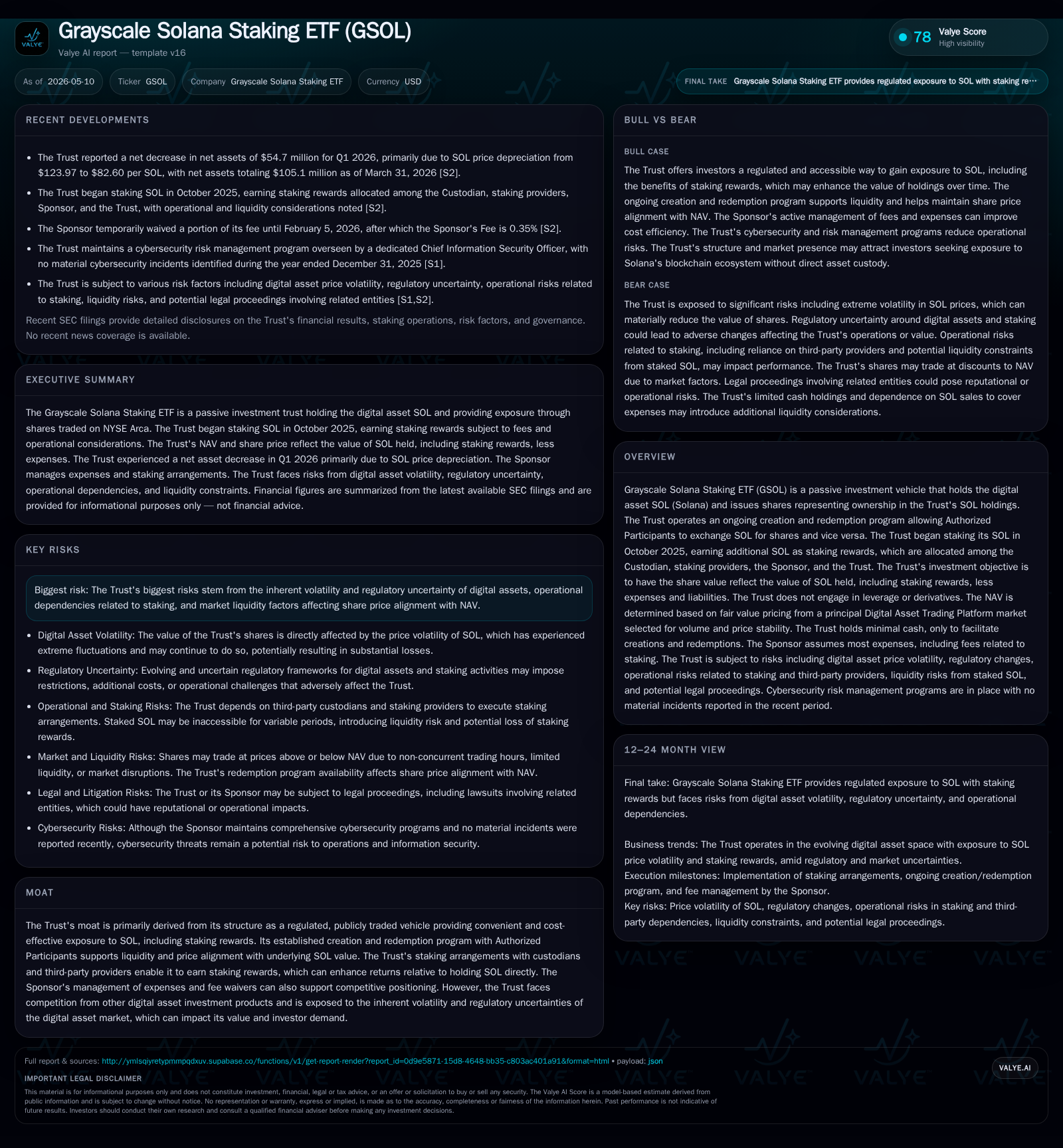
The Grayscale Solana Staking ETF (GSOL) reported a substantial 34% decline in net assets for Q1 2026, reflecting ongoing SOL price depreciation from late 2025. Since October 2025, GSOL has integrated staking operations, earning variable SOL rewards that enhance the Trust’s underlying assets but also introduce liquidity and operational complexities. The product offers investors regulated, liquid exposure to SOL plus staking yields, supported by an established creation/redemption mechanism with Authorized Participants. However, market volatility, regulatory ambiguity, and dependency on third-party custody and staking providers remain notable risks. Future focus areas include monitoring staking reward fluctuations, fee waivers, and NAV alignment amid evolving digital asset market dynamics.
Q1 2026 Operating Update Anchors Near-Term Context
In its latest SEC Form 10-Q filed May 8, 2026 [S2], Grayscale Solana Staking ETF (GSOL) disclosed a net asset value (NAV) decline of about 34% through the first quarter ending March 31, 2026. The drop largely mirrors the price depreciation of the underlying digital asset SOL from $123.97 to $82.60 per token within the period [S14]. This substantial contraction highlights the structural volatility GSOL faces due to its direct backing by the fluctuating SOL token.
Notably, since October 6, 2025 [S2], GSOL began staking its SOL holdings pursuant to arrangements with custodians and third-party staking providers. Staking yields accrue as additional SOL tokens termed “Staking Consideration,” which are partially shared among the Custodian, staking providers, Sponsor (via a defined Staking Fee), and retained by the Trust [S19]. By March 31, 2026, these rewards contributed roughly 21,437 SOL (valued near $2.2 million), offsetting some downward pressure on net assets [S4]. However, the Trust cautions that staking rewards are inherently irregular due to network conditions and protocol-specific reward rates.
During Q1 alone, approximately 137,592 SOL were deposited into the Trust in exchange for shares while about 176,488 SOL were redeemed for cash or shares withdrawn [S4]. This ongoing exchange program helps maintain alignment between GSOL’s share price on NYSE Arca and its NAV derived from fair market pricing on selected Digital Asset Trading Platforms considered principal markets [S7].
Operating expenses have been managed through Sponsor fee waivers effective November 5, 2025 until February 5, 2026 or when NAV surpasses $1 billion; this waiver expired in early February elevating fees to an annual rate of 0.35% [S3]. Cash holdings are kept minimal—only sufficient for facilitating creations/redemptions—limiting drag on returns and credit risk exposure [S4].
Grayscale GSOL’s Business Model and Product Offering
GSOL is structured as a passive trust holding direct investments in the Solana (SOL) blockchain token plus supplemental staked tokens earned as rewards [S1]. It offers investors exposure to SOL's investment characteristics combined with an incremental yield element derived from network staking participation initiated late in calendar year 2025 [S2]. The trust does not employ leverage or derivatives, aiming purely for reflective NAV performance of underlying blockchain assets less expenses.
The creation/redemption program functions through Basket units of precisely 10,000 shares issued or redeemed exclusively with designated Authorized Participants who facilitate large-block transactions directly exchanging bundles of SOL for ETFs shares and vice versa [S2]. This mechanism enhances market liquidity while helping keep secondary market trading prices aligned closely with intrinsic value calculated by reference prices from principal Digital Asset Trading Platforms exhibiting highest trade volume and price stability [S7].
Staking introduces operational layers: tokens committed to staking protocols become inaccessible temporarily due to un-staking lock-up periods mandated by Solana’s design; GSOL relies on specialized third-party custodians and validators to manage this process securely [S19]. The Trust incurs explicit costs via a Staking Fee deducted from gross rewards before allocation among stakeholders including itself. While this yields increased overall token balance improving shareholders’ potential returns compared to simple token holding without staking benefits, it creates liquidity constraints if investors demand large-scale redemptions during un-stake periods.
Investor appeal centers on offering a regulated securities wrapper facilitating convenient access to a volatile digital asset that otherwise requires direct blockchain custody management and technical know-how. By integrating staking benefits transparently within an exchange-traded format listed on NYSE Arca under ticker GSOL starting October 29, 2025 [S2], it has carved a niche conveying both capital appreciation potential plus recurring staking income.
Competitive Position and Industry Dynamics in Digital Asset ETFs
Within the digital asset investment ecosystem, GSOL competes alongside similar crypto-focused ETFs and trusts providing exposure either directly to native tokens like Bitcoin and Ethereum or various altcoins such as Solana [S1]. Its particular differentiation stems from combining public exchange listing liquidity with endorsement of staking yields—a feature not universally offered across all crypto investment vehicles.
Regulatory scrutiny distinguishes traditional US-listed ETFs like GSOL from less regulated private cryptocurrency funds or trusts which often suffer from liquidity bottlenecks or pricing opacity owing to discrepancies across numerous digital asset marketplaces [S5][S6]. GSOL benefits structurally by adhering to established SEC registration frameworks while still operating within novel digital asset classes.
Nevertheless, supply chain dependencies represent vulnerabilities: custody arrangements entrusted to third parties must maintain high security standards against cyber threats given the irreversibility of blockchain transactions [S23]; meanwhile third-party validators executing staking protocols introduce operational risk exposures impacting reward consistency.
Analysis of sponsor fees reveals that following expiration of fee waivers in early Q1 FY26 to a standard level of 0.35%, GSOL maintains competitive cost positioning though sponsors retain discretion over future reductions or temporary waivers aimed at attracting additional inflows or retaining investor interest amidst fluctuating market sentiment [S3].[F1]
Drivers of Growth: Staking Rewards and Market Adoption
Two primary vectors support growth potential for GSOL: increasing accumulation of staking rewards supplementing underlying token appreciation prospects; and growing investor appetite for simplified regulated access to both capital gains and passive income within emerging digital economies.
The intermittent nature of Solana staking conditions directly influences quarterly reward totals received by the Trust—the protocol-level distribution rates fluctuate based on network-wide participation levels and performance metrics limiting predictability but supporting average positive return enhancement above mere holding strategies [S19]. Rising institutional awareness about efficient blockchain yield generation through regulated vehicles like GSOL encourages further adoption beyond retail trading horizons.
Redemption/creation volume trends test appetite shifts signaling new inflows or withdrawals relevant for gauge demand elasticity directly impacting liquidity robustness observed in secondary trading channels—a healthy flux favors tighter bid-ask spreads sustaining investor confidence.[S14]
Fee waiver strategies deployed tactically can drive investor cost sensitivity response influencing capital ingress especially when competing crypto products adjust pricing or features dynamically. Also indexing improvements ensuring accurate fair-value calculation underpin importance for maintaining trustworthy NAV benchmarks critical for ETF structures serving fiduciary requirements.
Key Risks: Volatility, Regulatory Uncertainty, Operational Dependencies
Price swings inherent in digital assets amplify risk profile materially as NAV changes can rapidly compress investor capital during adverse moves given one-for-one backing with volatile SOL tokens; historical Q1 loss evidences this challenge where net realized/unrealized losses amounted to nearly $56.6 million driven primarily by falling token prices [S14]. Liquidity shocks triggered if authorized participants retract support or if redemption programs momentarily suspend could cause shares to diverge significantly from NAV causing valuation dislocations detrimental reputationally.
Regulatory clarity remains elusive surrounding definitions such as whether SOL qualifies as a security under U.S. laws or implications if proof-of-stake activities constitute regulated money services triggering added compliance costs or restrictions jeopardizing business continuity [S5][S6]. Potential litigation risks associated indirectly through parent company structures add further uncertainty though currently assessed immaterial vis-à-vis operations.
Operationally reliance on external Custodians responsible for safeguarding vast quantities of cryptographically secured assets entails inherent cybersecurity risk despite comprehensive internal safeguards overseen by veteran Chief Information Security Officer teams deploying proactive penetration assessments. Staking execution poses dependency risks whereby failures in validators’ performance could translate into loss scenarios reducing expected yields impairing NAV.
Forward Focus: Milestones and Execution Watchpoints
Looking ahead investors should track quarterly updates detailing patterns in staking reward accruals reflecting real-time network health plus Solana protocol upgrades which may evolve incentive frameworks altering future revenue streams for stakeholders including GSOL.[S14]
Monitoring adjustments by Sponsors regarding fee waivers post-February 2026 offer insight into cost competitiveness tactics promoting inflows amid digital asset fund proliferation.[S3]
Ongoing evaluation of spread dynamics between share price trading on NYSE Arca relative to NAV benchmarks serves as an immediate barometer for demand-supply balance along with Authorized Participant engagement levels confirming robustness of creation/redemption pipelines crucial for functional arbitrage preventing persistent premiums or discounts[S14].
Finally regulatory guidance developments remain a wildcard capable of forcing structural changes requiring adaptation in operational conduct or legal posture impacting viability necessitating transparent communication policies.[S5]
This analysis synthesizes operative disclosures primarily from GSOL's latest quarterly filing complemented by annual contextual data without recommending any trade action. Investors should independently verify any investment considerations given evolving cryptocurrency ecosystem volatility and regulatory environment uncertainties.
Disclaimer: This is research-only, informational analysis and not investment advice. It may include AI-generated interpretation and general industry context. Always verify important details using primary sources.

Comments