
Network-1 Technologies Advances Patent Litigation Outcomes Amid Uncertain Revenue Streams
A pivotal Federal Circuit ruling and ongoing patent litigations shape Network-1's near-term prospects and underscore risks intrinsic to its monetization model.
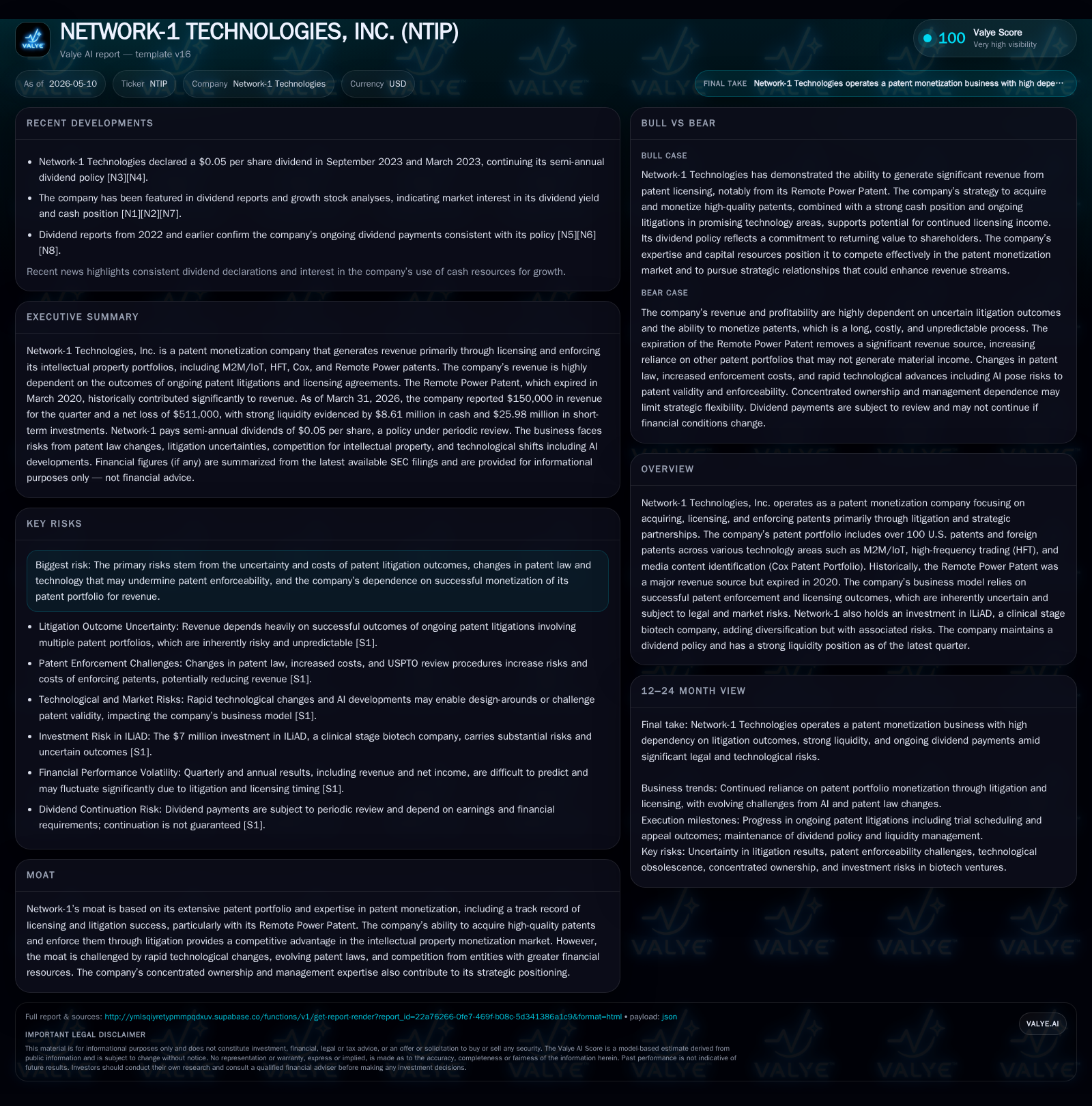
Network-1 Technologies recently secured a critical appellate court victory reversing a non-infringement ruling in its patent suit against Google’s Content ID, marking a significant legal milestone. The company continues active enforcement efforts across its M2M/IoT and High-Frequency Trading (HFT) patent portfolios, with key trials scheduled in 2027. Despite strong liquidity and a robust dividend track record, Network-1’s revenue remains highly uncertain and volatile as it depends on unpredictable litigation outcomes. Rapid technological changes and evolving patent law pose structural challenges to sustained growth in this niche patent monetization sector.
Recent Operating Update
Network-1 Technologies’ latest quarterly report for Q1 2026 [S2] highlights a key legal development that materially affects the company’s near-term operating landscape. In April 2026, the U.S. Court of Appeals for the Federal Circuit overturned a prior New York District Court decision of non-infringement related to Network-1’s Patent No. 8,205,237 against Google and YouTube’s Content ID [S3]. This appellate win reopens enforcement avenues for Network-1 within the Cox Patent Portfolio segment, potentially reviving royalty opportunities from a technology central to digital content identification systems.
Simultaneously, Network-1 continues aggressive litigation strategies targeting dominant entities: Samsung Electronics faces claims regarding embedded SIM (eSIM) and 5G tech within its consumer devices under the M2M/IoT Patent Portfolio [S29]; while financial firms including Citadel Securities, Jump Trading, and Optiver are named defendants in High-Frequency Trading (HFT) patent infringement suits [S29]. These complex litigations come with trial dates slated for June 2027, underscoring a substantial multi-year timeline before material revenue recognition could occur.
Financially, the company reported cash & equivalents of approximately $8.6 million at quarter-end March 2026 [F1], with no outstanding debt [F1]. Current assets stood at $34.8 million against liabilities of just $1.11 million, resulting in a current ratio exceeding 31—signaling exceptional short-term financial flexibility amidst uncertain cash flow from operations [F1].
Despite an operating loss reflected at year-end December 2025 ($3.3 million operating income deficit) [F1], Network-1 persists with a semiannual dividend payment policy of $0.05 per share that has been consistently maintained since inception in 2016 [S4]. However, management notes that dividend continuation hinges on earnings prospects tied fundamentally to successful patent monetization.[S4]
Business Model Analysis
Network-1 Technologies operates predominantly as an intellectual property (IP) monetization entity specialized in acquiring valuable patents related primarily to Machine-to-Machine communications (M2M/IoT), High-Frequency Trading algorithms (HFT), and media content identification technologies. The business model centers on generating revenue through strategic licensing arrangements or enforcing patent rights via litigation when infringement is alleged.
Revenue is thus highly contingent on outcomes of complex legal proceedings; successful enforcement can yield significant lump-sum or recurring license fees from infringing parties or settlements. Historically, the Remote Power Patent was a robust revenue driver contributing over $188 million cumulatively until expiration in March 2020 [S22]. With that legacy stream closed off, Network-1's future top-line depends on newer portfolios which remain in early monetization phases with uncertain results.
The company’s ability to generate licensing income involves several critical factors:
- Patent quality and scope: Acquiring high-quality patents that cover commercially relevant technologies which are difficult to design around.
- Enforcement capabilities: Effective use of litigation pathways without prohibitively high legal costs.
- Market relevance: Patents must protect technologies still widely implemented by infringing parties.
- Counterparty dynamics: Negotiations often involve large corporations with substantial legal resources.
Network-1 complements direct enforcement by developing partnerships or strategic relationships to monetize IP assets owned by third parties but faces intense competition for such deals from better-capitalized firms including hedge funds and venture-backed entities [S17]. The company's concentrated executive ownership further influences strategic agility.
Industry Structure and Competitive Position
The domain of patent monetization occupies an intersection between intellectual property law and niche technology markets such as IoT connectivity standards, algorithmic trading protocols, and digital content management platforms. Participants include specialist non-practicing entities (NPEs), corporates owning defensive portfolios, litigation funding firms, and integrated technology companies.
Network-1 distinguishes itself through:
- A portfolio exceeding 100 U.S. issued patents plus foreign counterparts covering multiple emerging tech verticals.
- Demonstrated track record of licensing successes anchored by Remote Power Patent revenues.
- In-house expertise navigating the complexities of both U.S. district courts and USPTO administrative challenges such as Inter Partes Review proceedings [S16].
Nonetheless, competitive pressures remain formidable given rapid technological shifts that may render certain inventions obsolete or allow infringers to circumvent patented methods via AI-driven innovation [S26]. Legal reforms under the America Invents Act have also raised barriers increasing costs and uncertainties inherent in enforcement actions [S4]. Resource disparities further complicate Network-1's position relative to larger market players.
Growth Drivers
Litigation Outcomes as Catalysts
Successful resolutions or favorable rulings in ongoing lawsuits against Samsung (for M2M/IoT tech) and financial institutions (for HFT patents) represent near-term potential inflection points capable of initiating fresh royalty streams or settlement income. The recent Federal Circuit reversal regarding Cox Patents against Google/YouTube demonstrates tangible progress unlocking latent asset value that had been previously nullified through lower court dismissal.
Portfolio Expansion Potential
Management pursues acquisition of additional high-value patents aligned with core technology verticals where licensing opportunities appear substantial [S22]. The capacity to identify underutilized IP assets with enforceable claims could diversify revenue basis beyond existing homogenous concentration.
Strategic Partnerships
Forming alliances with third-party IP owners allows Network-1 to leverage collective resources for co-monitization initiatives without capital intensive acquisitions—a path that could amplify scale if executed well amidst increased industry demand for effective patent utilization services.[S6]
Risks and Constraints
Litigation Uncertainty and Expense
Litigation outcomes are unpredictable; adverse judgments could invalidate patents or deny infringement claims leading to zero revenue generation despite heavy upfront legal outlays—expenses disclosed as material in filings impacting operating results negatively [S14]. The protracted duration til scheduled trials (~mid-2027) delays realization timelines further exacerbating cash flow volatility.
Technological Obsolescence & AI Challenges
Rapid evolution especially fueled by AI/ML innovations threatens both relevance of patented inventions and enforcement efficacy if defendants deploy advanced design-around solutions or challenge claim validity aggressively using new analytic tools.[S26]
Legislative & Regulatory Risks
Patent law reforms continue evolving with heightened scrutiny on non-practicing entities possibly leading to restrictive statutes or enhanced procedural hurdles diminishing enforceability advantage[S4].
Concentrated Management Ownership & Dependence
Significant stockholdings by executive officers particularly CEO Corey Horowitz imply decision-making bottlenecks or potential succession risk absent key-man insurance coverage noted.[S24]
Market Competition for IP Assets
Competition from financially stronger parties may limit Network-1’s ability to purchase attractive new patents thereby curtailing organic portfolio growth potential.[S17]
What To Watch Next
Key catalysts include:
- Progress updates on pending litigations involving Samsung (M2M/IoT portfolio), Citadel/Jump Trading/Optiver (HFT portfolio), especially pre-trial motions or settlements expected ahead of June 2027 trial dates.
- Any licensing deals announced stemming from reopened Cox Content ID appeals post recent favorable Federal Circuit ruling.
- Changes in dividend policy reflecting quarterly earnings trends linked directly to monetization success/failures.
- Announcements regarding additional patent acquisitions or strategic partnerships expanding Network-1’s IP footprint.
- Monitoring industry regulatory developments related to patent reform or AI-related intellectual property implications.
Financial Summary (Latest Quarter Ending March 31, 2026)
Latest financial snapshot
| Metric | Value | Period |
|---|---|---|
| Cash & equivalents | $9mm | |
| 2026-03-31 | ||
| Current assets | $35mm | |
| 2026-03-31 | ||
| Current liabilities | $1110000 | |
| 2026-03-31 | ||
| Current ratio | 31.34x | |
| 2026-03-31 |
Source: SEC companyfacts cache [F1].
*No current quarter debt data, defaulting to latest available zero debt figure.[F1]
Revenues reported for calendar year 2025 totaled approximately $150,000 deriving primarily from legacy sources post-expiration of the Remote Power Patent [F1][S22]. Losses at operating income level approximate $3.3 million due largely to continuing litigation expenses outpacing incoming royalties during this phase.[F1] Liquidity remains strong enough currently to support ongoing enforcement activities without immediate capital raises.
Disclaimer: This analysis is provided solely for informational purposes based on publicly available SEC filings up to May 10, 2026. It does not constitute investment advice nor an endorsement of any security mentioned herein.
Disclaimer: This is research-only, informational analysis and not investment advice. It may include AI-generated interpretation and general industry context. Always verify important details using primary sources.

Comments