
Banc of California Reinforces Market Position with Strategic Loan Management and Dividend Stability
Q1 2026 reveals a measured loan portfolio contraction alongside dividend payout constraints shaped by regulatory capital requirements.
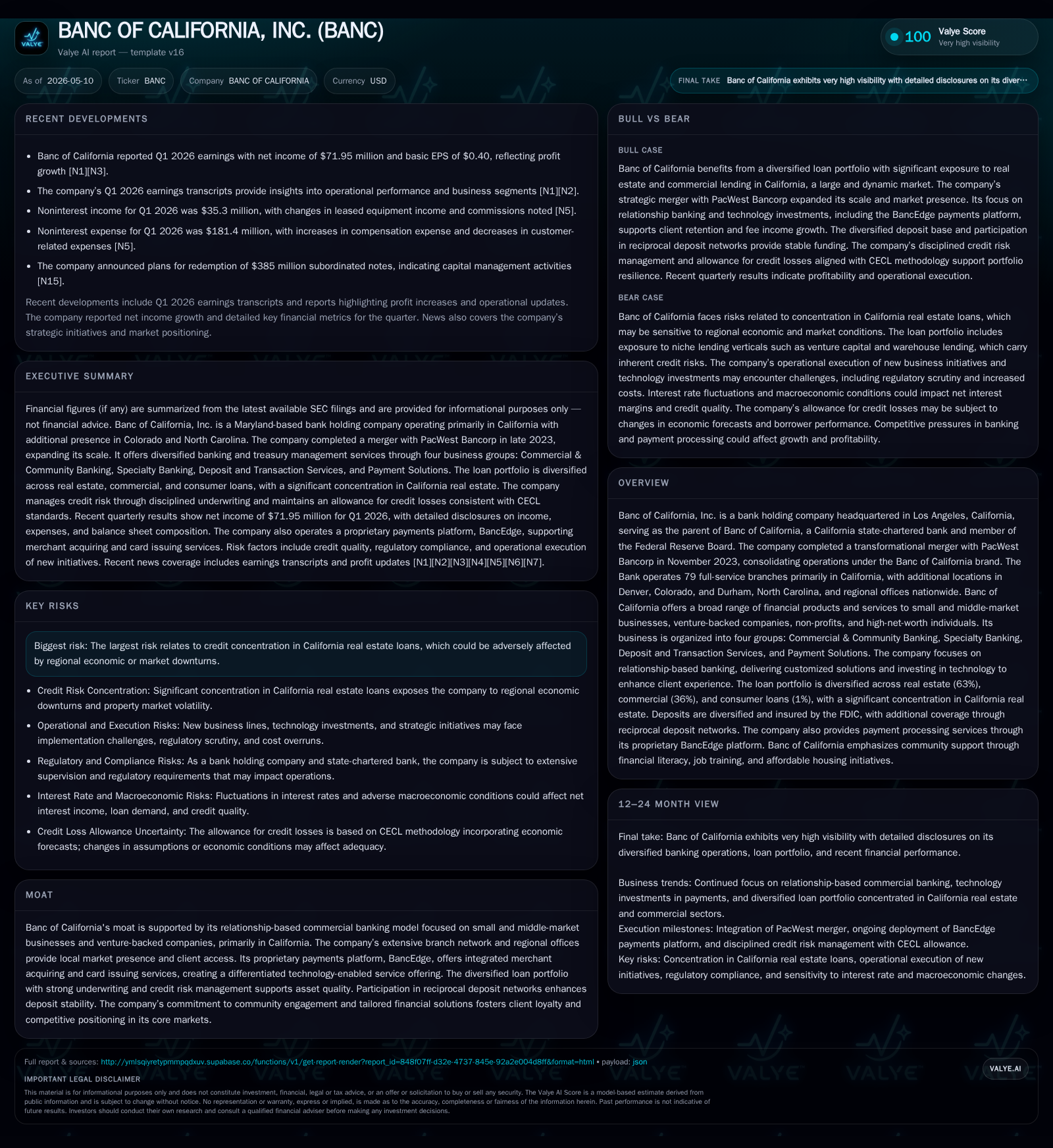
In the first quarter of 2026, Banc of California, Inc. experienced a modest net decrease in loans held for investment driven by payoffs exceeding new production, underscoring cautious credit deployment post-PacWest merger. Dividend payments on Series F preferred stock remain subject to bank capital regulation compliance, limiting near-term distributions despite solid earnings. The company operates a relationship-driven commercial banking model focused on small and middle-market businesses and benefits from integrated technology-enabled payment solutions. Key risks revolve around credit concentration in California real estate lending and regulatory capital restrictions. Monitoring upcoming loan growth trends and dividend policy changes will be critical for understanding Banc's operational trajectory.
Q1 2026 Operating Highlights and Loan Portfolio Dynamics
In the first quarter ending March 31, 2026, Banc of California reported a net decrease of $252 million in loans held for investment (HFI), closing at approximately $24.78 billion. This contraction reflected payoffs ($837 million) and paydowns ($1.44 billion) outpacing combined production and disbursements totaling $2.12 billion [S2]. The company’s active management of its loan book signals a calibrated credit approach following the late-2023 PacWest merger integration. Notably, charge-offs during the quarter were limited to $16 million, indicating maintained asset quality amidst portfolio runoff.
Noninterest income declined sequentially by $6.2 million to $35.3 million, chiefly due to a $7.9 million drop in leased equipment income attributable to prior quarter gains on early lease terminations. However, this was offset partially by a $1.5 million increase in commissions and fees plus a gain from debt extinguishment related to Banc’s credit-linked notes [S2]. Noninterest expenses saw a marginal rise to $181.4 million mainly driven by seasonal increases in compensation costs tied to incentive resets.
Dividend payments on Series F preferred stock remain constrained under applicable Federal Reserve Board (FRB) capital adequacy regulations and Department of Financial Protection & Innovation (DFPI) policies [S2]. The company must refrain from dividends if such actions would cause non-compliance with these requirements, reflecting prudence amid regulatory scrutiny.
Banc of California’s Relationship-Based Commercial Banking Model
Banc of California’s business model centers on providing relationship-driven banking solutions primarily to small- and middle-market enterprises plus venture-backed companies within California’s key economic corridors. This focus stems from its historical positioning as a community-centric bank now scaled through its merger with PacWest Bancorp in November 2023 [S1].
Operating through four distinct business pillars — Commercial & Community Banking (CCB), Specialty Banking, Deposit and Transaction Services, and Payment Solutions — the company delivers comprehensive financial products across diverse client needs. CCB concentrates on relationship lending backed by an extensive physical footprint spanning 79 full-service branches across California with extensions into Denver, Colorado, and Durham, North Carolina alongside regional offices tackling national accounts [S1],.
Specialty Banking addresses niche verticals such as SBA lending, lender finance, asset-based loans, media/entertainment industry financing, equipment leasing, mortgage warehouse services, venture banking, and consumer HOA servicing through the SmartStreet™ technology platform.
Payment Solutions is powered by BancEdge — an integrated payments platform offering merchant acquiring plus card issuing capabilities that bolster fee diversification beyond core net interest income streams. This tech-enabled service is a differentiator against regional peers who lack proprietary platforms delivering embedded payment processing capabilities.
Industry Context: Competition, Technology, and Regulatory Environment
Post-merger oversight has intensified regulatory complexity as Banc navigates dual supervision by the Federal Reserve Board (as a bank holding company) and California Department of Financial Protection & Innovation (for its state-chartered bank operations). This layered governance elevates compliance obligations particularly around capital adequacy metrics that limit inclusion of deferred tax assets (DTA) towards regulatory capital buffers; Banc currently reports about $315 million DTAs disallowed for capital purposes at quarter-end [S2], an important drag when assessing upstream dividend capacity.
Technological integration presents both opportunity and risk vectors. The emerging prominence of fintech partnerships — including those embedded within BancEdge operations — heightens exposure to cybersecurity threats that increasingly challenge detection amid advances like generative AI facilitating fraud sophistication [S1]. Furthermore, regional banks face competitive pressures harnessing similar fintech collaborations or deploy their own outsourced digital ecosystems to capture evolving client expectations.
Pricing power is nuanced given community bank competitors often compete aggressively on deposit pricing amid persistent funding cost volatility triggered by macroeconomic rate environments. Nonetheless, Banc has endeavored to grow granular relationship deposits emphasizing noninterest-bearing checking which accounted for elevated proportions relative to total deposits historically — supporting funding stability even if margins face headwinds from competition.
Growth Enablers: Payment Solutions and Specialty Banking Niches
Beyond traditional interest income generation through loan portfolios, Banc’s Payment Solutions segment offers promising revenue upside via scalable merchant acquiring fees coupled with higher-margin card issuing revenues embedded within BancEdge. This technology-intensive vertical allows recurring fee capture aligned with transaction volumes rather than solely asset-dependent spreads typical in commercial banking.
Specialty Banking verticals serve resilient niche markets such as SBA lending workflows aiding small businesses leveraging government guarantees; HOA finance supporting community associations nationwide via SmartStreet™; venture banking focusing on rapidly evolving entrepreneurial clients; media/entertainment financing tailored for sector-specific cash flow cycles; equipment finance offering asset-backed lending capacity; all collectively diversifying risk while growing noninterest fee revenue streams, [S1].
Incremental fintech integrations underpin incremental commissions and fees line growth observed sequentially in Q1 2026 which partially offset declining leased equipment income trends reflecting prior lease buyouts.
Key Risks: Credit Concentration and Regulatory Dividend Restrictions
The largest identifiable risk remains concentrated exposure to the California real estate market within loan portfolios where cyclical downturns or localized economic distress could prompt elevated credit losses or impair collateral values. Even though current charge-offs remain contained at moderate levels ($16 million for Q1), vigilance is warranted given the substantial exposure.
Regulatory limitations imposed on dividend payments due to capital adequacy rules create constrained distributable earnings pathways especially on preferred shares which require the bank subsidiary’s upstream dividends first before remittance at holding company level can occur without breaching FRB mandates [S2], [S3]. Additionally, the disallowance of significant deferred tax assets ($315 million) reduces tangible capital buffer impacting the cushion available for upstream dividends or share repurchases under existing frameworks.
Elevated operational risk originating from cybersecurity vulnerabilities intensified by fintech partnerships further adds complexity requiring continuous investments in risk mitigation systems.
Upcoming Catalysts and Monitoring Points
Key near-term operating milestones include:
- Quarterly earnings releases providing updated indicators on loan growth trajectory or continued runoff.
- Dividend policy announcements reflecting evolving compliance status under regulatory capital frameworks.
- Progress updates on post-merger integration efforts aimed at optimizing branch network efficiency while expanding selective branch presence outside California.
- Potential incremental disclosures related to payment solution platform enhancements or Specialty Banking vertical expansions.
- Changes in commission/fee income lines potentially signaling improving or weakening market penetration for ancillary offerings. Monitoring these KPIs will inform shifts in demand dynamics or strategic execution outcomes underpinning Banc’s medium-term outlook [S2], [N8], [N9].
Financial Profile and Capital Adequacy Insights
At quarter-end March 31, 2026, Banc maintained robust liquidity positions with approximately $4.5 billion in primary liquidity comprising cash balances excluding restrictions ($214 million), interest-bearing deposits ($2 billion), plus unencumbered available-for-sale securities ($2.65 billion minus pledges). Secondary liquidity via secured borrowing facilities totaled roughly $9.7 billion split between Federal Home Loan Bank advances (net $4.4 billion) and Federal Reserve Bank Discount Window availability ($5.3 billion) ensuring comfortable coverage over uninsured deposits estimated near $7.8 billion [S16].
Leverage levels reflect approximately $2.55 billion total debt outstanding as of March 31 compared against liquidity cushions supporting operational resilience; net debt after adjusting cash balances stands near $2.24 billion ([F1]). Banc’s Tier 1 capital ratios remain well positioned above regulatory minimum thresholds although impacted materially by deferred tax asset disallowances which curtail excess capital eligibility for dividends.
Disclaimer: This analysis is intended solely for informational purposes based on publicly available disclosures including SEC filings through May 2026. It does not constitute investment advice or recommendations regarding any securities discussed herein.
Disclaimer: This is research-only, informational analysis and not investment advice. It may include AI-generated interpretation and general industry context. Always verify important details using primary sources.

Comments