
Esperion Therapeutics Advances Non-Statin Cardiovascular Portfolio Post-Merger Deal
Esperion’s 2026 Q1 results and merger agreement with Essence Parent Inc. underscore a strategic push to strengthen its oral ACLY inhibitor portfolio and international market reach.
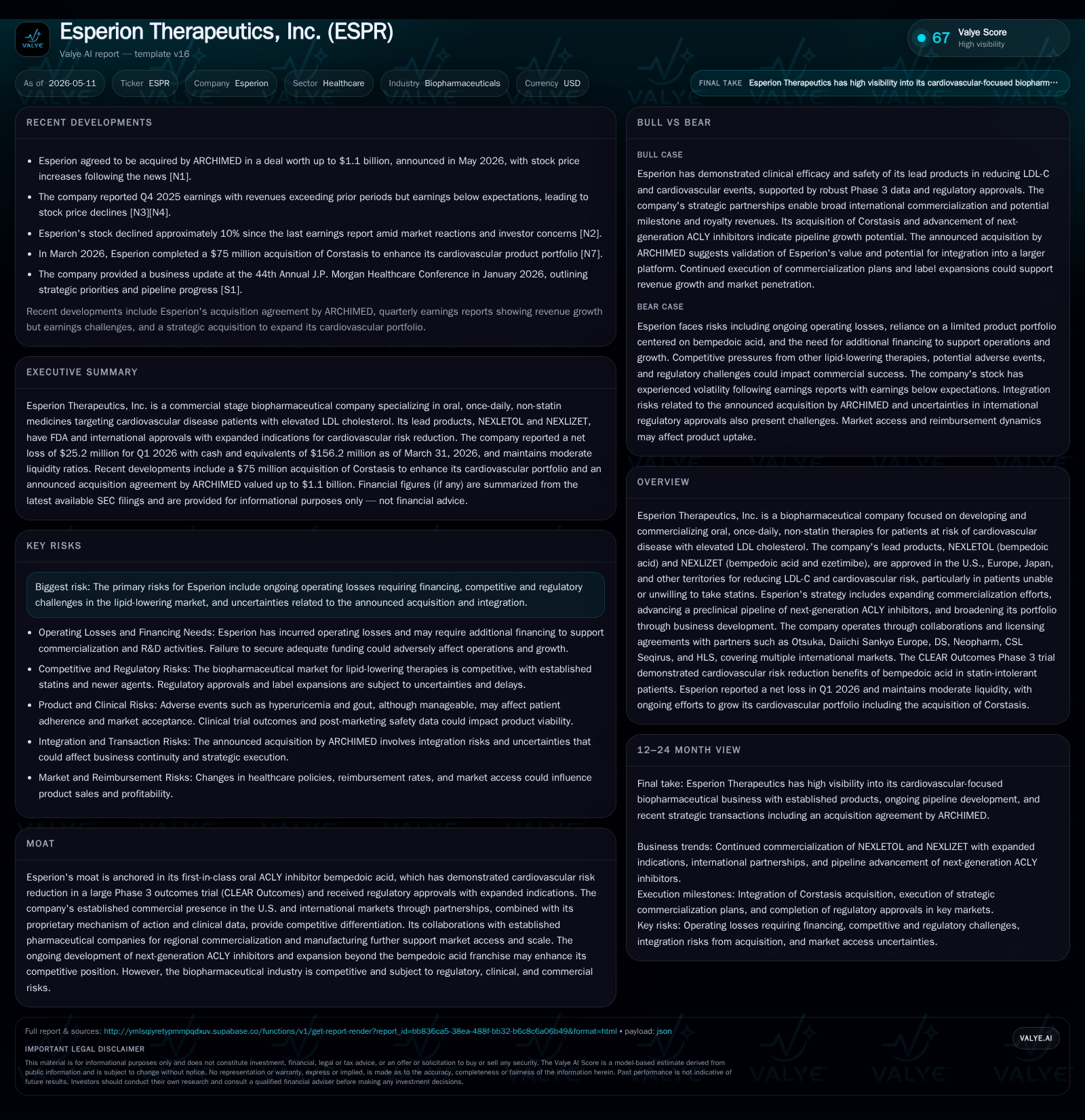
In early 2026, Esperion Therapeutics disclosed operational progress through its Q1 10-Q filing alongside announcing a definitive merger agreement with Essence Parent Inc. The company is commercializing oral non-statin therapies targeting LDL cholesterol reduction, chiefly bempedoic acid and the combination with ezetimibe. Expansion of regulatory indications, ongoing pipeline advancements including the acquisition of Corstasis, and strengthened global partnerships position Esperion for growth in the competitive cardiovascular therapeutics landscape. Capital resources appear adequate to support near-term clinical development and commercialization despite persistent net losses and patent litigation risks.
Latest Quarterly Update and Merger Agreement Analysis
Esperion Therapeutics' most recent quarterly disclosure dated May 8, 2026 (Form 10-Q) reflects continued commercial execution within its key product segments. The firm’s lead therapies — NEXLETOL (bempedoic acid) and NEXLIZET (bempedoic acid plus ezetimibe) — remain central to revenue generation amidst substantial investment in research and development for next-generation ACLY inhibitors [S2]. Notably, the quarter showed management prioritizing expansion activities coupled with sustained selling, general and administrative expenses consistent with strategic growth demands.
Shortly before the filing, on May 1, Esperion entered a material definitive merger agreement with Essence Parent Inc. (Essence) under which Essence’s wholly owned subsidiary will merge with Esperion. This transaction is backed by committed equity investments from related affiliates of Essence as well as a third-party lender debt facility intended to underwrite all payment obligations contemplated by the merger [S3]. This arrangement signals strong external confidence in Esperion’s evolving platform while also providing capital stability required for near-term operational continuity amid acquisition integration.
Business Model and Therapy Differentiation
Esperion operates primarily as a commercial-stage biopharmaceutical entity focused on oral non-statin LDL-C lowering drugs for patients whose cardiovascular risk remains elevated due to inability or unwillingness to tolerate statins. Its offerings — NEXLETOL and NEXLIZET — leverage bempedoic acid’s unique mechanism as an adenosine triphosphate citrate lyase (ACLY) inhibitor administered once daily orally [S1]. By acting upstream of statins in cholesterol biosynthesis yet avoiding muscle-related side effects that limit statin use, these drugs address unmet medical needs in secondary prevention populations as well as primary hyperlipidemia.
Revenue streams derive from direct U.S. sales combined with partnerships licensing rights across multiple geographies enabling broad market penetration. Collaborators such as Otsuka handle Japanese marketing after Ministry approval granted late 2025. Similarly, European approvals include both EMA centralized strategies and extensions into individual markets like Switzerland via Swissmedic authorization. Canadian filings and Israeli/Australian submissions further diversify geographic footprint with staggered expected approvals over coming quarters [S1]. Milestone payments linked to regulatory achievements add contingent revenue potential beyond base sales.
Competitive Landscape and Distribution Partnerships
The lipid-lowering treatment arena remains highly competitive dominated by statins supplemented by PCSK9 inhibitors and emerging RNA-targeted therapies offering varying efficacy/cost profiles. Within this context, Esperion’s first-in-class oral ACLY inhibitor positioning creates strategic differentiation via patient convenience (oral dosing) and tolerability advantages over injections or frequent infusions ubiquitous among some competitors.
Patent protections underpin the exclusivity around bempedoic acid and its combination forms but face headwinds from multiple ANDA filings challenging validity through Paragraph IV notices filed starting March 2024 onward. These litigations introduce generics risk that could compress pricing power if unsuccessful in maintaining exclusivity or deterring earlier generic entry through settlements or adjudication outcomes [S5,S15].
Internationally, licensing deals involving Daiichi Sankyo Europe (DSE), DS (covering Asia-Pacific territories), Neopharm, CSL Seqirus span commercialization rights facilitating localized distribution expertise critical for competitive market access outside the U.S. This network bolsters supply chain robustness yet requires effective coordination as new indications launch globally [S1,S5].
Growth Catalysts: Indication Expansion, Pipeline Advancement, and Market Penetration
Critical growth avenues stem from FDA approval expansions received in early 2024 extending use cases beyond initial labels to include adults at high cardiovascular risk without established disease—a sizeable target population often undertreated due to statin intolerance concerns [S1]. Subsequent EU approvals via EMA followed suit mid-2024 enhancing European uptake potential; Japan's September 2025 clearance completes a major market triad.
Pipeline enrichment comes principally from the acquisition pending close of Corstasis Therapeutics anticipated Q2 2026. Corstasis contributes an investigational asset ENBUMYST® (bumetanide), vying in congestive heart failure—complementary therapeutic territory enhancing portfolio breadth beyond pure lipid modifiers. Milestone-linked payments aggregate up to $180 million contingent on clinical/regulatory landmarks plus royalty streams upon future commercialization activities [N2,N3,S1]. Furthermore, next-generation oral ACLY inhibitors remain under preclinical development aiming to improve potency or reduce side effects relative to bempedoic acid.
International regulatory submission timelines in Canada (NEXLETOL approved Q4 2025; NEXLIZET expected H1 2026), Israel (approval expected H1 2026), Australia (expected late 2026) portend incremental revenue inflows supporting global expansion milestones [S1].
Risks and Challenges: Regulatory Hurdles, Market Competition, and Integration Risks
Operational challenges persist notably from continued negative earnings; net losses are projected due primarily to ongoing R&D investments alongside significant selling/general administrative expense layers necessary for commercialization scale-up [S2]. While liquidity is supported by committed financing related to the Essence merger [S3], reliance on external capital introduces execution risk should financing markets dislocate.
Regulatory uncertainty looms large—both in achieving timely international approvals that underpin milestone payments—and potential adverse changes in drug approval frameworks following recent legal precedents diminishing agency rule-making deference add complexity around FDA/EMA pathways [S18]. Additionally, patent disputes threaten exclusivity duration facing multiple generics ANDA challenges potentially catalyzing earlier price erosion undermining top-line predictability [S5,S15].
Market competition is escalating not only from entrenched statins but also newer modalities including RNAi agents or gene therapies addressing cholesterol reduction or cardiac conditions. Ongoing innovation cycles necessitate continuous pipeline progression combined with astute marketing efforts.
Finally, integration risks tied to the pending Corstasis deal plus announced Essence merger encompass cultural alignment challenges, operational dis-synergies, potential management distraction from core business lines affecting sales momentum during transition periods [S3,S5].
Upcoming Milestones and Market Monitors
Key value inflections include final closing of the Corstasis acquisition slated for Q2 2026 offering tangible near-term pipeline benefit realization sprinting beyond current bempedoic acid offerings [S1,S3]. Regulatory approvals for supplemental NDAs particularly Canadian approval of NEXLIZET anticipated first half 2026 will be closely watched as indicators of international penetration progress.
Commercial performance metrics post-label expansion such as new patient starts, prescription refill rates among statin-intolerant cohorts, payer formulary inclusions particularly outside the U.S., will serve as demand leader barometers.
Financially linked contingent remuneration benchmarks tied to achieved revenue milestones on bumetanide products covered in CVR agreements add additional event-driven triggers warranting investor attention going forward [S3,N2,N3]. Monitoring scope includes patent litigation outcomes feeding exclusivity clarity along with any regulatory scrutiny developments concerning pricing or marketing compliance.
Financial Overview: Liquidity Position and Capital Structure
Latest financial snapshot
| Metric | Value | Period |
|---|---|---|
| Cash & equivalents | $156mm | |
| 2026-03-31 | ||
| Current assets | $459mm | |
| 2026-03-31 | ||
| Current liabilities | $300mm | |
| 2026-03-31 | ||
| Current ratio | 1.53x | |
| 2026-03-31 |
Source: SEC companyfacts cache [F1].
As of March 31, 2026, Esperion reported cash & cash equivalents totaling approximately $156 million.
The announced merger agreement brought alongside it committed equity financing from affiliates linked to Essence Parent Inc. coupled with third-party lender debt commitments aimed at fully funding payment obligations arising from the transaction structure — underpinning capital availability for expanded pipeline investment and commercialization spending post-close [S3].
Despite these strengths, continual operating losses driven by sustained expenditures on research & development plus SG&A activities are expected in near-term projections necessitating vigilant capital management strategies paired with successful deal consummation execution to avoid liquidity pressure points [S2,S14].
This analysis incorporates data solely derived from recently filed SEC reports including quarterly Form 10-Q disclosures dated May 8, 2026; material transaction filings dated May 1; established annual filings through March 10; supplemented by contextual sector news releases consistent with Valye News standards. Forward-looking statements referenced reflect documented company guidance subject to usual biopharmaceutical industry uncertainties including regulatory outcomes plus market competition dynamics.
No investment advice or explicit financial recommendations are offered herein.
Disclaimer: This is research-only, informational analysis and not investment advice. It may include AI-generated interpretation and general industry context. Always verify important details using primary sources.

Comments