
Bank First Corp Bolsters Market Position Following Centre 1 Bancorp Acquisition
The recent acquisition of Centre 1 Bancorp and the renewal of a sizeable share repurchase program underscore Bank First Corp's commitment to expanding its community banking footprint and deploying capital effectively.
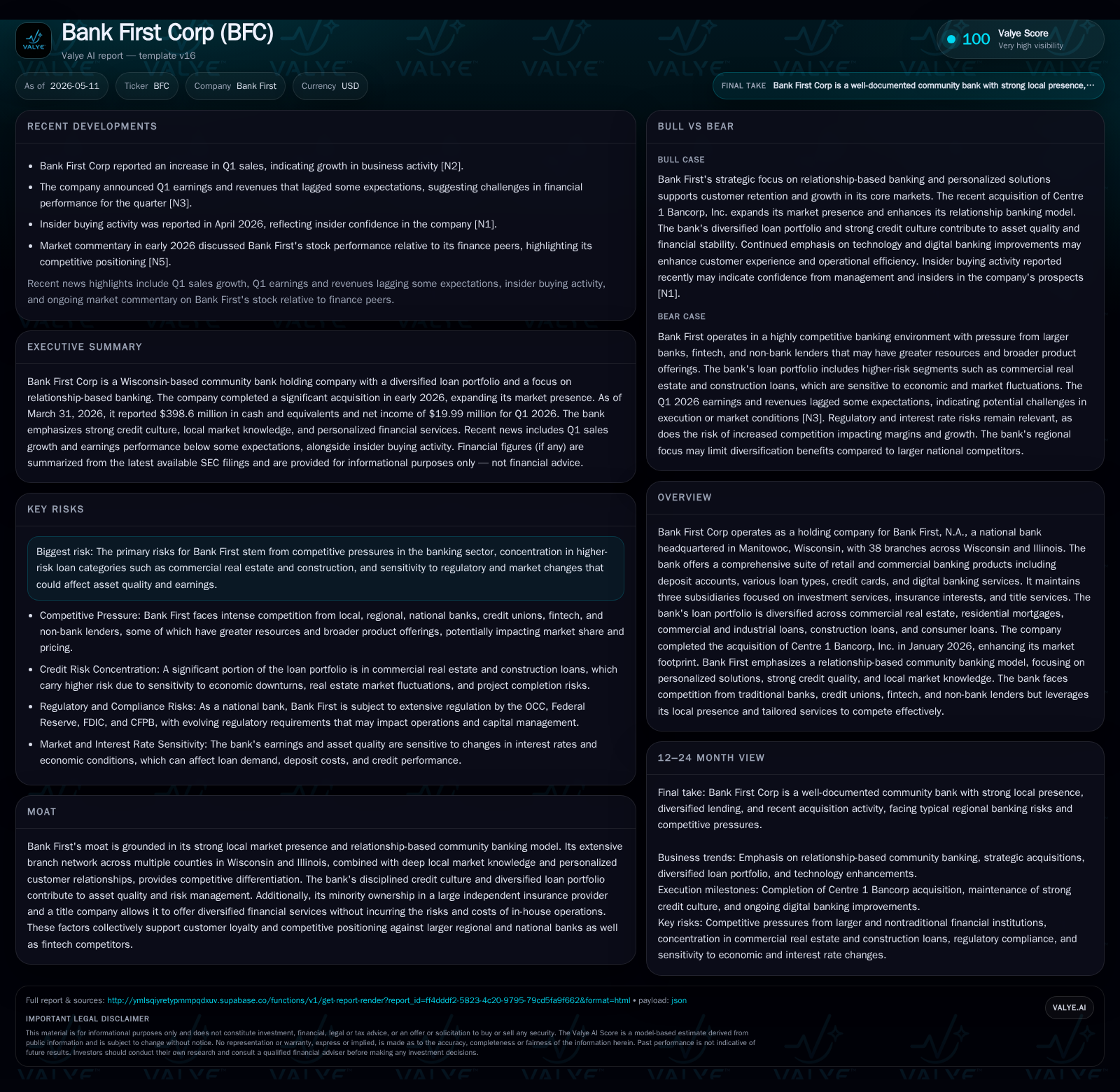
Bank First Corporation has reinforced its market presence with the completion of the Centre 1 Bancorp acquisition in early 2026, adding scale to its Wisconsin and Illinois branch network. Concurrently, the company renewed its $60 million annual share repurchase authorization, signaling confidence in its capital position amidst ongoing sector competitive pressures. The bank’s relationship-driven community model leverages broad local market knowledge and a diversified loan portfolio to sustain asset quality and customer loyalty. Key risks remain concentrated in commercial real estate loans and construction-related exposures, while regulatory and cybersecurity vigilance support operational resilience. Near-term growth will depend on integration execution, digital adoption, and credit quality monitoring.
Latest Operating Highlights and Strategic Moves
Bank First Corp’s latest quarterly disclosure filed May 11, 2026 [S2] anchors the current strategic panorama demarcated by two material developments from the early months of 2026. Foremost is the completion of the Centre 1 Bancorp acquisition on January 1, which has augmented Bank First’s branch network in Wisconsin and Illinois. This strategic merger expanded their physical footprint significantly within key markets including Winnebago counties spanning both states, further consolidating Bank First’s position as a leading community bank regionally.
Complementing this expansion is the April 21 announcement renewing the share repurchase program authorizing up to $60 million annually for two more years until April 20, 2028 [S3]. This sizable authorization renewal not only underscores management confidence in ample capital adequacy but also reflects a balanced approach towards returning shareholder value alongside organic growth and acquisition-led expansion.
These moves manifest Bank First’s intent to leverage scale benefits gained from consolidation while maintaining financial discipline pertinent within a competitive banking sector increasingly challenged by fintech entrants and evolving client expectations.
Business Model: Relationship-Driven Community Banking
Bank First operates as a holding company for Bank First, N.A., which is headquartered in Manitowoc, Wisconsin with an extensive branch network numbering thirty-eight offices across multiple counties in Wisconsin and Illinois [S1]. The core philosophy centers around personalized service within local communities fostering strong customer relationships—a defining moat distinguishing it from larger national banks or non-bank fintech lenders.
Revenue originates principally from interest income earned on a diversified loan portfolio alongside fee income from deposit accounts, credit cards, and ancillary financial services via three subsidiaries: Bank First Investments providing safekeeping/investment services; TVG Holdings holding a substantial 40% minority stake in Ansay & Associates LLC—a large independent insurance provider; and BFC Title owning nearly 6% of Generations Title LLC specializing in title services [S1]. This subsidiary structure enables offering diversified financial solutions without incurring direct operational risks tied to insurance underwriting or title operations.
The bank’s product breadth encompasses traditional deposits (checking, savings, CDs), various consumer loans (secured/unsecured installment loans), multiple commercial lending products including commercial real estate (CRE), construction loans, industrial loans as well as residential mortgages—all framed within a relationship lending model leveraging credit officers’ local market expertise for underwriting decisions tailored to the regional economy [S1].
Loan Portfolio Composition and Quality Focus
As of December 31, 2025—the latest annual reference point before quarterly updates—the loan portfolio aggregates approximately $3.6 billion constituting roughly 80% of total assets [S16]. The composition illustrates prudent diversification albeit with notable CRE exposure:
- Commercial real estate loans represent approximately $1.78 billion or nearly half (49.3%) of total loans [S13]. These loans tend to underpin owner-occupied offices, industrial properties where loan-to-value ratios generally do not exceed 85%, supplemented by borrower cash flow coverage targets (30%+) and personal guarantees from principal owners.
- Residential mortgage products including home equity lines account for just under $900 million or about one-quarter of the portfolio (24.8%) encompassing fixed/adjustable rate instruments extending up to thirty years with commonly capped loan-to-value at around 90% [S13].
- Construction and development loans comprise roughly $215 million or ~6% reflecting cautious underwriting with maximum LTVs held below regulatory thresholds supported by personal guarantees; these facilities mature typically within two years contingent on project completion or refinancing into permanent financing [S14].
- Commercial & industrial loans sum to approximately $647 million or ~18%, targeting small-to-medium businesses across varied sectors such as manufacturing, healthcare, wholesale trade; these facilities mix fixed/floating rates relying heavily on client cash flow sustainability assessments [S22].
- Consumer installment loans remain a minor portion (~1.5%) reflecting stricter underwriting involving income verification, collateral analysis for secured products; amortization tenors usually capped at seven years with flexible interest term structures [S14].
Credit administration confines risk through comprehensive loan review regimes outsourced entirely to an independent third party performing file reviews covering ~40% annually for commercial credits ensuring policy compliance/effectiveness of risk ratings validated by credit administrators reporting upward to committees/bank board per internal escalation thresholds outlined by CAMELS standards [S16]. This disciplined culture intends to sustain sound asset quality amidst exposure sensitivities inherent in CRE/construction sectors flagged explicitly in supervisory guidance for heightened monitoring when concentrations exceed defined ratios relative to risk-based capital [S7].
Industry Context and Competitive Positioning
Bank First positions itself squarely within regional community banking segments prevalent across Wisconsin-Illinois markets where local decision-making authority melds with branch proximity creates natural barriers against larger national institutions whose scale can translate into commoditized service approaches lacking personal touchpoints [S9][S21]. Their consistent top-three deposit market share rankings in several counties corroborate entrenched brand recognition facilitating steady deposit inflows critical amid competitive deposit pricing battles.
However, competition intensifies as fintech innovations disrupt traditional service delivery models by offering streamlined digital-only options often perceived as lower cost alternatives forcing traditional banks like Bank First to invest meaningfully in technology upgrades while balancing legacy infrastructure costs [S21]. Meanwhile regulatory measures governing capital adequacy impose constraints necessitating prudent balance sheet leverage management—Bank First opts to maintain well-capitalized buffers comfortably above mandated thresholds including CET1 minima supplemented by conservation buffers limiting aggressive risk-taking yet securing credibility among regulators fostering stability [S4][S8].
Within this milieu Bank First differentiates via its minority stakes in insurance (Ansay) and title services expanding servicer ecosystem breadth enhancing value propositions without adding core operational complexity or balance sheet risk; such partnerships augment cross-sell potential extending customer lifetime value beyond pure banking transactions [S1].
Growth Drivers and Capital Deployment Strategies
The acquisition of Centre 1 Bancorp consummated January 2026 gives immediate lift through accretive branch additions translating into a broader customer base allowing deeper penetration across sectors previously lightly served by Bank First—this inorganic growth complements organic pipeline initiatives focused on strengthening existing client relationships leveraging intensified digital capabilities deployed progressively throughout the franchise designed to boost user experience while reducing operating costs over time [S2][S3][S23].
Renewal of the $60 million per annum share repurchase authorization manifests robust underlying capital generation capacity enabling management discretion for opportunistic returns even amidst measured loan book expansion affecting capital consumption metrics moderately. This dual approach allows balanced deployment aligning shareholder interests while maintaining necessary foundation for future M&A activity if conducive opportunities arise.
Subsidiary platforms underwrite incremental cross-selling advantages—from investment advisory through insurance products down through complementary title solutions—increasing wallet share per household/business digitally integrated where feasible easing friction points historically preventing full-scope customer adoption.
Risks and Operational Watchpoints
Credit risk remains foremost with concentration exposures: CRE lending nearing regulatory focus levels commands continuous monitoring with detailed risk limits strictly enforced internally including collateral valuations updated periodically ensuring downside protection against cyclical downturns impacting property valuations or construction project viability exacerbated by rising interest rate environments challenging refinancing prospects [S7][S14]. Additionally technological dependencies increasing cybersecurity vulnerabilities receive high governance priority featuring board-level oversight supported by certified internal security officers cooperating closely with IT leadership implementing continuous readiness assessments including penetration testing vulnerability scanning augmented by third-party expert engagements mitigating breach incidents minimizing operational disruptions if incidents occur [S1].
External competitive threats emanate not only from regional/national bank peers wielding larger resource bases but growing fintech entities capable of delivering embedded finance services outside conventional brick-and-mortar frameworks pressuring traditional deposit/loan margins especially among younger demographics favoring convenience over longstanding relationships requiring adaptive strategies maintaining loyalty among core clienteles possibly less price sensitive but increasingly demanding multichannel seamlessness urgently required for sustainable retention gains.
Regulatory shifts also pose uncertainty surrounding future capital standards potentially raising compliance costs constraining dividend/buyback flexibility though current positioning reflects caution aligned with sustained profitability trajectories keeping well clear minimum benchmarks enabling unhindered capital distribution capacity so long as earnings maintain momentum.
Near-Term Catalysts and What Investors Should Monitor
Key immediate focus areas include integrating Centre 1 Bancorp operations smoothly maximizing synergy capture avoiding customer attrition risks typically attendant upon mergers expressed via loan/deposit metric trends presented transparently quarterly offering visibility into stabilization progress coupled with digital channel adoption statistics quantifying platform usage increments tied directly to enhanced product/service introductions improving net promoter scores reflecting customer satisfaction shifts needing further validation over subsequent quarters post close.
Share repurchase execution rates will provide insight into capital allocation discipline prudence reflective also indirectly signaling management confidence regarding underlying business outlook especially if buybacks coincide temporally with share price volatility periods offering favorable value opportunities.
Regulatory communique9s relating to capital adequacy evaluations post implementation reviews or stress test outcomes warrant scrutiny confirming regulatory tolerance reinforces strategic pacing plus ensuring no emergent compliance hurdles impairing growth aspirations.
Monitoring asset quality evolution particularly nonperforming loan ratios within CRE/construction segments alongside macroeconomic indicators affecting borrower cash flows serve as leading signals warranting proactive remedial measures if deterioration trends emerge ahead of potential economic downturns.
Concise Financial Snapshot and Capital Adequacy
At quarter-end March 31, 2026 Bank First reported cash & equivalents approximating $398.6 million alongside nominal total debt near $7.1 million resulting in a net cash-positive balance bolstering liquidity buffers supporting operational agility inclusive of opportunistic acquisitions or expanded shareholder returns - indicated by planned share repurchases up to $60 million annually restricting excessive leverage accumulation consistent with CAMELS framework emphasizing strong capital conservation buffers complementing above-minimum CET1 ratios evidenced year-end ensuring community bank leverage ratios comfortably met facilitating regulatory goodwill essential for unrestricted dividend/buyback activity execution [F1][S4][S8].
This capital posture substantiates the bank’s ability to pursue measured growth strategies without compromising stability or risking regulatory intervention underscoring prudent financial stewardship aligned tightly with risk management oversight.
This analysis synthesizes publicly available filings including the latest quarterly report (Form 10-Q), recent event disclosures (Form 8-K), annual reports (Form 10-K), and contemporaneous news articles respecting Bank First Corp’s operating environment as of May 2026 without expressing investment recommendations or forecasts.
Disclaimer: This is research-only, informational analysis and not investment advice. It may include AI-generated interpretation and general industry context. Always verify important details using primary sources.

Comments