
Hoyne Bancorp Strengthens Local Banking Franchise with Strategic Branch Optimization
The latest quarterly filing reveals Hoyne Bancorp’s focus on streamlining branch operations and maintaining loan portfolio quality despite regulatory constraints.
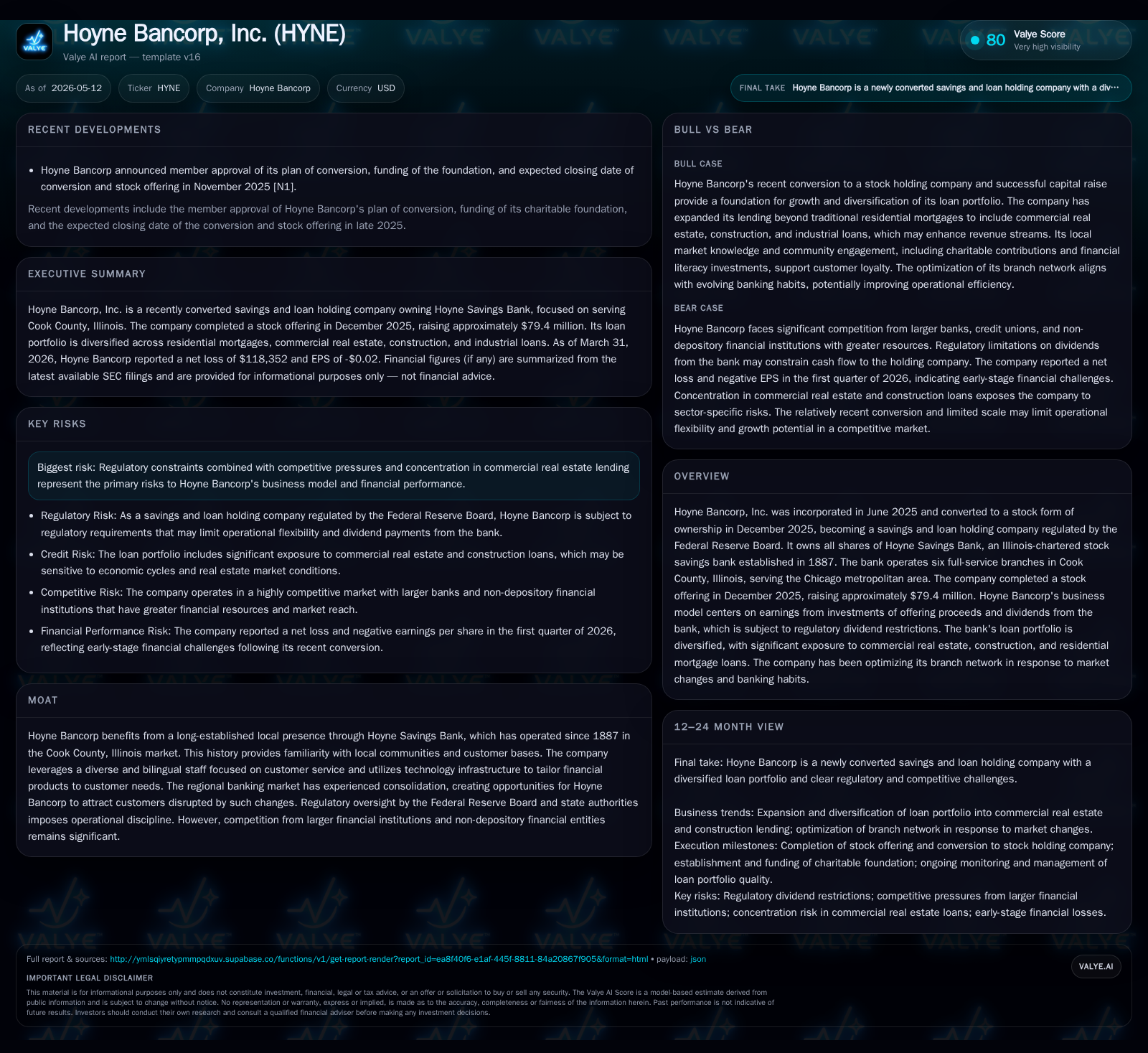
Hoyne Bancorp's May 2026 10-Q highlights evolving credit loss policies aligning with recent accounting standards while reflecting improved operational cash flow metrics. The company continues optimizing its six-branch footprint in Chicago’s metropolitan Cook County market to better serve local customers amid competitive pressures. Its business model centers on managing earnings via investment returns and dividends from its subsidiary bank, which faces regulatory dividend restrictions that limit internal capital flows. Diversified loans heavily weighted toward commercial real estate remain current with no reported 30+ day delinquencies, underscoring underwriting discipline in a sensitive market segment. Growth drivers hinge on leveraging longstanding local presence, bilingual staff capabilities, and modest technology adoption to deepen community engagement.
Latest Quarterly Operational Update: Branch and Portfolio Adjustments
The first quarter 2026 (Q1) Form 10-Q filing dated May 12, 2026 reveals key operational shifts at Hoyne Bancorp as it advances its local banking strategy within the Chicago metropolitan area. A notable element is the updated accounting policy reflecting implementation of ASU 2023-09. This standard influence clarifies impairment recognition by focusing credit loss allowances on differences between amortized cost basis and fair value for debt securities. Impressively, Hoyne recognizes provisions for or recoveries of credit losses through earnings as part of this allowance adjustment process [S2].
From a cash flow perspective, the company reported reduced net operating losses compared to comparable periods, suggesting incremental efficiency gains in expenses despite modest revenues. This better operating cash flow dynamic hints at early benefits of branch network optimization efforts. Importantly, the six full-service branches located across Cook County remain the core physical delivery network. Management notes no immediate plans for capital intensive expansions but is instead focused on tactical adjustments to the footprint to respond to shifting customer behaviors and regional market conditions [S2].
Business Model Overview: Local Banking with Regulatory Dividend Restrictions
Incorporated as recently as June 2025 and having transitioned to a stock holding company form by December that same year, Hoyne Bancorp centrally owns Hoyne Savings Bank—a century-old Illinois-chartered stock savings bank dating back to 1887. This dual-layer structure positions Hoyne Bancorp primarily as an investor entity that generates revenue from two main sources: investment income on the approximately $79.4 million raised during its December 2025 IPO offering and dividends paid from the bank subsidiary's profits [S1].
However, the dividend income flow is materially constrained by federal regulations limiting payouts from the bank to its holding company parent—a standard feature of savings and loan holding companies under Federal Reserve oversight. Consequently, Hoyne Bancorp's capacity to internally fund growth initiatives or pay out distributions depends heavily on regulated dividend approvals rather than unrestricted operational cash generation. Operational staff supporting the holding company largely are shared resources from Hoyne Savings Bank employees whose time is reimbursed per internal arrangements; no separate large support infrastructure exists at the parent level [S1].
Product Mix and Loan Portfolio Quality Highlights
Hoyne Bancorp's loan portfolio maintains a diversified composition with dominant exposure to commercial real estate (CRE), construction loans, residential mortgages including first lien owner-occupied homes and home equity loans, plus lines of credit extended chiefly to small businesses [S1], [S7], [S8]. The Q1 filings reaffirm strong asset quality management with no loans classified as delinquent more than 30 days or placed on non-accrual status as of year-end December 31, 2025 [S8]. Conservative underwriting discipline appears evident; for instance, CRE loans are typically backed by income-producing properties within the Chicago locale where rental cash flows are annually verified with rent rolls to gauge repayment expectations [S26].
Additionally, closed monitoring practices extend across credit exposures: larger-balance commercial loans undergo individual risk evaluations quarterly while smaller homogeneous loan groups are collectively assessed using historical loss metrics adjusted for current economic scenarios [S25]. Notably absent in recent disclosures are significant charged-off loan balances or adverse credit events through late 2025.
Competitive Positioning within the Chicago Metropolitan Market
Hoyne Savings Bank's legacy since 1887 grants it a distinctive brand equity within its geographic niche including Cook County neighborhoods such as Chicago proper, Oak Lawn, Wheeling, Worth, and Oak Park through a dedicated loan production office. The company's bilingual workforce underpins strategic community engagement particularly within diverse local populations where language barriers might otherwise impede banking relationships,[S1].
The densely consolidated regional banking industry amplifies competitive challenges from national banks expanding into suburban markets alongside fintech platforms eroding deposit bases or lending share. Nevertheless, Hoyne leverages a blend of localized personal service combined with selective deployment of technology infrastructure designed to tailor products such as mortgages and small business lines of credit to specific customer profiles—adding stickiness against competitors lacking intimate community familiarity or bilingual ability.
Growth Drivers: Local Market Penetration and Tech-Enabled Customer Service
Future expansion hinges primarily on deepening penetration in its existing metro customer base rather than rapid geographical branch proliferation given limited scale. The value proposition focuses on trust born from longstanding local presence coupled with culturally relevant staff who can serve multilingual clients effectively—a structural advantage over large institutions often perceived as impersonal.
Market turbulence characterized by ongoing regional consolidation among banking institutions may present potential acquisition targets or ripe pools of customers dislocated by competitor retrenchment. Moreover, incremental technology adoption supports cross-selling opportunities across deposit products, residential mortgages, and small business loans without radically changing cost structures.
The relatively stable branch network prevents substantive capital outlay while enabling incremental increases in utilization ratios through enhanced service models supported by digital platforms.
Risks and Operating Challenges: Regulatory Limits and CRE Concentration
Core risks persist around regulatory dividend constraints which limit flexibility at the holding company level—inhibiting rapid reinvestment or shareholder payout capacity despite profitable bank operations. The enforced "community bank leverage ratio" framework delineates capital adequacy but tightens leverage parameters potentially reducing room for balance sheet expansion absent external capital infusions [S1].
Credit concentration in commercial real estate exposes Hoyne to cyclical macroeconomic downturns affecting property values and occupancy rates—critical given that CRE dominates loan book composition. Although conservative underwriting mitigates some exposure risks via debt coverage ratios and borrower financial condition reviews performed periodically [S8], broader economic shocks could prompt elevated delinquency or charge-offs.
Competitive pressures from larger regional banks capable of deploying scale efficiencies plus non-bank lenders offering faster digital services create an ongoing challenge for customer acquisition and retention sans substantive innovation or expanded product breadth.
Monitoring Markers: Upcoming Demand Signals and Execution Milestones
Investors should watch closely for shifts in key quarterly indicators such as changes in net operating cash flow reflecting expense management efficacy post-branch optimization strategies highlighted recently [S2]. Loan portfolio health metrics including any upticks in delinquency beyond current zero cases will signal emerging credit risks—particularly important given CRE sector sensitivity.
Furthermore, any communications regarding alterations to dividends paid by Hoyne Savings Bank impacting holding company revenues will be critical given dependency on restricted dividend flows for sustaining corporate-level liquidity [S1].
Announcements signaling branch expansion or further optimization would elucidate strategic direction amid evolving customer distribution preferences. Digital platform adoption rates or enhanced customer engagement metrics could also presage future growth vectors beyond traditional brick-and-mortar channels.
This analysis synthesizes Hoyne Bancorp's publicly filed quarterly and annual disclosures up to May 2026 focusing strictly on operating developments without extrapolation beyond provided facts. No investment advice is offered herein.
Disclaimer: This is research-only, informational analysis and not investment advice. It may include AI-generated interpretation and general industry context. Always verify important details using primary sources.

Comments