
HWH International Advances Hapi Marketplace and Cafés While Addressing Capital Needs
HWH International’s latest quarter highlights operational expansion alongside renewed financing efforts to support its emerging multi-category consumer platform.
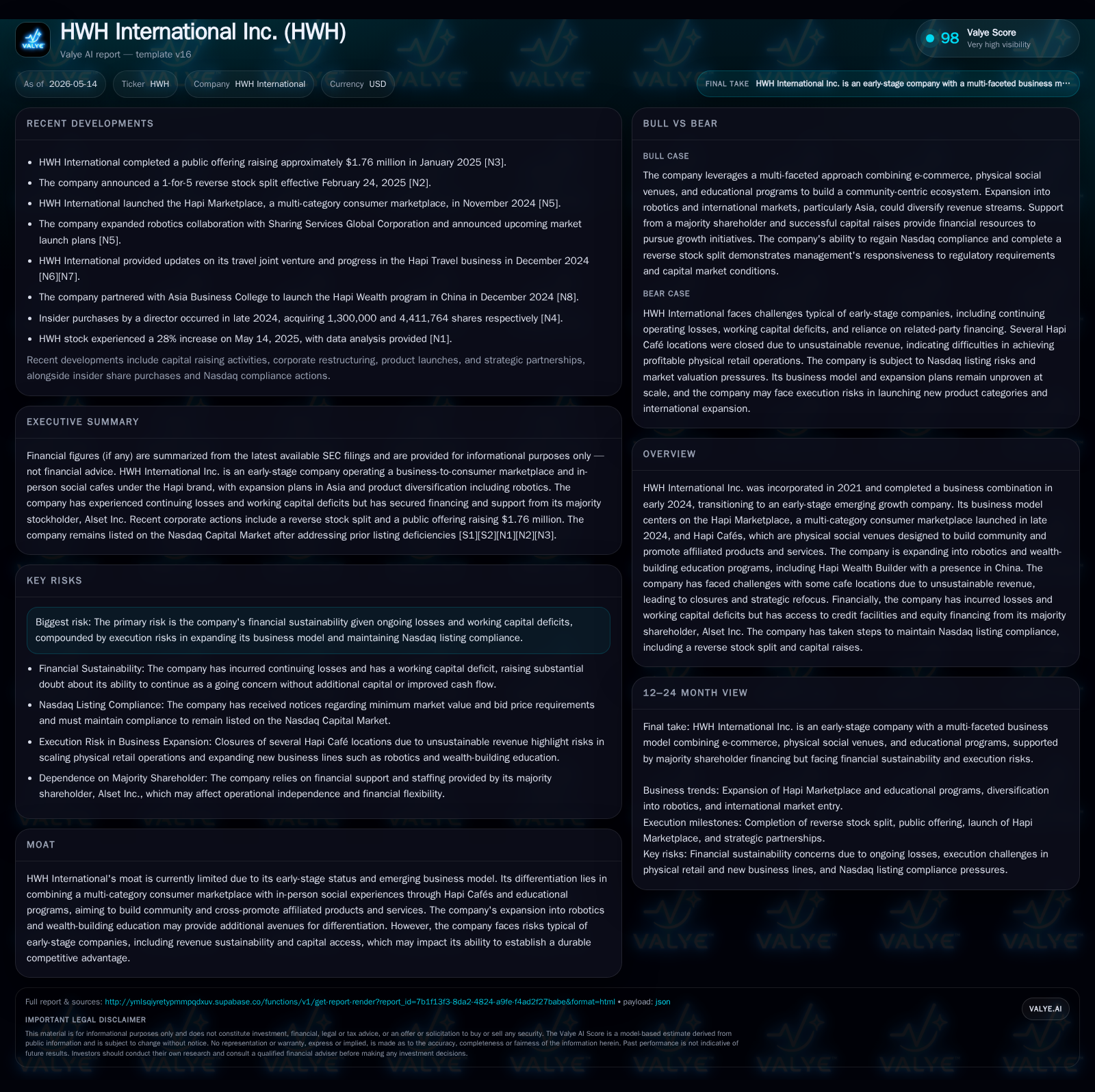
In its 2026 first quarter filing, HWH International Inc. outlined progress in scaling its Hapi Marketplace and physical Hapi Cafés while navigating financial sustainability challenges typical for an early-stage growth company [S2]. The company entered a $10 million strategic financing term sheet with Smart Dynamics Technology Limited to secure working capital and support expansion plans [S28]. Despite ongoing losses and a working capital deficit, HWH maintains a supportive relationship with majority shareholder Alset Inc., which continues to provide credit facilities and equity infusions to enable operational continuity [S1], [F1]. HWH’s business model uniquely blends an online multi-category marketplace with physical social venues aimed at fostering community and cross-promotion of affiliate offerings, though some café locations have recently closed due to underperformance [S1]. Expansion into robotics and wealth-building education programs in Asia further diversify the company’s growth avenues [S1]. This mix positions HWH in a nascent competitive space with execution and capital access as key risk factors ahead.
Recent Operating Update: Q1 2026 Filing
HWH International’s latest 10-Q filing dated May 13, 2026 portrays a company actively advancing its early-stage growth agenda within the consumer marketplace sector but still grappling with working capital deficits common to emerging businesses [S2]. The report underscores operational focus on scaling the innovative Hapi Marketplace launched in late 2024 alongside physical Hapi Cafés that serve as community hubs fostering affiliation awareness. However, the company candidly acknowledges financial strain from losses incurred during this ramp-up phase.
Business Model Overview
HWH International operates an integrated ecosystem anchored by two core pillars:
Hapi Marketplace: A multi-category B2C online platform offering product assortments across wellness, elderly care, auto accessories among more than forty-seven categories. The Marketplace debuted in the U.S. in late 2024 with ambitions for phased international rollouts targeting South Korea, Hong Kong, and broader Asian markets subject to regulatory and logistical clearances [S1].
Hapi Cafés: Physical brick-and-mortar venues designed not primarily as profit centers but as social spaces promoting community interaction aligned with the brand ethos “health, wealth, happiness.” These cafés provide touchpoints where consumers engage with affiliated services and products through experiential marketing that supports the ecommerce platform indirectly. Initial proof-of-concept cafes launched in Seoul (two) and Singapore faced revenue sustainability challenges leading to selective closures or ownership changes aimed at streamlining operations [S1], [S22],.
In addition to these tangible offerings, HWH is expanding into:
- Robotics: Targeting consumer and commercial robotics markets synergistic with existing product lines.
- Wealth-Building Education: The "Hapi Wealth Builder" program offers courses and workshops designed to educate participants on equity investment strategies. A dedicated presence has been established in China fostering collaborative learning environments intended to strengthen brand affinity among prospective customers [S1], [S10].
Revenue generation primarily depends on sales transactions through the Marketplace enabled by consumer adoption of affiliated products. The Cafés function more as marketing extensions rather than direct revenue drivers; their success thus correlates indirectly by increasing brand recognition and expanding user base participation. Membership options tied to affiliate discount benefits create a recurring element offering potential margin improvement if scaled effectively.
Industry Structure & Competitive Position
HWH occupies an emergent niche intersecting ecommerce marketplaces, lifestyle community venues, educational content delivery, and nascent robotics ventures—industries themselves facing rapid evolution influenced by digital transformation trends.
Within marketplaces centered on wellness/elder care etc., competition includes established ecommerce incumbents specializing in vertical or horizontal categories supported by robust logistics infrastructure —a significant barrier for newcomers attempting cross-market breadth without scale advantages.
The physical café model introduces experiential retail elements akin to lifestyle brands but diverges by coupling social networking aspirations with product affiliation rather than pure food & beverage profitability. This positioning is distinctive yet nascent; replication risks depend on execution quality balancing ambience appeal versus cost structure constraints.
Educational sub-segments contend with large content providers however niche wealth-building programming combined with physical hubs may build stickiness within target demographics particularly in Asian geographies adopting increased retail investing interest.
At present, HWH's moat remains limited due to its emergent status but features:
- Integrated omni-channel approach combining digital commerce & social venue presence.
- Early foothold into Asian markets like South Korea & China leveraging both cultural affinity/social habits aligned with community-centric consumption.
- Affiliation network potentially driving incremental wallet share through bundled membership benefits.
Growth Drivers
Key catalysts for medium-term expansion include:
- Geographic Market Entry: Successful phased expansion of the Hapi Marketplace into South Korea, Hong Kong followed by wider Asia will open significant addressable markets where aging populations and wellness demand are rising trends.
- Café Network Scaling: Though challenged recently by underperforming locations necessitating closures or ownership shifts, optimized cafés located strategically can enhance customer engagement supporting ecosystem growth.
- Product Line Diversification: Introduction of consumer/commercial robotics alongside existing wellness-related categories expands market reach offering new revenue streams.
- Educational Program Rollout: Launching of Hapi Wealth Builder in China taps growing appetite for financial literacy evidenced by increased retail investor activity regionally.
Measured KPIs likely relevant here would be membership growth rates on marketplace platform, café foot traffic trends post-restructuring, incremental product category rollouts delivered monthly/quarterly benchmarks, educational enrollment figures from pilot regions along with key financial metrics related to margin progression post-expansion.
Risks / Watchpoints / Growth Constraints
Principal concerns affecting trajectory include:
- Financial Sustainability: Continued losses coupled with historical working capital deficits highlight dependency on equity raises & parent company support creating funding risk if capital markets tighten or ownership appetite wanes [F1], [S1], [S5].
- Execution Complexity: Managing concurrent rollouts across heterogeneous business lines (marketplace operations, bricks-and-mortar cafés, educational programming) demands cross-functional coordination challenging for small teams (noted as 4 employees end-2025) relying heavily on outsourced functions or affiliate contributions [S9].
- Revenue Mix Volatility: Café closures underscore difficulties achieving stand-alone profitability; failure to stabilize this channel risks undermining holistic business case centered around community engagement benefits.
- Regulatory & Logistical Barriers: Market entry timing dependent on securing licenses/payment gateways/banking setups especially critical when expanding internationally may delay anticipated network effects or create cost overruns.
- Shareholder Dilution & Governance: Large equity issuances associated with recent financings impose dilution pressure; new investors require board representation rights introducing potential governance complexities impacting strategic decisions [S28].
- Market Acceptance: Consumer adoption lags possible given competition from larger platforms possessing scale advantages; establishing credible brand differentiation is essential but uncertain given early-stage positioning.
These factors merit close monitoring via cash burn rates relative to fundraising progress matched against customer acquisition costs along with detailed operational updates concerning café profitability turnaround plans or marketplace penetration statistics.
What To Watch Next
Critical upcoming milestones include:
- Completion of the $10 million financing transaction following requisite stockholder approvals which will materially impact cash runway length and flexibility [S28].
- Progress updates on international expansion phases specifically any launches realized outside U.S., including regulatory clearances obtained or initial market feedback.
- Implementation outcomes from café location restructuring efforts indicating whether closure strategy stabilizes unit economics sufficiently.
- Enrollment data from planned educational program rollouts in China acting as barometers for diversification strategy effectiveness.
- Updates regarding NASDAQ listing compliance status given prior history of minimum bid price challenges mitigated through reverse splits; supporting market confidence essential for future capital raising capacity.
- Any partnership or affiliate pipeline developments signaling expanded product/service breadth capabilities enhancing overall ecosystem stickiness.
Financial Profile Summary
Latest financial snapshot
As evidenced by the March 31, 2026 balance sheet snapshot:[F1]
The firm's net debt position is negative reflecting cash holdings exceeding debt obligations —a positive liquidity indicator at face value—with cash and equivalents totaling approximately $1.46 million and total debt around $259 thousand, resulting in net cash of about $1.2 million. Current assets stand at roughly $2.45 million against current liabilities near $1.53 million, yielding a current ratio of 1.6, indicating adequate short-term liquidity [F1].
Historical reliance on shareholder Alset Inc.’s line of credit arrangements (up to $700K available as end FY25) plus multiple equity injections underline constrained funding dynamics typical for early-stage growth endeavors.[S1],[S5]
The convertible note transaction related to a cancelled acquisition illustrates recent management conservatism prioritizing capital preservation while redeploying strategic focus away from complex deals bearing integration risks.[S28]
In summary, the financial landscape evidences adequate short-term liquidity buttressed by committed related-party support yet underscores necessity for successful external fundraising completion plus operational progress towards self-sustainability amid variable cash burn dynamics.
This report synthesizes publicly available SEC filings up through May 13, 2026 alongside contextual industry perspectives specific to HWH International Inc.'s evolving business model. It does not constitute investment advice or recommendations but aims to provide an informed analytical overview suitable for internal consideration within buy-side or corporate strategy settings.
Disclaimer: This is research-only, informational analysis and not investment advice. It may include AI-generated interpretation and general industry context. Always verify important details using primary sources.

Comments