
Soulpower Acquisition's Business Combination Poised to Transform Digital Financial Services
Soulpower Acquisition Corp. advances its merger with SWB Holdings, targeting the launch of SOUL WORLD BANK™ with innovative AI-driven stablecoin banking solutions.
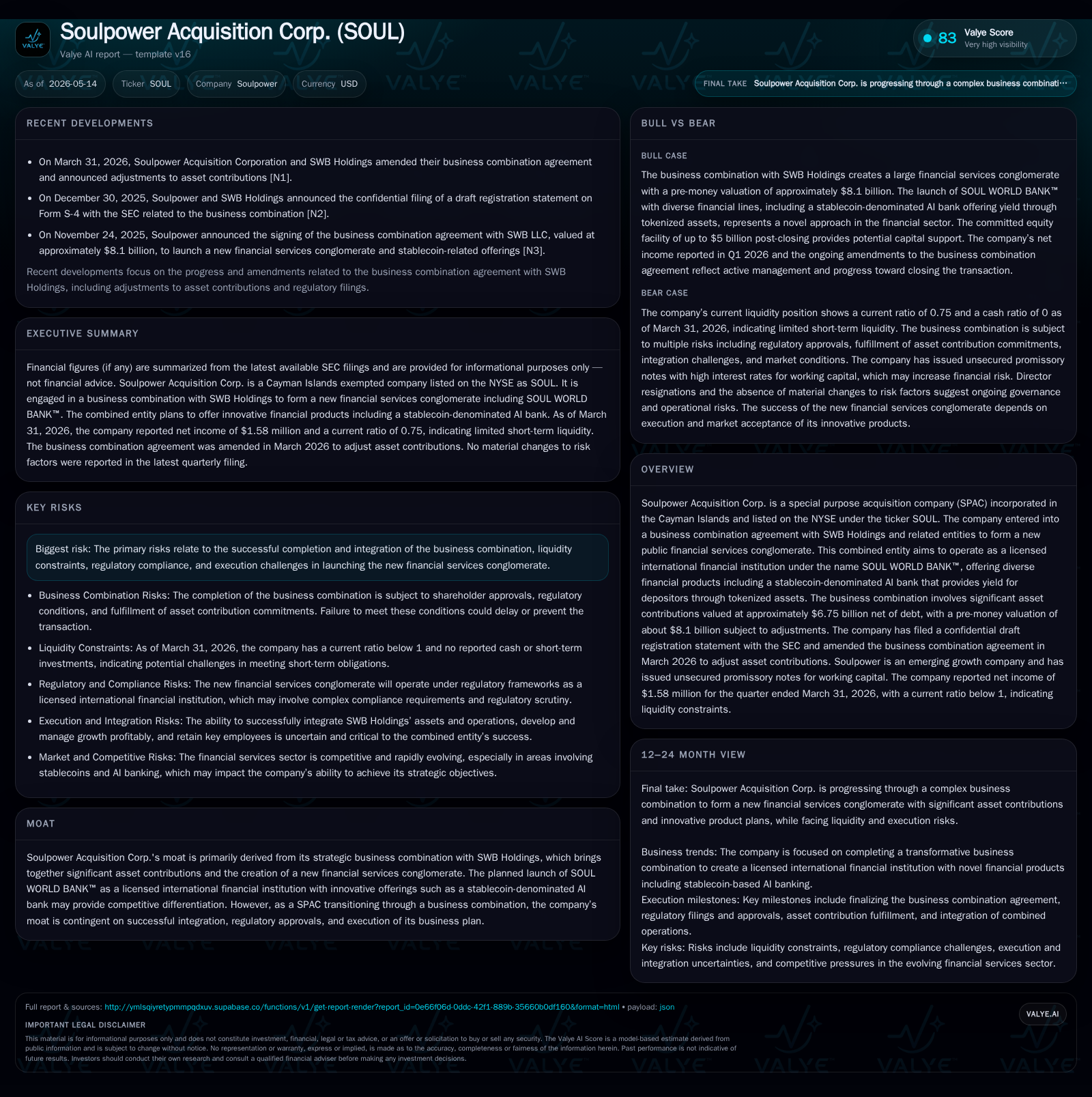
In its latest quarterly filing dated May 13, 2026, Soulpower Acquisition Corp. (SOUL) reports steady progress toward completing its business combination with SWB Holdings. This transaction will establish SOUL WORLD BANK™, a licensed international financial institution focusing on digital and crypto-enabled financial services including a stablecoin-denominated AI bank. The deal involves significant asset contributions valued around $6.75 billion net of debt and a pre-money valuation near $8.1 billion. Growth catalysts hinge on regulatory approvals, asset integration, and launch execution, whereas risks include liquidity pressures and regulatory complexities in launching a hybrid traditional-crypto bank. SOUL’s prospective competitive moat depends heavily on successful integration and navigating evolving international financial regulations.
Latest Quarterly Operating Developments and Business Combination Status
Soulpower Acquisition Corp.'s (NYSE: SOUL) latest 10-Q filing on May 13, 2026 [S2] reaffirms steady progress toward consummating its initial business combination with SWB Holdings, detailed originally in the November 24, 2025 agreement which has seen amendments factoring in revised asset contributions [S3][N1]. Although the filing notes no material changes in risk factors from their prior disclosures in the March 27 annual report [S1], it signals operational momentum crucial for realizing the planned transition from a blank-check SPAC into an operating financial services conglomerate.
The transaction involves SWB's injection of binding asset contributions collectively valued at approximately $6.75 billion net of debt payments into the combined entity ahead of closing—establishing a pre-money valuation around $8.1 billion subject to change pending additional commitments [N1][S3]. These sizeable commitments reflect the backbone funding prerequisite for launching the envisioned financial institution.
SOUL has filed confidential draft registration statements with the SEC consistent with normal due diligence steps for such transformational deals, indicating progress through regulatory review channels critical for timing closure [S3]. The company confirmed recent board activity including director resignations unrelated to company operations—typical governance housekeeping in SPAC transitions [S2][S11].
Soulpower's Business Model and Innovative Product Strategy
Upon closing the business combination, SOUL plans to operate under the brand SOUL WORLD BANK™, aiming to be a licensed international financial institution that uniquely blends traditional banking infrastructures with cutting-edge digital finance technologies including stablecoin-denominated AI-based banking products [S1][N1].
Unlike traditional banks that merely digitize legacy products, SOUL WORLD BANK™ intends to offer depositors yield-generating accounts backed by tokenized assets managed by advanced AI algorithms—a hybrid approach that leverages blockchain’s transparency and programmability while operating under conventional banking licenses. This strategic positioning targets both mainstream depositors seeking yield beyond standard interest rates and crypto-capital holders desirous of regulatory assurances typically absent in DeFi environments.
Revenue generation post-combination is expected from multiple streams: interest spread management over tokenized lending pools, fees on AI-powered asset management services embedded within deposit products, future transactional income as scaled through licensed global operations, plus potential equity upside from its substantial asset base [S1]. This multifaceted model contrasts with bare-bones SPAC legacy status where no revenues existed pre-combination.
Competitive Dynamics and Regulatory Environment in Digital Financial Services
SOUL stands at an inflection point straddling fintech innovation and heavily regulated international finance sectors. While digital banks proliferate globally, few combine licensed multi-jurisdictional financial institution status with integrated crypto-stablecoin offerings—a niche contentious amid fragmented regulatory landscapes worldwide.
Regulatory complexity is heightened given evolving stances towards stablecoins from major authorities like the U.S. Treasury and Federal Reserve as well as international bodies assessing AML/KYC compliance frameworks tied to blockchain transactions. Thus SOUL's moat will hinge substantially on effectively navigating these layered licensing regimes while deploying compliant stablecoin yield products within licensed banking envelopes [S2][S1].
Furthermore, competition includes established digital-first banks like Revolut or N26 who excel in user experience but lack deep crypto offerings; alongside emergent hybrid crypto-banks seeking licenses but often limited by smaller asset bases or non-traditional corporate structures. Successfully integrating SWB’s large asset pool could differentiate SOUL by enabling both scale and product innovation beyond early-stage crypto ventures.
Key Growth Drivers: Asset Contributions, AI Bank Rollout, and Global Licensing
Primary growth levers for SOUL post-business combination closure are tightly linked to milestones involving:
- Completion of regulatory licensing approval processes permitting operation as an international bank bridging fiat and crypto realms.
- Full integration of SWB’s contributed assets (~$6.75 billion net) into operational vaults supporting liquidity for tokenized yield products.
- Deployment of SOUL WORLD BANK™’s AI platform enabling dynamic portfolio management atop stablecoin deposits while ensuring capital efficiency.
- Successful marketing and onboarding of retail and institutional depositors attracted by safe-yield crypto-bank offerings validated by a conventional banking license.
Each driver is measurable via KPIs such as license issuance dates, asset conversion completions into product liquidity pools, number of active depositors and wallet usage metrics following launch; alongside technology uptime or performance metrics tied to AI bank algorithm capabilities [N1][S1].
These growth drivers underscore a structural shift toward convergence between regulated finance infrastructure and customer demand for yield alternatives amid persistent low-interest environments globally.
Critical Risks and Constraints in Execution and Regulatory Approval
SOUL's transformative ambitions carry significant risks crystallized around:
- Potential delays or failure in closing the business combination due to unmet conditions or shareholder votes impairing timely launch.
- Regulatory hurdles amid shifting global crypto/stablecoin regulations; any adverse rulings could limit product scope or require costly modifications.
- Execution risks involving integrating complex asset contributions from SWB into operational banking infrastructure while managing compliance across multiple jurisdictions.
- Market acceptance risks if depositor adoption lags or competing digital banks erode anticipated market share gains.
Risk mitigation will require disciplined cash management addressing working capital pressure; proactive dialogue with regulators; agile technology rollouts backed by robust compliance frameworks; and focused pricing/product strategies defensive against crowded fintech spaces.
Upcoming Catalysts: Milestones to Watch for Completion and Launch
Relevant near-term indicators investors should monitor include:
- Scheduling and outcome of shareholder voting sessions approving final business combination terms.
- Updates from SEC regarding Form S-4 effectiveness or any additional disclosure filings clarifying transaction detail progress.
- Announcements confirming receipt of required international banking licenses authorizing operations under the SOUL WORLD BANK™ banner.
- Marketing releases signaling imminent commercial launch dates or phased rollout plans for flagship AI stablecoin yield accounts.
- Any further amendments to the business combination agreement reflecting shifts in asset contributions or financing facilities like the $5 billion equity line-of-credit noted previously [N1][S2].
Tracking these events will offer concrete evidence about transactional trajectory uncertainties as well as readiness for operational ramp-up post-merger closure.
Current Financial Snapshot: Liquidity and Operational Metrics
As evidenced from SEC companyfacts quarterly data [F1], SOUL's current ratio stands at approximately 0.75 as of March 31, 2026, indicating that current liabilities exceed current assets. This reflects typical liquidity positioning for a pre-revenue SPAC in transition prior to business combination closure.
This analysis focuses solely on publicly available SEC filings as primary data sources supplemented by reputable news outlets covering Soulpower Acquisition Corp.'s transaction progress through mid-May 2026 without offering investment recommendations or price expectations.
Disclaimer: This is research-only, informational analysis and not investment advice. It may include AI-generated interpretation and general industry context. Always verify important details using primary sources.

Comments